
 中文
中文 English
 한국어
한국어 日本語
日本語 Español
 Français
 Русский
| Número de catálogo | HS705014 | ||||||||
|---|---|---|---|---|---|---|---|---|---|
| Descripción |
Anti-ADRM1 Polyclonal Antibody (HS705014) is a rabbit polyclonal antibody detecting ADRM1 in ELISA, IHC, WB. Suitable for Bovine, Chicken, Human, Mouse, and Rat.
Highlights
|
||||||||
| Reactividad de especies | Bos taurus, Chicken, Human, Mouse, Rat, Xenopus tropicalis, Xenopus laevis | ||||||||
| Aplicaciones | ELISA, IHC, WB | ||||||||
| Especie huésped | Rabbit | ||||||||
| Isotipo | IgG | ||||||||
| Clonalidad | Polyclonal | ||||||||
| Inmunógeno | E. coli - derived recombinant Human ADRM1 (Thr2-Asp407). | ||||||||
| Objetivo | Adhesion-regulating molecule 1, ADRM1, GP110, Rpn13 homolog, 110 kDa cell membrane glycoprotein, hRpn13, Gp110, Proteasome regulatory particle non-ATPase 13, ARM-1, Proteasomal ubiquitin receptor ADRM1 | ||||||||
| Purificación | Purified by antigen affinity column. | ||||||||
| Número de acceso | Q16186 | ||||||||
| Forma | Liquid | ||||||||
| Buffer de almacenamiento | 0.01M PBS, pH 7.4, 50% Glycerol, 0.05% Proclin 300. Consulte la información específica del buffer en la copia impresa del datasheet o en el COA específico del lote. |
||||||||
| Información de uso del producto |
| ||||||||
| Estabilidad y almacenamiento | Use a manual defrost freezer and avoid repeated freeze thaw cycles. Store at 2 to 8°C for frequent use. Store at -20 to -80°C for twelve months from the date of receipt. | ||||||||
| Fondo | Proteasomal ubiquitin receptor ADRM1 is a ~42 kDa protein. Component of the 26S proteasome, a multiprotein complex involved in the ATP-dependent degradation of ubiquitinated proteins. This complex plays a key role in the maintenance of protein homeostasis by removing misfolded or damaged proteins, which could impair cellular functions, and by removing proteins whose functions are no longer required. Therefore, the proteasome participates in numerous cellular processes, including cell cycle progression, apoptosis, or DNA damage repair. Within the complex, functions as a proteasomal ubiquitin receptor. Engages and activates 19S-associated deubiquitinases UCHL5 and PSMD14 during protein degradation. 1. Jørgensen, JP. et al. (2006) Journal of molecular biology 360, 1043-52. PMID: 16815440 2. Yao, T. et al. (2006) Nature cell biology 8, 994-1002. PMID: 16906146 3. Hamazaki, J. et al. (2006) The EMBO journal 25, 4524-36. PMID: 16990800 4. Qiu, XB. et al. (2006) The EMBO journal 25, 5742-53. PMID: 17139257 5. Husnjak, K. et al. (2008) Nature 453, 481-8. PMID: 18497817 6. Jiao, L. et al. (2014) Protein & cell 5, 616-30. PMID: 24752541 7. Sahtoe, DD. et al. (2015) Molecular cell 57, 887-900. PMID: 25702870 8. Vander Linden, RT. et al. (2015) Molecular cell 57, 901-911. PMID: 25702872 | ||||||||
| Nota | For research use only. |
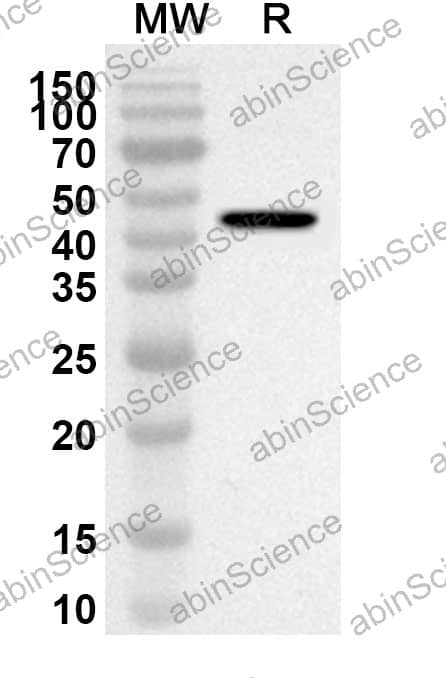
Western blot analysis was performed using anti-ADRM1 polyclonal antibody at 1ug/mL on recombinant ADRM1 (Catalog No. HS705012).
Contáctenos para cotizaciones personalizadas, solicitudes en masa y cualquier otro problema.
Correo: support@abinScience.com
+86-027-65523339
Edificio C, No. 666, Calle Shendunsi, Wuhan, 430206, China


