
 中文
中文 English
 한국어
한국어 日本語
日本語 Español
 Français
 Русский
| Número de catálogo | HV077014 | ||||||||
|---|---|---|---|---|---|---|---|---|---|
| Descripción |
Anti-NOD1 Polyclonal Antibody (HV077014) is a rabbit polyclonal antibody detecting NOD1 in ELISA, IHC, WB. Suitable for Human.
Highlights
|
||||||||
| Reactividad de especies | Human | ||||||||
| Aplicaciones | ELISA, IHC, WB | ||||||||
| Especie huésped | Rabbit | ||||||||
| Isotipo | IgG | ||||||||
| Clonalidad | Polyclonal | ||||||||
| Inmunógeno | E. coli - derived recombinant Human NOD1 (Ala612-Asp826). | ||||||||
| Objetivo | NOD1, Nucleotide-binding oligomerization domain-containing protein 1, Caspase recruitment domain-containing protein 4, CARD4 | ||||||||
| Purificación | Purified by antigen affinity column. | ||||||||
| Número de acceso | Q9Y239 | ||||||||
| Forma | Liquid | ||||||||
| Buffer de almacenamiento | 0.01M PBS, pH 7.4, 50% Glycerol, 0.05% Proclin 300. Consulte la información específica del buffer en la copia impresa del datasheet o en el COA específico del lote. |
||||||||
| Información de uso del producto |
| ||||||||
| Estabilidad y almacenamiento | Use a manual defrost freezer and avoid repeated freeze thaw cycles. Store at 2 to 8°C for frequent use. Store at -20 to -80°C for twelve months from the date of receipt. | ||||||||
| Fondo | Nucleotide-binding oligomerization domain-containing protein 1 (NOD1) is a ~107 kDa protein. Pattern recognition receptor (PRR) that detects bacterial peptidoglycan fragments and other danger signals and thus participates in both innate and adaptive immune responses. Specifically recognizes and binds gamma-D-glutamyl-meso-diaminopimelic acid (iE-DAP), a dipeptide present in peptidoglycan of Gram-negative bacteria. Preferentially binds iE-DAP in tripeptide-containing muropeptides (MurNAc-TriDAP or TriDAP). Ligand binding triggers oligomerization that facilitates the binding and subsequent activation of the proximal adapter receptor-interacting RIPK2. Following recruitment, RIPK2 undergoes 'Met-1'- (linear) and 'Lys-63'-linked polyubiquitination by E3 ubiquitin-protein ligases XIAP, BIRC2, BIRC3 and the LUBAC complex, becoming a scaffolding protein for downstream effectors, triggering activation of the NF-kappa-B and MAP kinases signaling. 1. Inohara, N. et al. (2001) The Journal of biological chemistry 276, 2551-4. PMID: 11058605 2. Girardin, SE. et al. (2003) Science (New York, N.Y.) 300, 1584-7. PMID: 12791997 3. Chamaillard, M. et al. (2003) Nature immunology 4, 702-7. PMID: 12796777 4. Tanabe, T. et al. (2004) The EMBO journal 23, 1587-97. PMID: 15044951 5. Girardin, SE. et al. (2005) The Journal of biological chemistry 280, 38648-56. PMID: 16172124 6. Fukazawa, A. et al. (2008) PLoS pathogens 4, e1000228. PMID: 19043560 7. Lautz, K. et al. (2012) Cellular microbiology 14, 1568-83. PMID: 22672233 8. Vegna, S. et al. (2016) Journal of virology 90, 6022-6035. PMID: 27099311 10. Magalhaes, JG. et al. (2005) EMBO reports 6, 1201-7. PMID: 16211083 | ||||||||
| Nota | For research use only. |
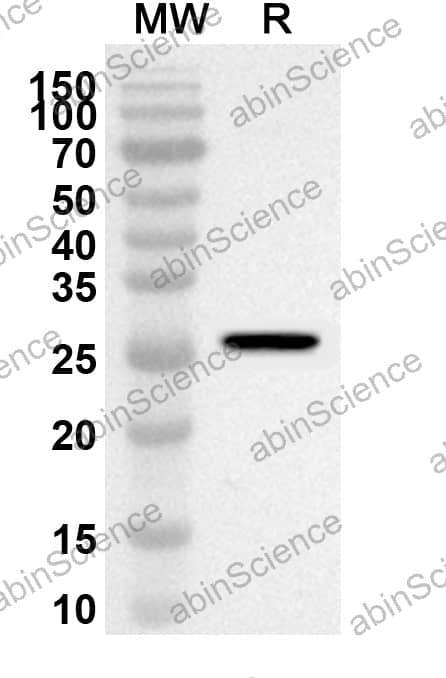
Western blot analysis was performed using anti-NOD1 polyclonal antibody at 1ug/mL on recombinant NOD1 (Catalog No. HV077012).
Contáctenos para cotizaciones personalizadas, solicitudes en masa y cualquier otro problema.
Correo: support@abinScience.com
+86-027-65523339
Edificio C, No. 666, Calle Shendunsi, Wuhan, 430206, China


