
 中文
中文 English
 한국어
한국어 日本語
日本語 Español
 Français
 Русский
| Número de catálogo | HS804014 | ||||||||
|---|---|---|---|---|---|---|---|---|---|
| Descripción |
Anti-MAPK14 Polyclonal Antibody (HS804014) is a rabbit polyclonal antibody detecting MAPK14 in ELISA, IHC, WB. Suitable for Dog, Cyprinus carpio, Danio rerio, Human, and Mouse.
Highlights
|
||||||||
| Reactividad de especies | Dog, Cyprinus carpio, Danio rerio, Human, Mouse, Pan troglodytes, Rat, Xenopus laevis | ||||||||
| Aplicaciones | ELISA, IHC, WB | ||||||||
| Especie huésped | Rabbit | ||||||||
| Isotipo | IgG | ||||||||
| Clonalidad | Polyclonal | ||||||||
| Inmunógeno | E. coli - derived recombinant Human MAPK14 (Met1-Ser360). | ||||||||
| Objetivo | Stress-activated protein kinase 2a, Mitogen-activated protein kinase 14, Mitogen-activated protein kinase p38 alpha, SAPK2A, Cytokine suppressive anti-inflammatory drug-binding protein, CSBP, CSPB1, MAP kinase 14, MAP kinase MXI2, MAPK14, CSBP2, MAP kinase p38 alpha, MAPK 14, MXI2, CSAID-binding protein, MAX-interacting protein 2, CSBP1, SAPK2a | ||||||||
| Purificación | Purified by antigen affinity column. | ||||||||
| Número de acceso | Q16539 | ||||||||
| RRID | Anti-MAPK14 Polyclonal Antibody (abinScience Cat# HS804014, RRID:AB_3730298) |
||||||||
| Forma | Liquid | ||||||||
| Buffer de almacenamiento | 0.01M PBS, pH 7.4, 50% Glycerol, 0.05% Proclin 300. Consulte la información específica del buffer en la copia impresa del datasheet o en el COA específico del lote. |
||||||||
| Información de uso del producto |
| ||||||||
| Estabilidad y almacenamiento | Use a manual defrost freezer and avoid repeated freeze thaw cycles. Store at 2 to 8°C for frequent use. Store at -20 to -80°C for twelve months from the date of receipt. | ||||||||
| Fondo | Mitogen-activated protein kinase 14 (MAPK14) is a ~41 kDa protein. Serine/threonine kinase which acts as an essential component of the MAP kinase signal transduction pathway. MAPK14 is one of the four p38 MAPKs which play an important role in the cascades of cellular responses evoked by extracellular stimuli such as pro-inflammatory cytokines or physical stress leading to direct activation of transcription factors. Accordingly, p38 MAPKs phosphorylate a broad range of proteins and it has been estimated that they may have approximately 200 to 300 substrates each. Some of the targets are downstream kinases which are activated through phosphorylation and further phosphorylate additional targets. RPS6KA5/MSK1 and RPS6KA4/MSK2 can directly phosphorylate and activate transcription factors such as CREB1, ATF1, the NF-kappa-B isoform RELA/NFKB3, STAT1 and STAT3, but can also phosphorylate histone H3 and the nucleosomal protein HMGN1. 1. Deak, M. et al. (1998) The EMBO journal 17, 4426-41. PMID: 9687510 2. Pierrat, B. et al. (1998) The Journal of biological chemistry 273, 29661-71. PMID: 9792677 3. Scheper, GC. et al. (2001) Molecular and cellular biology 21, 743-54. PMID: 11154262 4. Sayed, M. et al. (2000) The Journal of biological chemistry 275, 16569-73. PMID: 10747897 5. Khurana, A. et al. (2006) The Journal of biological chemistry 281, 35316-26. PMID: 17003045 6. Webber, JL. et al. (2010) The EMBO journal 29, 27-40. PMID: 19893488 7. Zwang, Y. et al. (2006) The EMBO journal 25, 4195-206. PMID: 16932740 8. Xu, P. et al. (2010) Molecular cell 37, 551-66. PMID: 20188673 | ||||||||
| Nota | For research use only. |
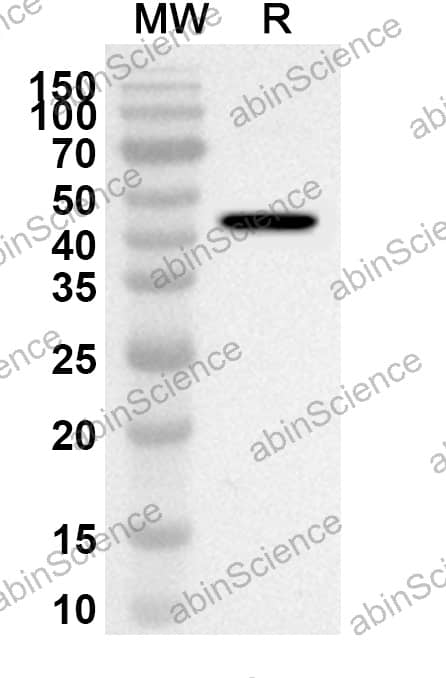
Western blot analysis was performed using anti-MAPK14 polyclonal antibody at 1ug/mL on recombinant MAPK14 (Catalog No. HS804012).
Contáctenos para cotizaciones personalizadas, solicitudes en masa y cualquier otro problema.
Correo: support@abinScience.com
+86-027-65523339
Edificio C, No. 666, Calle Shendunsi, Wuhan, 430206, China


