What problem does OMIP-021 aim to address?
As a key component of the innate immune system, γδ T cells play an indispensable role in tumor immunity, infectious immunity, and autoimmunity. Conventional T cell flow cytometry analysis typically focuses on CD4 and CD8, while γδ T cells, MAIT cells, and iNKT cells are either pooled or analyzed in isolation—making direct comparisons within a unified T cell framework challenging. This fragmented approach limits the comparability of differentiation status and proportional changes across T cell subsets.
What has OMIP-021 specifically achieved?
OMIP-021 presents a 14-color flow cytometry panel designed to accurately identify and distinguish diverse T cell populations, including NKT cells, MAIT cells, γδ T cells, and conventional αβ T cells. With these markers, researchers can comprehensively assess T cells’ immune memory status, activation state, and functional traits in a single experiment.
The Value of OMIP-021
OMIP-021 integrates the differentiation axis and lineage axis of T cells into one unified panel, enables simultaneous capture of differentiation status and functional characteristics in one tube. This innovative design delivers a deeper immune landscape for immunological research, facilitating insights into T cell dynamics during immune surveillance.
OMIP-021 breaks through traditional T cell panel limitations by incorporating γδ T cells with other innate-like T cells (e.g., NKT and MAIT cells). Merging differentiation status and lineage axes, it enhances overall understanding of immune responses and provides a robust tool for precise immune analysis of rare samples. Ideal for clinical immune monitoring, tumor immunology research, and in-depth autoimmune disease exploration.
1. OMIP-021 Panel
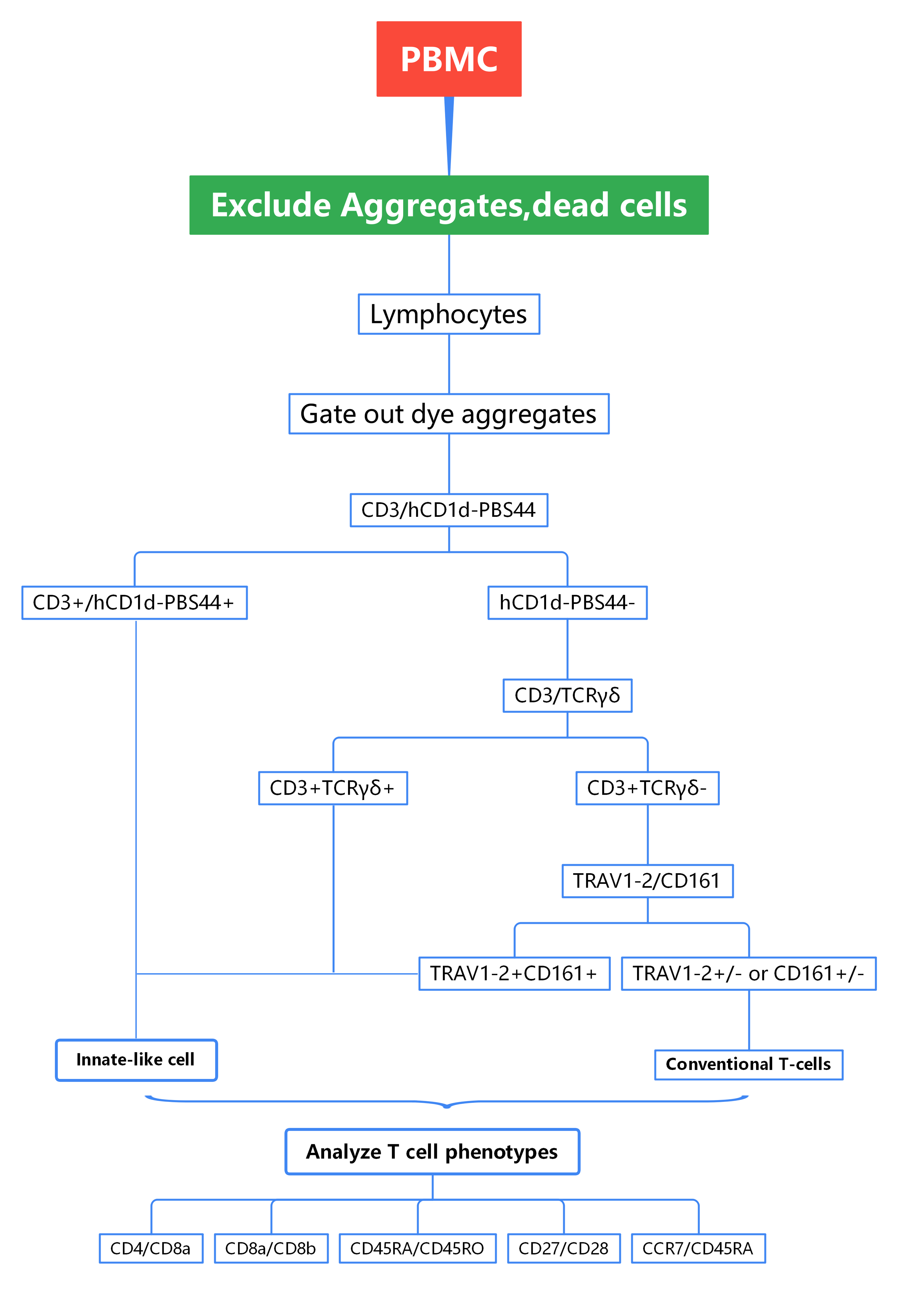
2. Gating Logic
1
Main Cell Population Identification
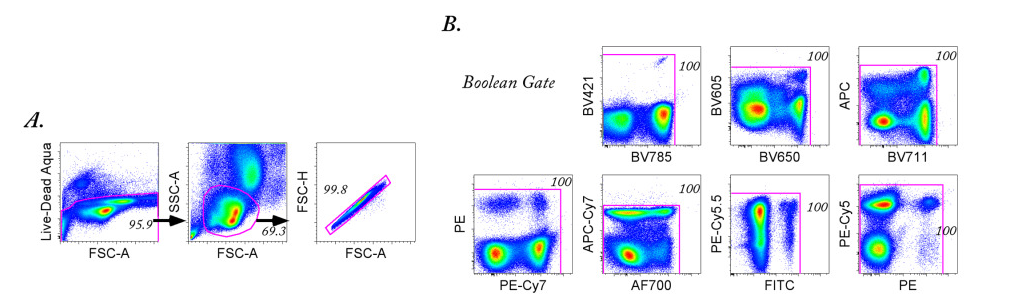
Exclude dead cells, gate live lymphocytes, and gate out dye aggregates.
2
T Cell Subset Analysis
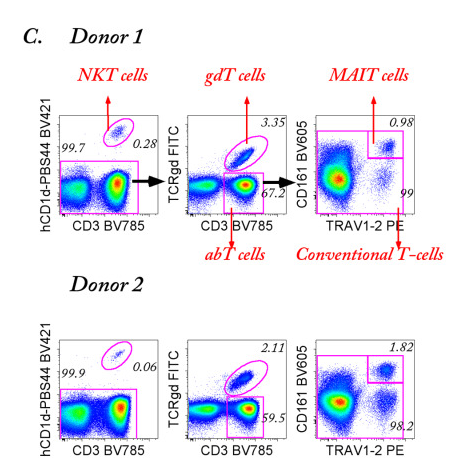
Gate distinct T cell subsets using CD3/hCD1d, CD3/TCR-γ/δ, and TRAV1-2/CD161.
3
Phenotypic Analysis of Different T Cells
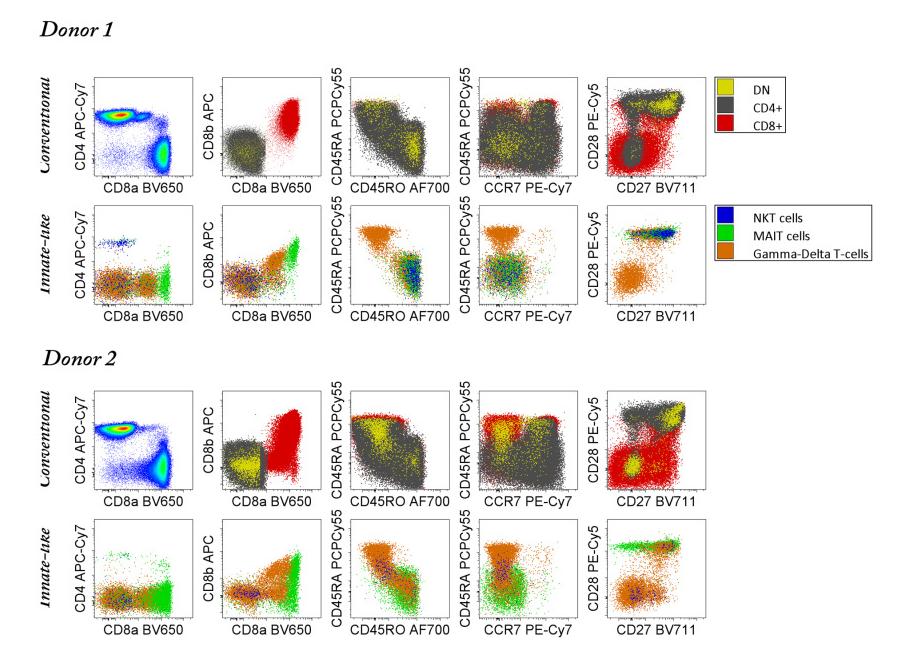
Characterize T cell phenotypes with CD4, CD8a, CD8b, CD27, CD28, CD45RA, CD45RO, and CCR7.
3. Experimental Results
1). Exclude dead cells, aggregates, gate live lymphocytes, and gate out dye aggregates.
2). Within lymphocytes, gate NKT cells, γ/δ T cells, α/β T cells, MAIT cells, and conventional T cells via CD3/hCD1d, CD3/TCR-γ/δ, and TRAV1-2/CD161.
3). Analyze T cell phenotypes using the aforementioned markers, then compare phenotypic distributions between classical T cells and innate-like T cell populations.
4. Panel Interpretation
4.1 Resolving Innate-like T Cell Identification
A key highlight of OMIP-021 is reaffirming the significance of innate-like T cells (NKT, MAIT, γδ T cells) instead of dismissing them as "peripheral populations." These cells play critical roles in tumors, infections, and other diseases, yet traditional panels often exclude or misclassify them. OMIP-021 integrates specific markers for simultaneous analysis of conventional and non-classical T cells, ensuring comprehensive immune response evaluation.
4.2 Precise T Cell Subset Distinction
OMIP-021 uses targeted marker combinations for accurate subset identification: CD1d-αGalCer tetramer for NKT cells, TRAV1-2/CD161 for MAIT cells, and pan-γδ TCR antibodies (replacing negative selection) for γδ T cells. This avoids misclassification of phenotypically similar cells, guaranteeing reliable immunophenotyping for clinical or rare samples.
4.3 Integrated Differentiation and Lineage Analysis
OMIP-021 innovatively merges T cells’ differentiation axis (naïve, TCM, TEM, TEMRA) and lineage axis (αβ, γδ T cells, NKT, MAIT cells). This multi-dimensional approach reveals immune memory status and inter-subset relationships, delivering precise results for clinical research—especially with small samples or large population proportion variations.
5. Applications
Basic Immunology Research Immunotherapy Monitoring Tumor Immune Monitoring Infectious Immunity Research Autoimmune Disease Research High-dimensional Flow Cytometric Immune Profiling
6. Conclusion
OMIP-021 innovatively combines conventional and innate-like T cell (NKT, MAIT, γδ T cells) analysis, enabling comprehensive immune system interpretation. It precisely distinguishes T cell subsets while integrating differentiation and lineage data for accurate immune monitoring. Ideal for tumor immune surveillance, infectious immunity research, autoimmune diseases, and clinical immune assessment, this panel serves as a powerful tool to unravel complex immune responses and disease mechanisms.
Get OMIP-021 Compatible Flow Cytometry Antibodies
abinScience provides validated flow cytometry antibodies covering key targets in this panel, supporting your different T cell research
References
[1] Gherardin NA, Ritchie DS, Godfrey DI, Neeson PJ. OMIP-021: Simultaneous quantification of human conventional and innate-like T-cell subsets. Cytometry A. 2014 Jul;85(7):573-5.

About Us
As a strategic venture of AtaGenix (established 2011), abinScience was founded in 2023 to deliver premium life science reagents that accelerate discovery. Our flow cytometry antibody products cover commonly used detection markers, with a wide variety to meet the research needs of multiple species (Human/Mouse/Rat/Dog/Hamster/Monkey, etc.). We provide stable and reliable support for scientific research.
Explore abinScience Flow Cytometry Antibodies


 中文
中文 English
 한국어
한국어 日本語
日本語 Español
 Français
 Русский