
 中文
 English
 한국어
 日本語
 Español
 Français
 Русский
| Numéro de catalogue | HB443014 | ||||||||
|---|---|---|---|---|---|---|---|---|---|
| Description |
Anti-ADPRS Polyclonal Antibody (HB443014) is a rabbit polyclonal antibody detecting ADP-ribosylhydrolase ARH3; ADP-ribose glycohydrolase ARH3; ADP-ribosylhydrolase 3; O-acetyl-ADP-ribose deacetylase ARH3; 3.5.1.-; Poly(ADP-ribose) glycohydrolase ARH3; 3.2.1.143; [Protein ADP-ribosylarginine] hydrolase-like protein 2; [Protein ADP-ribosylserine] hydrolase; 3.2.2.-; ADPRS; ADPRHL2; ARH3 in ELISA, IHC, WB. Suitable for Human, Bovine, and Mouse.
Highlights
|
||||||||
| Reactivité des espèces | Human, Mouse | ||||||||
| Applications | ELISA, IHC, WB | ||||||||
| Espèce hôte | Rabbit | ||||||||
| Clonalité | Polyclonal | ||||||||
| Isotype | IgG | ||||||||
| Immunogène | E. coli - derived recombinant human ADPRS (Ser19-Ser363). | ||||||||
| Cible | ADP-ribosylhydrolase ARH3; ADP-ribose glycohydrolase ARH3; ADP-ribosylhydrolase 3; O-acetyl-ADP-ribose deacetylase ARH3; 3.5.1.-; Poly(ADP-ribose) glycohydrolase ARH3; 3.2.1.143; [Protein ADP-ribosylarginine] hydrolase-like protein 2; [Protein ADP-ribosylserine] hydrolase; 3.2.2.-; ADPRS; ADPRHL2; ARH3 | ||||||||
| Niveau d'endotoxines | Please contact with the lab for this information. | ||||||||
| Purification | Purified by antigen affinity column. | ||||||||
| Numéro d'accès | Q9NX46, Q3SYV9, Q8CG72 | ||||||||
| Forme | Liquid | ||||||||
| Tampon de stockage | 0.01M PBS, pH 7.4, 50% Glycerol, 0.05% Proclin 300. Reférez-vous aux informations spécifiques sur le tampon dans la copie papier du datasheet ou dans le COA spécifique au lot. |
||||||||
| Informations d'utilisation du produit |
| ||||||||
| Stabilité et stockage | Use a manual defrost freezer and avoid repeated freeze thaw cycles. Store at 2 to 8°C for frequent use. Store at -20 to -80°C for twelve months from the date of receipt. | ||||||||
| Contexte | ADP-ribosylhydrolase ARH3 (ADPRS) is a ~38 kDa protein. ADP-ribosylhydrolase that preferentially hydrolyzes the scissile alpha-O-linkage attached to the anomeric C1'' position of ADP-ribose and acts on different substrates, such as proteins ADP-ribosylated on serine and threonine, free poly(ADP-ribose) and O-acetyl-ADP-D-ribose. Specifically acts as a serine mono-ADP-ribosylhydrolase by mediating the removal of mono-ADP-ribose attached to serine residues on proteins, thereby playing a key role in DNA damage response. Serine ADP-ribosylation of proteins constitutes the primary form of ADP-ribosylation of proteins in response to DNA damage. Does not hydrolyze ADP-ribosyl-arginine, -cysteine, -diphthamide, or -asparagine bonds. Also able to degrade protein free poly(ADP-ribose), which is synthesized in response to DNA damage: free poly(ADP-ribose) acts as a potent cell death signal and its degradation by ADPRHL2 protects cells from poly(ADP-ribose)-dependent cell death, a process named parthanatos. 1. Kasamatsu, A. et al. (2011) The Journal of biological chemistry 286, 21110-7. PMID: 21498885 2. Pourfarjam, Y. et al. (2018) The Journal of biological chemistry 293, 12350-12359. PMID: 29907568 3. Wang, M. et al. (2018) The Journal of biological chemistry 293, 14470-14480. PMID: 30045870 4. Danhauser, K. et al. (2018) American journal of human genetics 103, 817-825. PMID: 30401461 5. Mashimo, M. et al. (2019) JCI insight 4. PMID: 30830864 6. Bonfiglio, JJ. et al. (2020) Cell 183, 1086-1102.e23. PMID: 33186521 7. Voorneveld, J. et al. (2021) Chemistry (Weinheim an der Bergstrasse, Germany) 27, 10621-10627. PMID: 33769608 8. Pourfarjam, Y. et al. (2021) The Journal of biological chemistry 296, 100692. PMID: 33894202 9. Prokhorova, E. et al. (2021) Molecular cell 81, 2640-2655.e8. PMID: 34019811 10. Rack, JGM. et al. (2021) Nature communications 12, 4581. PMID: 34321462 | ||||||||
| Note | For research use only |
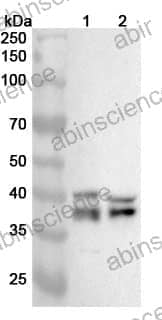
Western blot analysis was performed using anti-ADPRS polyclonal antibody at 1ug/mL on various samples.
Lane 1: Rat brain lysate
Lane 2: Rat heart lysate
Contactez-nous
+86-027-65523339
Bâtiment C, No. 666, Rue Shendunsi, Wuhan, 430206, Chine


