
 中文
中文 English
 한국어
한국어 日本語
日本語 Español
 Français
 Русский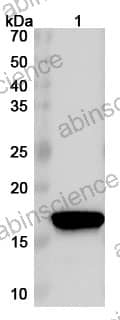
| Número de catálogo | VK686014 | ||||||||
|---|---|---|---|---|---|---|---|---|---|
| Descripción |
Anti-EBV/HHV4 EBNA1/BKRF1 Polyclonal Antibody (VK686014) is a rabbit polyclonal antibody detecting EBNA1 in ELISA, IHC, WB.
Highlights
|
||||||||
| Reactividad de especies | Epstein-Barr virus (HHV-4) (Human herpesvirus 4) | ||||||||
| Aplicaciones | ELISA, IHC, WB | ||||||||
| Especie huésped | Rabbit | ||||||||
| Clonalidad | Polyclonal | ||||||||
| Isotipo | IgG | ||||||||
| Inmunógeno | E. coli - derived recombinant EBV/HHV4 EBNA1/BKRF1 (His468-Pro607). | ||||||||
| Objetivo | Epstein-Barr nuclear antigen 1, EBNA-1, EBV nuclear antigen 1, EBNA1, BKRF1 | ||||||||
| Purificación | Purified by antigen affinity column. | ||||||||
| Número de acceso | P03211 | ||||||||
| Forma | Liquid | ||||||||
| Buffer de almacenamiento | 0.01M PBS, pH 7.4, 50% Glycerol, 0.05% Proclin 300. Consulte la información específica del buffer en la copia impresa del datasheet o en el COA específico del lote. |
||||||||
| Información de uso del producto |
| ||||||||
| Estabilidad y almacenamiento | Use a manual defrost freezer and avoid repeated freeze thaw cycles. Store at 2 to 8°C for frequent use. Store at -20 to -80°C for twelve months from the date of receipt. | ||||||||
| Fondo | Epstein-Barr nuclear antigen 1 (EBNA1/BKRF1) is a ~56 kDa protein. Responsible for the origin of replication (oriP) dependent replication and maintenance of viral episomes during latent infection. EBNA1 dimer interacts with the DS (dyad symmetry) element within the origin of replication oriP and with a host mitotic chromosome to initiate viral DNA replication during latency. EBNA1 binding to DS recruits the host origin recognition complex (ORC). Governs the faithful mitotic segregation of the viral episomes by binding both the FR (family of repeats) element within oriP and the host mitotic chromosomes. Forms a cell cycle-dependent tyrosine-dependent DNA cross-link and single-strand cleavage at oriP required for terminating replication and maintaining viral episomes. 1. Sears, J. et al. (2004) Journal of virology 78, 11487-505. PMID: 15479791 2. Rawlins, DR. et al. (1985) Cell 42, 859-68. PMID: 2996781 3. Hodin, TL. et al. (2013) Journal of virology 87, 13020-8. PMID: 24067969 4. Malecka, KA. et al. (2019) Journal of virology 93. PMID: 31142669 5. Summers, H. et al. (1996) Journal of virology 70, 1228-31. PMID: 8551585 6. Ritzi, M. et al. (2003) Journal of cell science 116, 3971-84. PMID: 12953058 7. Hung, SC. et al. (2001) Proceedings of the National Academy of Sciences of the United States of America 98, 1865-70. PMID: 11172042 | ||||||||
| Nota | For research use only. |
Western blot analysis was performed using anti-EBNA1 polyclonal antibody at 1ug/mL on various samples.
Lane 1: recombinant EBV/HHV4 EBNA1/BKRF1 (Catalog No: VK686012)


Contáctenos para cotizaciones personalizadas, solicitudes en masa y cualquier otro problema.
Correo: [email protected]
+86-027-65523339
Edificio C, No. 666, Calle Shendunsi, Wuhan, 430206, China


