
 中文
中文 English
 한국어
한국어 日本語
日本語 Español
 Français
 Русский
| Número de catálogo | HY112207 |
|---|---|
| Reactividad de especies | Human |
| Aplicaciones | FCM, IHC, WB |
| Especie huésped | Mouse |
| Clonalidad | Monoclonal |
| Isotipo | IgG2a, kappa |
| ID de clon | SAA0334 |
| Aplicaciones probadas | FCM |
| Objetivo | INSR, IR, CD220, Insulin receptor |
| Nivel de endotoxinas | Please contact with the lab for this information. |
| Pureza | >95% as determined by SDS-PAGE. |
| Purificación | Protein A/G purified from cell culture supernatant. |
| Número de acceso | P06213 |
| Forma | Liquid |
| Buffer de almacenamiento | 0.01M PBS, pH 7.4, 0.09% Sodium azide. Consulte la información específica del buffer en la copia impresa del datasheet o en el COA específico del lote. |
| Estabilidad y almacenamiento | Use a manual defrost freezer and avoid repeated freeze-thaw cycles. Store at 4°C short term (1-2 weeks). Store at -20°C 12 months. Store at -80°C long term. |
| Fondo | Insulin receptor (CD220/INSR) is a ~156 kDa protein. Receptor tyrosine kinase which mediates the pleiotropic actions of insulin. Binding of insulin leads to phosphorylation of several intracellular substrates, including, insulin receptor substrates (IRS1, 2, 3, 4), SHC, GAB1, CBL and other signaling intermediates. Each of these phosphorylated proteins serve as docking proteins for other signaling proteins that contain Src-homology-2 domains (SH2 domain) that specifically recognize different phosphotyrosine residues, including the p85 regulatory subunit of PI3K and SHP2. Phosphorylation of IRSs proteins lead to the activation of two main signaling pathways: the PI3K-AKT/PKB pathway, which is responsible for most of the metabolic actions of insulin, and the Ras-MAPK pathway, which regulates expression of some genes and cooperates with the PI3K pathway to control cell growth and differentiation. Binding of the SH2 domains of PI3K to phosphotyrosines on IRS1 leads to the activation of PI3K and the generation of phosphatidylinositol-(3, 4, 5)-triphosphate (PIP3), a lipid second messenger, which activates several PIP3-dependent serine/threonine kinases, such as PDPK1 and subsequently AKT/PKB. 1. Pandini, G. et al. (2002) The Journal of biological chemistry 277, 39684-95. PMID: 12138094 2. Slaaby, R. et al. (2006) The Journal of biological chemistry 281, 25869-74. PMID: 16831875 |
| Nota | For research use only. |
SDS-PAGE for Anti-Human CD220/INSR Antibody (SAA0334)
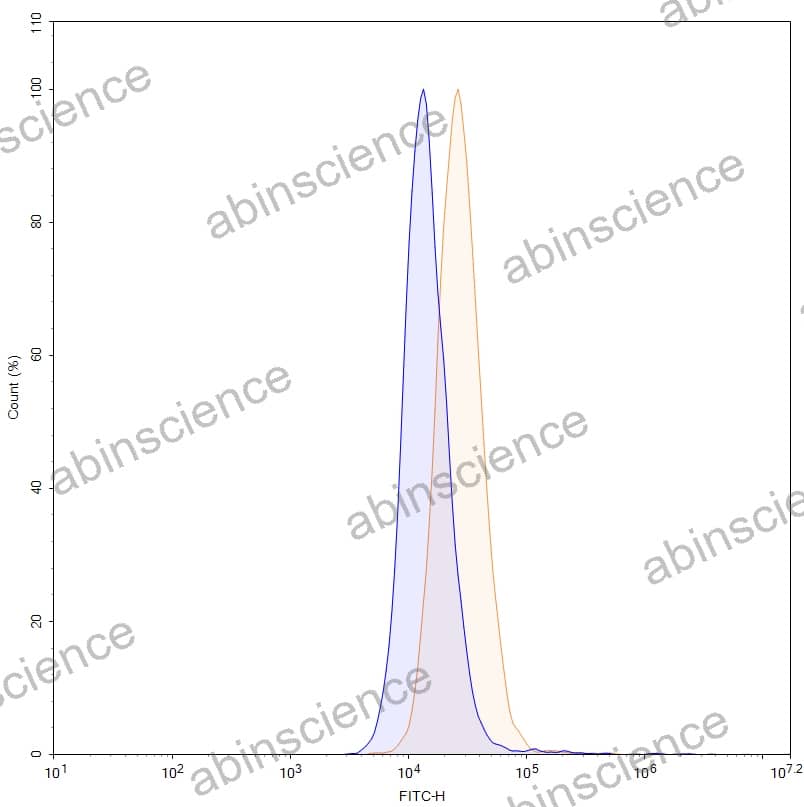
Flow-cytometry using anti-human CD220 antibody. MCF7 cells were stained with an irrelevant antibody (Blue Histogram) or an anti-human CD220 monoclonal antibody (Catalog HY112207, Yellow Histogram) at a concentration of 5 µg/ml for 30 mins at RT. After washing, bound antibody was detected using a Goat Anti-Mouse IgG H&L Polyclonal Antibody, FITC (abinScience: MF690414) and cells analysed on a NovoCyte Flow Cytometer.
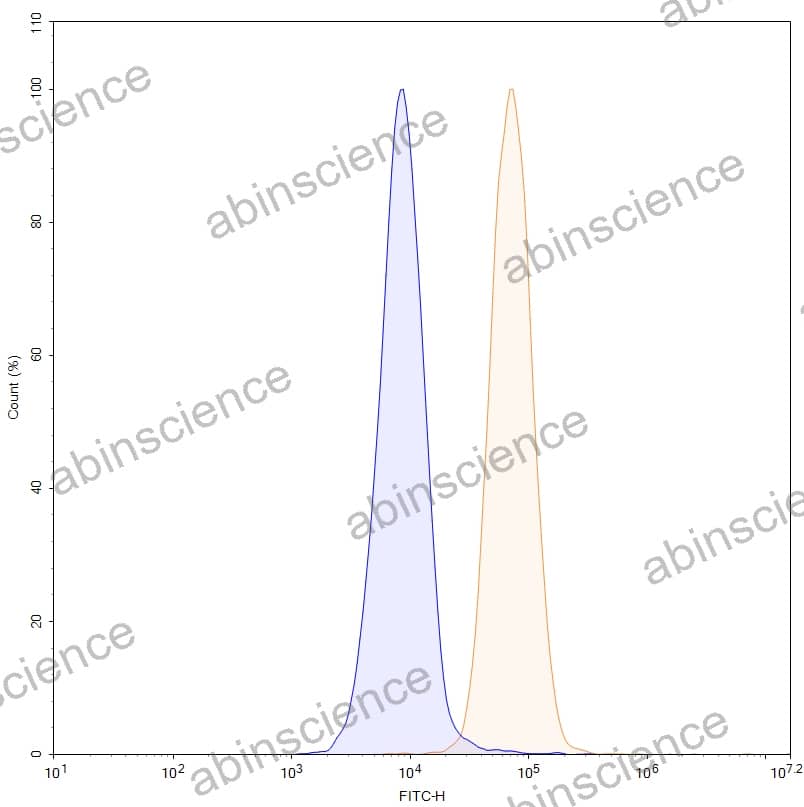
Flow-cytometry using anti-human CD220 antibody. HepG2 cells were stained with an irrelevant antibody (Blue Histogram) or an anti-human CD220 monoclonal antibody (Catalog HY112207, Yellow Histogram) at a concentration of 5 µg/ml for 30 mins at RT. After washing, bound antibody was detected using a Goat Anti-Mouse IgG H&L Polyclonal Antibody, FITC (abinScience: MF690414) and cells analysed on a NovoCyte Flow Cytometer.


Contáctenos para cotizaciones personalizadas, solicitudes en masa y cualquier otro problema.
Correo: [email protected]
+86-027-65523339
Edificio C, No. 666, Calle Shendunsi, Wuhan, 430206, China


