
 中文
中文 English
 한국어
한국어 日本語
日本語 Español
 Français
 Русский
| Каталожный номер | HC438014 | ||||||||
|---|---|---|---|---|---|---|---|---|---|
| Описание |
Anti-Human CLN3 Polyclonal Antibody (HC438014) is a rabbit polyclonal antibody detecting Protein CLN3 in ELISA, IHC, WB. Suitable for Human.
Highlights
|
||||||||
| Реактивность видов | Human | ||||||||
| Применения | ELISA, IHC, WB | ||||||||
| Хозяинский вид | Rabbit | ||||||||
| Клоональность | Polyclonal | ||||||||
| Изотип | IgG | ||||||||
| Иммуноген | E. coli - derived recombinant Human CLN3 (Gln204-Val277). | ||||||||
| Цель | BTS, Batten disease protein, Battenin, CLN3, Protein CLN3 | ||||||||
| Уровень эндотоксинов | Please contact with the lab for this information. | ||||||||
| Очистка | Purified by antigen affinity column. | ||||||||
| Номер доступа | Q13286 | ||||||||
| Форма | Liquid | ||||||||
| Буфер хранения | 0.01M PBS, pH 7.4, 50% Glycerol, 0.05% Proclin 300. Пожалуйста, обратитесь к конкретной информации о буфере в печатной версии даташита или в индивидуальном сертификате качества (COA) для партии. |
||||||||
| Информация об использовании продукта |
| ||||||||
| Устойчивость и хранение | Use a manual defrost freezer and avoid repeated freeze thaw cycles. Store at 2 to 8°C for frequent use. Store at -20 to -80°C for twelve months from the date of receipt. | ||||||||
| Фон | Battenin (CLN3) is a ~47 kDa protein. Mediates microtubule-dependent, anterograde transport connecting the Golgi network, endosomes, autophagosomes, lysosomes and plasma membrane, and participates in several cellular processes such as regulation of lysosomal pH, lysosome protein degradation, receptor-mediated endocytosis, autophagy, transport of proteins and lipids from the TGN, apoptosis and synaptic transmission. Facilitates the proteins transport from trans-Golgi network (TGN)-to other membrane compartments such as transport of microdomain-associated proteins to the plasma membrane, IGF2R transport to the lysosome where it regulates the CTSD release leading to regulation of CTSD maturation and thereby APP intracellular processing. Moreover regulates CTSD activity in response to osmotic stress. Also binds galactosylceramide and transports it from the trans Golgi to the rafts, which may have immediate and downstream effects on cell survival by modulating ceramide synthesis. At the plasma membrane, regulates actin-dependent events including filopodia formation, cell migration, and pinocytosis through ARF1-CDC42 pathway and also the cytoskeleton organization through interaction with MYH10 and fodrin leading to the regulation of the plasma membrane association of Na+, K+ ATPase complex. 1. Golabek, AA. et al. (2000) Molecular genetics and metabolism 70, 203-13. PMID: 10924275 2. Luiro, K. et al. (2004) Human molecular genetics 13, 3017-27. PMID: 15471887 3. Rusyn, E. et al. (2008) Pediatric research 63, 625-31. PMID: 18317235 4. Metcalf, DJ. et al. (2008) Traffic (Copenhagen, Denmark) 9, 1905-14. PMID: 18817525 5. Getty, AL. et al. (2011) Experimental cell research 317, 51-69. PMID: 20850431 6. Uusi-Rauva, K. et al. (2012) Cellular and molecular life sciences : CMLS 69, 2075-89. PMID: 22261744 7. Getty, A. et al. (2013) PloS one 8, e66203. PMID: 23840424 8. Cárcel-Trullols, J. et al. (2017) Journal of cellular biochemistry 118, 3883-3890. PMID: 28390177 | ||||||||
| Примечание | For research use only |
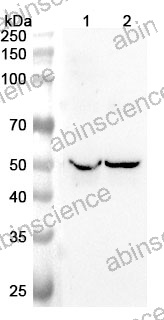
Lane 1: Mouse brain lysate
Lane 2: Rat brain lysate
Свяжитесь с нами для индивидуальных предложений, оптовых запросов и других вопросов.
Почта: [email protected]
+86-027-65523339
Building C, No. 666, Shen Dun Si Lu, Wuhan, 430206, China


