
 中文
 English
 한국어
 日本語
 Español
 Français
 Русский

| Numéro de catalogue | HY509014 | ||||||||
|---|---|---|---|---|---|---|---|---|---|
| Description |
Anti-Human RNH1 Polyclonal Antibody (HY509014) is a rabbit polyclonal antibody detecting RNH1 in ELISA, IHC, WB. Suitable for Human.
Highlights
|
||||||||
| Reactivité des espèces | Human | ||||||||
| Applications | ELISA, IHC, WB | ||||||||
| Espèce hôte | Rabbit | ||||||||
| Clonalité | Polyclonal | ||||||||
| Isotype | IgG | ||||||||
| Immunogène | E. coli - derived recombinant Human RNH1 (Asp218-Glu444). | ||||||||
| Cible | Ribonuclease inhibitor, Placental ribonuclease inhibitor, Placental RNase inhibitor, Ribonuclease/angiogenin inhibitor 1, RAI, RNH1, PRI, RNH | ||||||||
| Niveau d'endotoxines | Please contact with the lab for this information. | ||||||||
| Purification | Purified by antigen affinity column. | ||||||||
| Numéro d'accès | P13489 | ||||||||
| Forme | Liquid | ||||||||
| Tampon de stockage | 0.01M PBS, pH 7.4, 50% Glycerol, 0.05% Proclin 300. Reférez-vous aux informations spécifiques sur le tampon dans la copie papier du datasheet ou dans le COA spécifique au lot. |
||||||||
| Informations d'utilisation du produit |
| ||||||||
| Stabilité et stockage | Use a manual defrost freezer and avoid repeated freeze thaw cycles. Store at 2 to 8°C for frequent use. Store at -20 to -80°C for twelve months from the date of receipt. | ||||||||
| Contexte | Ribonuclease inhibitor (RNH1) is a ~49 kDa protein. Ribonuclease inhibitor which inhibits RNASE1, RNASE2 and angiogenin (ANG). May play a role in redox homeostasis. Required to inhibit the cytotoxic tRNA ribonuclease activity of ANG in the cytoplasm in absence of stress. Relocates to the nucleus in response to stress, relieving inhibition of ANG in the cytoplasm, and inhibiting the angiogenic activity of ANG in the nucleus. 1. Teufel, DP. et al. (2003) Biochemistry 42, 1451-9. PMID: 12578357 2. Huang, GH. et al. (2003) Sheng wu hua xue yu sheng wu wu li xue bao Acta biochimica et biophysica Sinica 35, 960-3. PMID: 14515218 3. Lee, FS. et al. (1988) Biochemistry 27, 8545-53. PMID: 3219362 4. Schneider, R. et al. (1988) The EMBO journal 7, 4151-6. PMID: 3243277 5. Shapiro, R. et al. (1987) Proceedings of the National Academy of Sciences of the United States of America 84, 2238-41. PMID: 3470787 6. Chen, CZ. et al. (1997) Proceedings of the National Academy of Sciences of the United States of America 94, 1761-6. PMID: 9050852 7. Monti, DM. et al. (2007) FEBS letters 581, 930-4. PMID: 17292889 8. Pizzo, E. et al. (2013) Journal of cell science 126, 4308-19. PMID: 23843625 9. Bai, R. et al. (2020) The EMBO journal 39, e103325. PMID: 32510170 | ||||||||
| Note | For research use only |
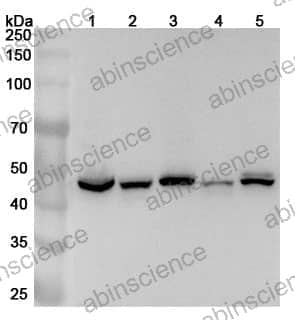
Western blot analysis was performed using anti-RNH1 polyclonal antibody at 1ug/mL on various samples.
Lane 1: HepG2 cell lysate
Lane 2: LO2 cell lysate
Lane 3: Jurkat cell lysate
Lane 4: U87 cell lysate
Lane 5: Raji cell lysate
Contactez-nous pour les devis personnalisés, les demandes en gros et tout autre problème.
Courrier : [email protected]
Contactez-nous
+86-027-65523339
Bâtiment C, No. 666, Rue Shendunsi, Wuhan, 430206, Chine


