
 中文
中文 English
 한국어
한국어 日本語
日本語 Español
 Français
 Русский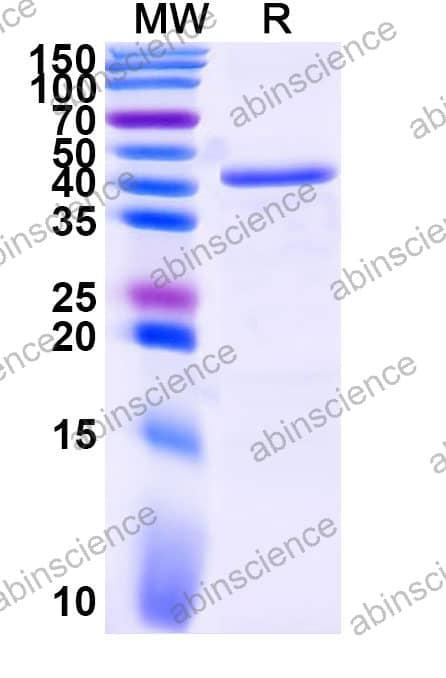

| カタログ番号 | HT176013 | ||||
|---|---|---|---|---|---|
| 説明 |
Anti-Human TMPRSS2 Nanobody (SAA2324) [SAA2324] (HT176013) is a human monoclonal antibody detecting TMPRSS2 in ELISA, Inhibition. Suitable for Human. |
||||
| 種反応性 | Alpaca | ||||
| アプリケーション | ELISA, Inhibition | ||||
| 宿主種 | Human | ||||
| クローン性 | Monoclonal | ||||
| アイソタイプ | VHH-His | ||||
| クローンID | SAA2324 | ||||
| ターゲット | Transmembrane protease serine 2, EC:3.4.21.122, Serine protease 10, Transmembrane protease serine 2 non-catalytic chain, Transmembrane protease serine 2 catalytic chain, TMPRSS2, PRSS10 | ||||
| エンドトキシンレベル | Please contact with the lab for this information. | ||||
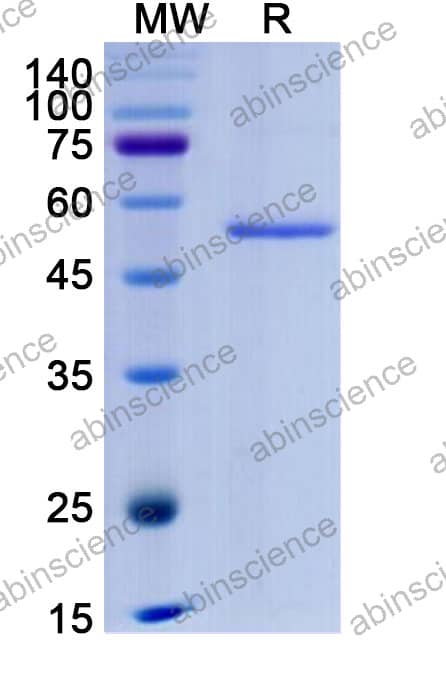
| 純度 | >95% as determined by SDS-PAGE. | ||||
| 精製 | Purified by Nickel column | ||||
| アクセッション番号 | O15393 | ||||
| 形態 | Liquid | ||||
| 保存バッファー | 0.01M PBS pH 7.4 データシートのハードコピーまたはロット固有のCOAに記載された具体的なバッファー情報を参照してください。 |
||||
| 再構成 | Reconstitute in sterile water for a stock solution. A copy of datasheet will be provided with the products, please refer to it for details. | ||||
| 製品使用情報 |
| ||||
| 安定性と保存 | Use a manual defrost freezer and avoid repeated freeze thaw cycles. Store at 2 to 8°C for frequent use. Store at -20 to -80°C for twelve months from the date of receipt. | ||||
| 背景 | Transmembrane protease serine 2 (TMPRSS2) is a ~53 kDa protein. Plasma membrane-anchored serine protease that cleaves at arginine residues. Participates in proteolytic cascades of relevance for the normal physiologic function of the prostate. Androgen-induced TMPRSS2 activates several substrates that include pro-hepatocyte growth factor/HGF, the protease activated receptor-2/F2RL1 or matriptase/ST14 leading to extracellular matrix disruption and metastasis of prostate cancer cells. In addition, activates trigeminal neurons and contribute to both spontaneous pain and mechanical allodynia. _x005F_x005F_x000D_ _x005F_x005F_x000D_1. Bestle, D. et al. (2020) Life science alliance 3. PMID: 32703818 _x005F_x005F_x000D_
_x005F_x005F_x000D_
2. Fraser, BJ. et al. (2022) Nature chemical biology 18, 963-971. PMID: 35676539 _x005F_x005F_x000D_
_x005F_x005F_x000D_
3. Wang, H. et al. (2023) Nature communications 14, 7574. PMID: 37990007 _x005F_x005F_x000D_
_x005F_x005F_x000D_
4. McCallum, M. et al. (2024) Cell 187, 4231-4245.e13. PMID: 38964328 _x005F_x005F_x000D_
_x005F_x005F_x000D_
5. Lucas, JM. et al. (2014) Cancer discovery 4, 1310-25. PMID: 25122198 _x005F_x005F_x000D_
_x005F_x005F_x000D_
6. Wilson, S. et al. (2005) The Biochemical journal 388, 967-72. PMID: 15537383 _x005F_x005F_x000D_
_x005F_x005F_x000D_
7. Ko, CJ. et al. (2015) Cancer research 75, 2949-60. PMID: 26018085 _x005F_x005F_x000D_ | ||||
| 注意事項 | For research use only |
+86-027-65523339
中国武漢市深敦寺路666号C棟、武漢、430206


