
 中文
中文 English
 한국어
한국어 日本語
日本語 Español
 Français
 Русский
| Numéro de catalogue | HP715014 | ||||||||
|---|---|---|---|---|---|---|---|---|---|
| Description |
Anti-Human UBQLN4 Polyclonal Antibody (HP715014) is a rabbit polyclonal antibody detecting Ubiquilin-4; Ataxin-1 interacting ubiquitin-like protein; A1Up; Ataxin-1 ubiquitin-like-interacting protein A1U; Connexin43-interacting protein of 75 kDa; CIP75; UBQLN4; C1orf6; CIP75; UBIN. Suitable for Mouse and Human.
Highlights
|
||||||||
| Reactivité des espèces | Human, Mouse | ||||||||
| Applications | ELISA, IHC, WB | ||||||||
| Espèce hôte | Rabbit | ||||||||
| Clonalité | Polyclonal | ||||||||
| Isotype | IgG | ||||||||
| Immunogène | E. coli - derived recombinant Human UBQLN4 (Pro12-Lys83). | ||||||||
| Cible | Ubiquilin-4; Ataxin-1 interacting ubiquitin-like protein; A1Up; Ataxin-1 ubiquitin-like-interacting protein A1U; Connexin43-interacting protein of 75 kDa; CIP75; UBQLN4; C1orf6; CIP75; UBIN | ||||||||
| Niveau d'endotoxines | Please contact with the lab for this information. | ||||||||
| Purification | Purified by antigen affinity column. | ||||||||
| Numéro d'accès | Q9NRR5 | ||||||||
| Forme | Liquid | ||||||||
| Tampon de stockage | 0.01M PBS, pH 7.4, 50% Glycerol, 0.05% Proclin 300. Reférez-vous aux informations spécifiques sur le tampon dans la copie papier du datasheet ou dans le COA spécifique au lot. |
||||||||
| Informations d'utilisation du produit |
| ||||||||
| Contexte | Ubiquilin-4 (UBQLN4) is a ~63 kDa protein. Regulator of protein degradation that mediates the proteasomal targeting of misfolded, mislocalized or accumulated proteins. Acts by binding polyubiquitin chains of target proteins via its UBA domain and by interacting with subunits of the proteasome via its ubiquitin-like domain. Key regulator of DNA repair that represses homologous recombination repair: in response to DNA damage, recruited to sites of DNA damage following phosphorylation by ATM and acts by binding and removing ubiquitinated MRE11 from damaged chromatin, leading to MRE11 degradation by the proteasome. MRE11 degradation prevents homologous recombination repair, redirecting double-strand break repair toward non-homologous end joining (NHEJ). Specifically recognizes and binds mislocalized transmembrane-containing proteins and targets them to proteasomal degradation. 1. Riley, BE. et al. (2004) The Journal of biological chemistry 279, 42290-301. PMID: 15280365 2. Suzuki, R. et al. (2016) EMBO reports 17, 842-57. PMID: 27113755 3. Hirayama, S. et al. (2018) Proceedings of the National Academy of Sciences of the United States of America 115, E4199-E4208. PMID: 29666234 4. Jachimowicz, RD. et al. (2019) Cell 176, 505-519.e22. PMID: 30612738 5. Lee, DY. et al. (2013) EMBO reports 14, 373-81. PMID: 23459205 | ||||||||
| Note | For research use only |
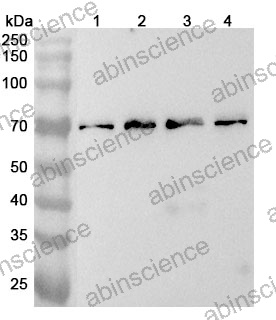
Lane 1: Hela cell lysate
Lane 2: 293T cell lysate
Lane 3: MCF-7 cell lysate
Lane 4: K562 cell lysate
Contactez-nous pour les devis personnalisés, les demandes en gros et tout autre problème.
Courrier : [email protected]
+86-027-65523339
Bâtiment C, No. 666, Rue Shendunsi, Wuhan, 430206, Chine


