
 中文
 English
 한국어
 日本語
 Español
 Français
 Русский

| Numéro de catalogue | MB716014 | ||||||||
|---|---|---|---|---|---|---|---|---|---|
| Description |
Anti-Mouse ADCYAP1 Polyclonal Antibody (MB716014) is a rabbit polyclonal antibody detecting Adcyap1 in ELISA, IHC, WB. Suitable for Mouse.
Highlights
|
||||||||
| Reactivité des espèces | Mouse, Rat | ||||||||
| Applications | ELISA, IHC, WB | ||||||||
| Espèce hôte | Rabbit | ||||||||
| Clonalité | Polyclonal | ||||||||
| Isotype | IgG | ||||||||
| Immunogène | E. coli - derived recombinant Mouse ADCYAP1 (Arg79-Arg171). | ||||||||
| Cible | Pituitary adenylate cyclase-activating polypeptide, PACAP, PACAP-related peptide, PRP-48, Pituitary adenylate cyclase-activating polypeptide 27, PACAP-27, PACAP27, Pituitary adenylate cyclase-activating polypeptide 38, PACAP-38, PACAP38, Adcyap1, Pacap | ||||||||
| Niveau d'endotoxines | Please contact with the lab for this information. | ||||||||
| Pureté | >95% as determined by SDS-PAGE. | ||||||||
| Purification | Purified by antigen affinity column. | ||||||||
| Numéro d'accès | O70176 | ||||||||
| Forme | Liquid | ||||||||
| Tampon de stockage | 0.01M PBS, pH 7.4, 50% Glycerol, 0.05% Proclin 300. Reférez-vous aux informations spécifiques sur le tampon dans la copie papier du datasheet ou dans le COA spécifique au lot. |
||||||||
| Informations d'utilisation du produit |
| ||||||||
| Stabilité et stockage | Use a manual defrost freezer and avoid repeated freeze thaw cycles. Store at 2 to 8°C for frequent use. Store at -20 to -80°C for twelve months from the date of receipt. | ||||||||
| Contexte | Pituitary adenylate cyclase-activating polypeptide (ADCYAP1/PACAP) is a ~19 kDa protein. PACAP is a neuropeptide involved in diverse array of physiological processes through activating the PACAP subfamily of class B1 G protein-coupled receptors: VIP receptor 1 (VIPR1), VIP receptor 2 (VIPR2), and PACAP type I receptor (ADCYAP1R1). Exerts neuroprotective and general cytoprotective effects due to anti-apoptotic, anti-inflammatory, and antioxidant actions. Promotes neuron projection development through the RAPGEF2/Rap1/B-Raf/ERK pathway. In chromaffin cells, induces long-lasting increase of intracellular calcium concentrations and neuroendocrine secretion. Involved in the control of glucose homeostasis, induces insulin secretion by pancreatic beta cells. 1. Armstrong, BD. et al. (2008) Neuroscience 151, 63-73. PMID: 18055122 2. Prevost, G. et al. (2013) Endocrinology 154, 3796-806. PMID: 23913443 | ||||||||
| Note | For research use only. |
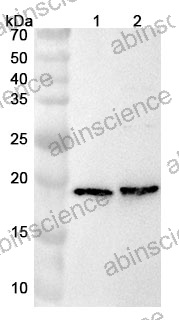
Lane 1: Hela cell lysate
Lane 2: 293T cell lysate
Contactez-nous pour les devis personnalisés, les demandes en gros et tout autre problème.
Courrier : [email protected]
Contactez-nous
+86-027-65523339
Bâtiment C, No. 666, Rue Shendunsi, Wuhan, 430206, Chine


