
 中文
 English
 한국어
 日本語
 Español
 Français
 Русский


| Numéro de catalogue | MF985014 | ||||||||
|---|---|---|---|---|---|---|---|---|---|
| Description |
Anti-Mouse CD160 Polyclonal Antibody (MF985014) is a rabbit polyclonal antibody detecting CD160 in ELISA, IHC, WB. Suitable for Mouse.
Highlights
|
||||||||
| Reactivité des espèces | Mouse | ||||||||
| Applications | ELISA, IHC, WB | ||||||||
| Espèce hôte | Rabbit | ||||||||
| Clonalité | Polyclonal | ||||||||
| Isotype | IgG | ||||||||
| Immunogène | E. coli - derived recombinant Mouse CD160 (Ile30-Gln146). | ||||||||
| Cible | Natural killer cell receptor BY55, CD160 antigen, CD160, BY55 | ||||||||
| Purification | Purified by antigen affinity column. | ||||||||
| Numéro d'accès | O88875 | ||||||||
| Forme | Liquid | ||||||||
| Tampon de stockage | 0.01M PBS, pH 7.4, 50% Glycerol, 0.05% Proclin 300. Reférez-vous aux informations spécifiques sur le tampon dans la copie papier du datasheet ou dans le COA spécifique au lot. |
||||||||
| Informations d'utilisation du produit |
| ||||||||
| Stabilité et stockage | Use a manual defrost freezer and avoid repeated freeze thaw cycles. Store at 2 to 8°C for frequent use. Store at -20 to -80°C for twelve months from the date of receipt. | ||||||||
| Contexte | CD160 antigen is a ~20 kDa protein. Receptor on immune cells capable to deliver stimulatory or inhibitory signals that regulate cell activation and differentiation. Exists as a GPI-anchored and as a transmembrane form, each likely initiating distinct signaling pathways via phosphoinositol 3-kinase in activated NK cells and via LCK and CD247/CD3 zeta chain in activated T cells. Receptor for both classical and non-classical MHC class I molecules. Receptor or ligand for TNF superfamily member TNFRSF14, participating in bidirectional cell-cell contact signaling between antigen presenting cells and lymphocytes. Upon ligation of TNFRSF14, provides stimulatory signal to NK cells enhancing IFNG production and anti-tumor immune response. 1. Maeda, M. et al. (2005) Journal of immunology (Baltimore, Md. : 1950) 175, 4426-32. PMID: 16177084 2. Tu, TC. et al. (2015) The Journal of experimental medicine 212, 415-29. PMID: 25711213 3. Shui, JW. et al. (2012) Nature 488, 222-5. PMID: 22801499 | ||||||||
| Note | For research use only. |
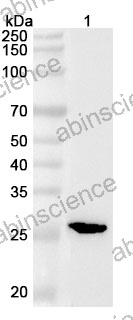
Lane 1: Rat kidney lysate
Contactez-nous pour les devis personnalisés, les demandes en gros et tout autre problème.
Courrier : [email protected]
+86-027-65523339
Bâtiment C, No. 666, Rue Shendunsi, Wuhan, 430206, Chine


