
 中文
 English
 한국어
 日本語
 Español
 Français
 Русский

| カタログ番号 | MB008014 | ||||||||
|---|---|---|---|---|---|---|---|---|---|
| 説明 |
Anti-Mouse FPR1 Polyclonal Antibody (MB008014) is a rabbit polyclonal antibody detecting fMet-Leu-Phe receptor; fMLP receptor; N-formyl peptide receptor; FPR; N-formylpeptide chemoattractant receptor; Fpr1 in ELISA, IHC, WB. Suitable for Mouse.
Highlights
|
||||||||
| 種反応性 | Mouse | ||||||||
| アプリケーション | ELISA, IHC, WB | ||||||||
| 宿主種 | Rabbit | ||||||||
| クローン性 | Polyclonal | ||||||||
| アイソタイプ | IgG | ||||||||
| 免疫原 | E. coli - derived recombinant mouse FPR1 (Asp2-Val35&Ser92-Phe108&Arg171-Arg216&Gln278-Ile296). | ||||||||
| ターゲット | fMet-Leu-Phe receptor; fMLP receptor; N-formyl peptide receptor; FPR; N-formylpeptide chemoattractant receptor; Fpr1 | ||||||||
| エンドトキシンレベル | Please contact with the lab for this information. | ||||||||
| 精製 | Purified by antigen affinity column. | ||||||||
| アクセッション番号 | P33766 | ||||||||
| 形態 | Liquid | ||||||||
| 保存バッファー | 0.01M PBS, pH 7.4, 50% Glycerol, 0.05% Proclin 300. データシートのハードコピーまたはロット固有のCOAに記載された具体的なバッファー情報を参照してください。 |
||||||||
| 製品使用情報 |
| ||||||||
| 安定性と保存 | Use a manual defrost freezer and avoid repeated freeze thaw cycles. Store at 2 to 8°C for frequent use. Store at -20 to -80°C for twelve months from the date of receipt. | ||||||||
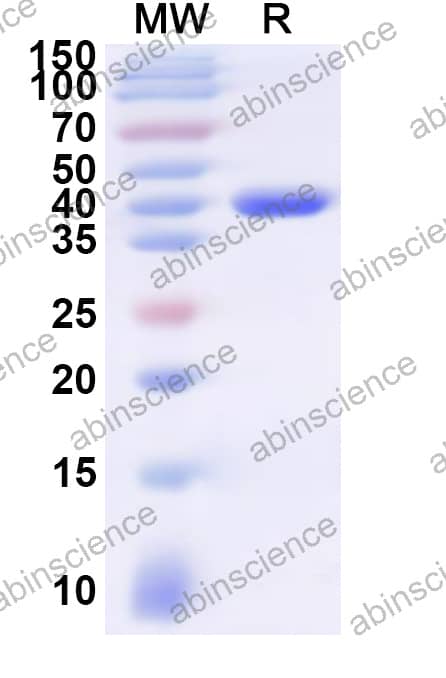
| 背景 | N-formyl peptide receptor 1 (FPR1) is a ~40 kDa protein. Pattern recognition G-protein coupled receptor (PRR/GPCR) involved in innate recognition of N-formyl-methionyl peptides derived from invading microbes and host mitochondria as pathogen- and damage-associated molecular patterns (PAMPs and DAMPs). Functions as a sensor of PAMPs and DAMPs released upon microbial infection or tissue damage, triggering immune cell activation and chemotaxis to eliminate pathogens and restore tissue homeostasis. Peptide binding leads to conformational changes coupled to heterotrimeric G(i) protein signaling. Upon GDP to GTP conversion, G(i)-alpha subunit dissociates from G-beta and G-gamma subunits. Free G(i)-alpha subunit inhibits cyclic adenylate cyclase and cAMP synthesis whereas the G-beta and G-gamma dimer activates downstream phospholipase C-beta and phosphoinositide 3-kinase signaling cascades leading to Ca(2+) influx. 1. Southgate, EL. et al. (2008) Journal of immunology (Baltimore, Md. : 1950) 181, 1429-37. PMID: 18606697 2. Bufe, B. et al. (2015) The Journal of biological chemistry 290, 7369-87. PMID: 25605714 3. Gao, JL. et al. (1993) The Journal of biological chemistry 268, 25395-401. PMID: 8244972 4. Gao, JL. et al. (1999) The Journal of experimental medicine 189, 657-62. PMID: 9989980 5. McDonald, B. et al. (2010) Science (New York, N.Y.) 330, 362-6. PMID: 20947763 | ||||||||
| 注意事項 | For research use only |
お問い合わせ
+86-027-65523339
中国武漢市深敦寺路666号C棟、武漢、430206


