
 中文
 English
 한국어
 日本語
 Español
 Français
 Русский
| Numéro de catalogue | HB637014 | ||||||||
|---|---|---|---|---|---|---|---|---|---|
| Description |
Anti-PTGS1 Polyclonal Antibody (HB637014) is a rabbit polyclonal antibody detecting PTGS1 in ELISA, IHC, WB. Suitable for Human, Mouse, and Rat.
Highlights
|
||||||||
| Reactivité des espèces | Human | ||||||||
| Applications | ELISA, IHC, WB | ||||||||
| Espèce hôte | Rabbit | ||||||||
| Clonalité | Polyclonal | ||||||||
| Isotype | IgG | ||||||||
| Immunogène | E. coli - derived recombinant human PTGS1 (Gly367-Leu599). | ||||||||
| Cible | Prostaglandin G/H synthase 1, EC:1.14.99.1, Cyclooxygenase-1, COX-1, Prostaglandin H2 synthase 1, PGH synthase 1, PGHS-1, PHS 1, Prostaglandin-endoperoxide synthase 1, PTGS1, COX1 | ||||||||
| Niveau d'endotoxines | Please contact with the lab for this information. | ||||||||
| Purification | Purified by antigen affinity column. | ||||||||
| Numéro d'accès | P23219, P22437, Q63921 | ||||||||
| Forme | Liquid | ||||||||
| Tampon de stockage | 0.01M PBS, pH 7.4, 50% Glycerol, 0.05% Proclin 300. Reférez-vous aux informations spécifiques sur le tampon dans la copie papier du datasheet ou dans le COA spécifique au lot. |
||||||||
| Informations d'utilisation du produit |
| ||||||||
| Stabilité et stockage | Use a manual defrost freezer and avoid repeated freeze thaw cycles. Store at 2 to 8°C for frequent use. Store at -20 to -80°C for twelve months from the date of receipt. | ||||||||
| Contexte | Prostaglandin G/H synthase 1 (PTGS1) is a ~68 kDa protein. Dual cyclooxygenase and peroxidase that plays an important role in the biosynthesis pathway of prostanoids, a class of C20 oxylipins mainly derived from arachidonate ((5Z,8Z,11Z,14Z)-eicosatetraenoate, AA, C20:4(n-6)), with a particular role in the inflammatory response. The cyclooxygenase activity oxygenates AA to the hydroperoxy endoperoxide prostaglandin G2 (PGG2), and the peroxidase activity reduces PGG2 to the hydroxy endoperoxide prostaglandin H2 (PGH2), the precursor of all 2-series prostaglandins and thromboxanes. This complex transformation is initiated by abstraction of hydrogen at carbon 13 (with S-stereochemistry), followed by insertion of molecular O2 to form the endoperoxide bridge between carbon 9 and 11 that defines prostaglandins. The insertion of a second molecule of O2 (bis-oxygenase activity) yields a hydroperoxy group in PGG2 that is then reduced to PGH2 by two electrons. Involved in the constitutive production of prostanoids in particular in the stomach and platelets. 1. Barnett, J. et al. (1994) Biochimica et biophysica acta 1209, 130-9. PMID: 7947975 | ||||||||
| Note | For research use only |
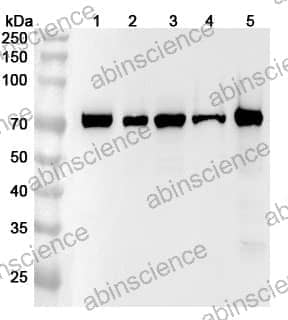
Western blot analysis was performed using anti-PTGS1 polyclonal antibody at 1ug/mL on various samples.
Lane 1: A431 cell lysate
Lane 2: THP-1 cell lysate
Lane 3: LO2 cell lysate
Lane 4: K562 cell lysate
Lane 5: Hacat cell lysate
Contactez-nous
+86-027-65523339
Bâtiment C, No. 666, Rue Shendunsi, Wuhan, 430206, Chine


