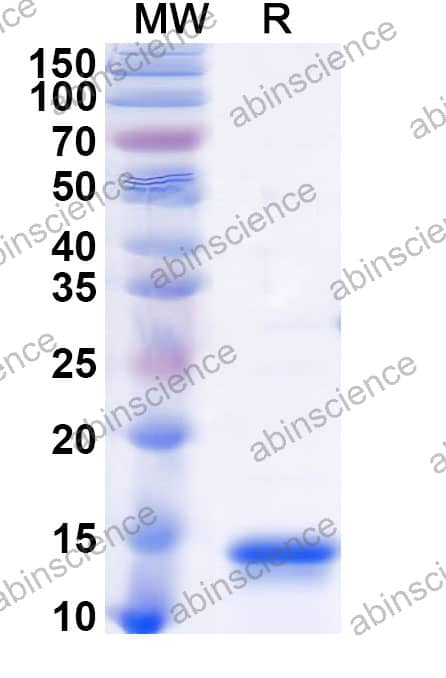
| Cible |
ILP, IAP-like protein, X-linked inhibitor of apoptosis protein, IAP-3, hILP, X-linked IAP, Baculoviral IAP repeat-containing protein 4, Inhibitor of apoptosis protein 3, RING-type E3 ubiquitin transferase XIAP, E3 ubiquitin-protein ligase XIAP, API3, XIAP, hIAP-3, hIAP3, BIRC4, IAP3 |
| Contexte | E3 ubiquitin-protein ligase XIAP is a ~56 kDa protein. Multi-functional protein which regulates not only caspases and apoptosis, but also modulates inflammatory signaling and immunity, copper homeostasis, mitogenic kinase signaling, cell proliferation, as well as cell invasion and metastasis. Acts as a direct caspase inhibitor. Directly bind to the active site pocket of CASP3 and CASP7 and obstructs substrate entry. Inactivates CASP9 by keeping it in a monomeric, inactive state. Acts as an E3 ubiquitin-protein ligase regulating NF-kappa-B signaling and the target proteins for its E3 ubiquitin-protein ligase activity include: RIPK1, RIPK2, MAP3K2/MEKK2, DIABLO/SMAC, AIFM1, CCS, PTEN and BIRC5/survivin. 3. Suzuki, Y. et al. (2001) Proceedings of the National Academy of Sciences of the United States of America 98, 8662-7. PMID: 114472974. MacFarlane, M. et al. (2002) The Journal of biological chemistry 277, 36611-6. PMID: 121219695. Shiozaki, EN. et al. (2003) Molecular cell 11, 519-27. PMID: 126202387. Wilkinson, JC. et al. (2008) Molecular and cellular biology 28, 237-47. PMID: 179678708. Van Themsche, C. et al. (2009) The Journal of biological chemistry 284, 20462-6. PMID: 194739829. Brady, GF. et al. (2010) Molecular and cellular biology 30, 1923-36. PMID: 2015413810. Lewis, EM. et al. (2011) Biochemistry 50, 11084-96. PMID: 22103349 |
|---|

 中文
中文 English
 한국어
한국어 日本語
日本語 Español
 Français
 Русский