
 中文
中文 English
 한국어
한국어 日本語
日本語 Español
 Français
 Русский
| Numéro de catalogue | HB903012 |
|---|---|
| Description |
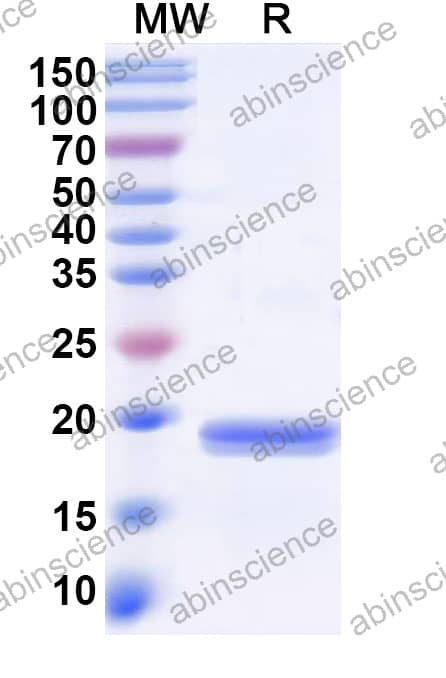
Recombinant Human HTN3 Protein, N-His-KSI (HB903012) expressed in E. coli, spanning Asp20-Asn51. Purity: >90% by SDS-PAGE.
Highlights
|
| Système d'expression | E. coli |
| Numéro d'accès | P15516 |
| Longueur de protéine | Asp20-Asn51 |
| Applications | ELISA, Immunogen, SDS-PAGE, WB, Bioactivity testing in progress |
| Espèces | Homo sapiens (Human) |
| Nature | Recombinant |
| Niveau d'endotoxines | Please contact with the lab for this information. |
| Pureté | >90% as determined by SDS-PAGE. |
| Masse moléculaire prédite | 19.82 kDa |
| Forme | Lyophilized |
| Tampon de stockage | Lyophilized from a solution in PBS pH 7.4, 0.02% NLS, 1 mM EDTA, 4% Trehalose, 1% Mannitol. Reférez-vous aux informations spécifiques sur le tampon dans la copie papier du datasheet ou dans le COA spécifique au lot. |
| Reconstitution | Reconstitute in sterile water for a stock solution. Adjust the volume of sterile water so that, after reconstitution, the final stock concentration matches the value indicated on the product label or datasheet. RECONSTITUTION PROTOCOL 1. Allow the product to be reconstituted and the reconstitution diluent to reach room temperature. 2. Tap or briefly centrifuge the product vial before opening to dislodge any lyophilized material that may be dispersed on the wall or cap of the vial. 3. Use the diluent and stock concentration recommended in the product datasheet. If preparing a stock concentration higher than recommended, contact Technical Service. 4. After adding the diluent, re-cap the vial and invert gently by hand or place on a slow rocking platform to allow the reconstitution diluent to coat all the surfaces inside the vial. Note: Do not mix by vortexing or by pipetting the material up and down. 5. Allow the vial to sit at room temperature with gentle agitation for at least 15 minutes before aliquotting or using. 6. Store the reconstituted material in single use aliquots in polypropylene or siliconized tubes. Aliquots of 10 μL or larger are recommended. |
| Expédition | In general, proteins are provided as lyophilized powder/frozen liquid. They are shipped out with dry ice/blue ice unless customers require otherwise. |
| Stabilité et stockage | Use a manual defrost freezer and avoid repeated freeze thaw cycles. Store at 2 to 8°C for frequent use. Store at -20 to -80°C for twelve months from the date of receipt. |
| Noms alternatifs | His3 20/31, Histatin-5, His3-(15-24)-peptide, His3 26/32, His3 28/32, His3 31/51, Histatin-12, Histatin-3 29/32, Histatin-3 6/11, His3 45/51, His3 7/12, His3 31/43, PB, His3 24/32, Histatin-6, HTN3, His3 33/43, His3-(5-13)-peptide, His3 5/11, Histidine-rich protein 3, His3 6/13, His3-(13-24)-peptide, His3 48/51, Histatin-3 14/25, Histatin-3 15/24, HIS2, His3 26/31, His3-(26-32)-peptide, His3 20/43, His3 14/24, His3-(7-11)-peptide, His3-(14-24)-peptide, His3 5/12, His3 34/43, Histatin-3 5/13, His3 32/44, His3 12/24, His3-(6-11)-peptide, Basic histidine-rich protein, Histatin-3 1/12, His3 13/25... |
| Contexte | Histatin-3 (HTN3) is a ~6 kDa protein. Histatins are cationic and histidine-rich peptides mainly found in the saliva of higher primates. They are considered to be major precursors of the protective proteinaceous structure on tooth surfaces (enamel pellicle). Hsts can be divided into two major groups according to their biological functions: antimicrobial Hsts (e.g. Hst 5/HTN3) and cell-activating Hsts (e.g. Hst 1/HTN1, Hst 2/HTN1 and Hst 3/HTN3). 1. Oppenheim, FG. et al. (1988) The Journal of biological chemistry 263, 7472-7. PMID: 3286634 2. Ma, D. et al. (2020) Cells 9. PMID: 32225006 |
| Note | For research use only. |
SDS-PAGE for Recombinant Human HTN3 Protein, N-His-KSI
Contactez-nous pour les devis personnalisés, les demandes en gros et tout autre problème.
Courrier : [email protected]
+86-027-65523339
Bâtiment C, No. 666, Rue Shendunsi, Wuhan, 430206, Chine


