
 中文
中文 English
 한국어
한국어 日本語
日本語 Español
 Français
 Русский
| Número de catálogo | HS908022 |
|---|---|
| Descripción |
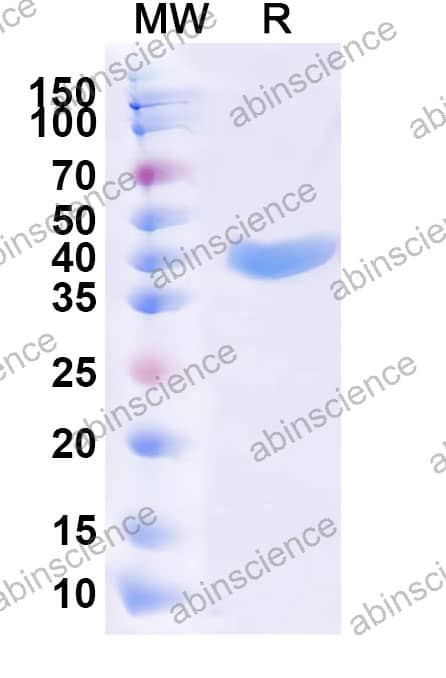
Recombinant Human MED1 Protein, N-His (HS908022) expressed in E. coli, spanning Gly165-Thr522. Purity: >90% by SDS-PAGE.
Highlights
|
| Sistema de expresión | E. coli |
| Número de acceso | Q15648 |
| Longitud de proteína | Gly165-Thr522 |
| Aplicaciones | ELISA, Immunogen, SDS-PAGE, WB, Bioactivity testing in progress |
| Especies | Homo sapiens (Human) |
| Naturaleza | Recombinant |
| Nivel de endotoxinas | Please contact with the lab for this information. |
| Pureza | >90% as determined by SDS-PAGE. |
| Peso molecular predicho | 42.02 kDa |
| Forma | Lyophilized |
| Buffer de almacenamiento | Lyophilized from a solution in PBS pH 7.4, 1 mM EDTA, 4% Trehalose, 1% Mannitol. Consulte la información específica del buffer en la copia impresa del datasheet o en el COA específico del lote. |
| Reconstitución | Reconstitute in sterile water for a stock solution. Adjust the volume of sterile water so that, after reconstitution, the final stock concentration matches the value indicated on the product label or datasheet. RECONSTITUTION PROTOCOL 1. Allow the product to be reconstituted and the reconstitution diluent to reach room temperature. 2. Tap or briefly centrifuge the product vial before opening to dislodge any lyophilized material that may be dispersed on the wall or cap of the vial. 3. Use the diluent and stock concentration recommended in the product datasheet. If preparing a stock concentration higher than recommended, contact Technical Service. 4. After adding the diluent, re-cap the vial and invert gently by hand or place on a slow rocking platform to allow the reconstitution diluent to coat all the surfaces inside the vial. Note: Do not mix by vortexing or by pipetting the material up and down. 5. Allow the vial to sit at room temperature with gentle agitation for at least 15 minutes before aliquotting or using. 6. Store the reconstituted material in single use aliquots in polypropylene or siliconized tubes. Aliquots of 10 μL or larger are recommended. |
| Envío | In general, proteins are provided as lyophilized powder/frozen liquid. They are shipped out with dry ice/blue ice unless customers require otherwise. |
| Estabilidad y almacenamiento | Use a manual defrost freezer and avoid repeated freeze thaw cycles. Store at 2 to 8°C for frequent use. Store at -20 to -80°C for twelve months from the date of receipt. |
| Nombres alternativos | Mediator of RNA polymerase II transcription subunit 1, Activator-recruited cofactor 205 kDa component, ARC205, Mediator complex subunit 1, Peroxisome proliferator-activated receptor-binding protein, PBP, PPAR-binding protein, Thyroid hormone receptor-associated protein complex 220 kDa component, Trap220, Thyroid receptor-interacting protein 2, TR-interacting protein 2, TRIP-2, Vitamin D receptor-interacting protein complex component DRIP205, p53 regulatory protein RB18A, MED1 |
| Fondo | Mediator of RNA polymerase II transcription subunit 1 (MED1) is a ~168 kDa protein. Component of the Mediator complex, a coactivator involved in the regulated transcription of nearly all RNA polymerase II-dependent genes. Mediator functions as a bridge to convey information from gene-specific regulatory proteins to the basal RNA polymerase II transcription machinery. Mediator is recruited to promoters by direct interactions with regulatory proteins and serves as a scaffold for the assembly of a functional preinitiation complex with RNA polymerase II and the general transcription factors. Acts as a coactivator for GATA1-mediated transcriptional activation during erythroid differentiation of K562 erythroleukemia cells. 1. Zhang, J. et al. (1999) Molecular endocrinology (Baltimore, Md.) 13, 1130-40. PMID: 10406464 2. Kang, YK. et al. (2002) Proceedings of the National Academy of Sciences of the United States of America 99, 2642-7. PMID: 11867769 3. Ge, K. et al. (2002) Nature 417, 563-7. PMID: 12037571 4. Wang, Q. et al. (2002) The Journal of biological chemistry 277, 42852-8. PMID: 12218053 5. Coulthard, VH. et al. (2003) The Journal of biological chemistry 278, 10942-51. PMID: 12556447 6. Wallberg, AE. et al. (2003) Molecular cell 12, 1137-49. PMID: 14636573 7. Malik, S. et al. (2004) Molecular and cellular biology 24, 8244-54. PMID: 15340084 8. Wu, Q. et al. (2004) The Journal of biological chemistry 279, 53602-12. PMID: 15471764 9. Zhang, X. et al. (2005) Molecular cell 19, 89-100. PMID: 15989967 10. Udayakumar, TS. et al. (2006) The Journal of biological chemistry 281, 14691-9. PMID: 16574658 |
| Nota | For research use only. |
SDS-PAGE for Recombinant Human MED1 Protein, N-His
Contáctenos para cotizaciones personalizadas, solicitudes en masa y cualquier otro problema.
Correo: [email protected]
+86-027-65523339
Edificio C, No. 666, Calle Shendunsi, Wuhan, 430206, China


