
 中文
 English
 한국어
 日本語
 Español
 Français
 Русский
| Número de catálogo | HB592012 |
|---|---|
| Descripción |
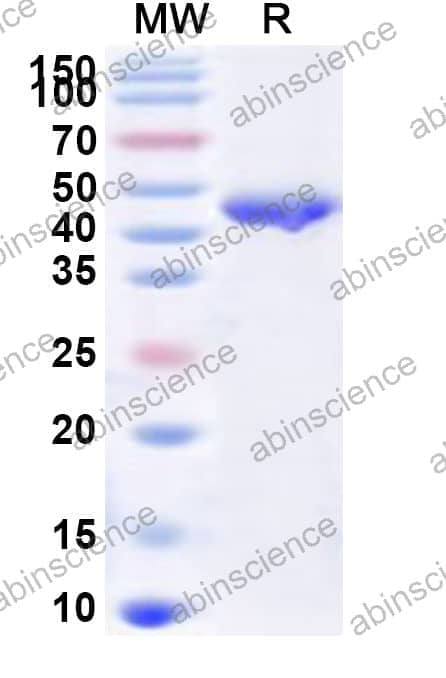
Recombinant Human PAPSS2 Protein, N-His (HB592012) expressed in E. coli, spanning Glu231-Asn614. Purity: >90% by SDS-PAGE.
Highlights
|
| Sistema de expresión | E. coli |
| Número de acceso | O95340 |
| Longitud de proteína | Glu231-Asn614 |
| Aplicaciones | ELISA, Immunogen, SDS-PAGE, WB, Bioactivity testing in progress |
| Especies | Homo sapiens (Human) |
| Naturaleza | Recombinant |
| Nivel de endotoxinas | Please contact with the lab for this information. |
| Pureza | >90% as determined by SDS-PAGE. |
| Peso molecular predicho | 46.21 kDa |
| Forma | Lyophilized |
| Buffer de almacenamiento | Lyophilized from a solution in PBS pH 7.4, 1 mM EDTA, 4% Trehalose, 1% Mannitol. Consulte la información específica del buffer en la copia impresa del datasheet o en el COA específico del lote. |
| Reconstitución | Reconstitute in sterile water for a stock solution. Adjust the volume of sterile water so that, after reconstitution, the final stock concentration matches the value indicated on the product label or datasheet. RECONSTITUTION PROTOCOL 1. Allow the product to be reconstituted and the reconstitution diluent to reach room temperature. 2. Tap or briefly centrifuge the product vial before opening to dislodge any lyophilized material that may be dispersed on the wall or cap of the vial. 3. Use the diluent and stock concentration recommended in the product datasheet. If preparing a stock concentration higher than recommended, contact Technical Service. 4. After adding the diluent, re-cap the vial and invert gently by hand or place on a slow rocking platform to allow the reconstitution diluent to coat all the surfaces inside the vial. Note: Do not mix by vortexing or by pipetting the material up and down. 5. Allow the vial to sit at room temperature with gentle agitation for at least 15 minutes before aliquotting or using. 6. Store the reconstituted material in single use aliquots in polypropylene or siliconized tubes. Aliquots of 10 μL or larger are recommended. |
| Envío | In general, proteins are provided as lyophilized powder/frozen liquid. They are shipped out with dry ice/blue ice unless customers require otherwise. |
| Estabilidad y almacenamiento | Use a manual defrost freezer and avoid repeated freeze thaw cycles. Store at 2 to 8°C for frequent use. Store at -20 to -80°C for twelve months from the date of receipt. |
| Nombres alternativos | Bifunctional 3'-phosphoadenosine 5'-phosphosulfate synthase 2; PAPS synthase 2; PAPSS 2; Sulfurylase kinase 2; SK 2; SK2; Sulfate adenylyltransferase; 2.7.7.4; ATP-sulfurylase; Sulfate adenylate transferase; SAT; Adenylyl-sulfate kinase; 2.7.1.25; 3'-phosphoadenosine-5'-phosphosulfate synthase; APS kinase; Adenosine-5'-phosphosulfate 3'-phosphotransferase; Adenylylsulfate 3'-phosphotransferase; PAPSS2; ATPSK2 |
| Fondo | Bifunctional 3'-phosphoadenosine 5'-phosphosulfate synthase 2 is a ~69 kDa protein. Bifunctional enzyme with both ATP sulfurylase and APS kinase activity, which mediates two steps in the sulfate activation pathway. The first step is the transfer of a sulfate group to ATP to yield adenosine 5'-phosphosulfate (APS), and the second step is the transfer of a phosphate group from ATP to APS yielding 3'-phosphoadenylylsulfate/PAPS, the activated sulfate donor used by sulfotransferases. In mammals, PAPS is the sole source of sulfate while APS appears to only be an intermediate in the sulfate-activation pathway. Plays indirectly an important role in skeletogenesis during postnatal growth. 1. Xu, ZH. et al. (2002) Pharmacogenetics 12, 11-21. PMID: 11773860 2. Noordam, C. et al. (2009) The New England journal of medicine 360, 2310-8. PMID: 19474428 3. Iida, A. et al. (2013) Human mutation 34, 1381-6. PMID: 23824674 4. Oostdijk, W. et al. (2015) The Journal of clinical endocrinology and metabolism 100, E672-80. PMID: 25594860 5. Faiyaz ul Haque, M. et al. (1998) Nature genetics 20, 157-62. PMID: 9771708 |
| Nota | For research use only |
SDS-PAGE for Recombinant Human PAPSS2 Protein, N-His
+86-027-65523339
Edificio C, No. 666, Calle Shendunsi, Wuhan, 430206, China


