
 中文
 English
 한국어
 日本語
 Español
 Français
 Русский

| Numéro de catalogue | MB964012 |
|---|---|
| Description |
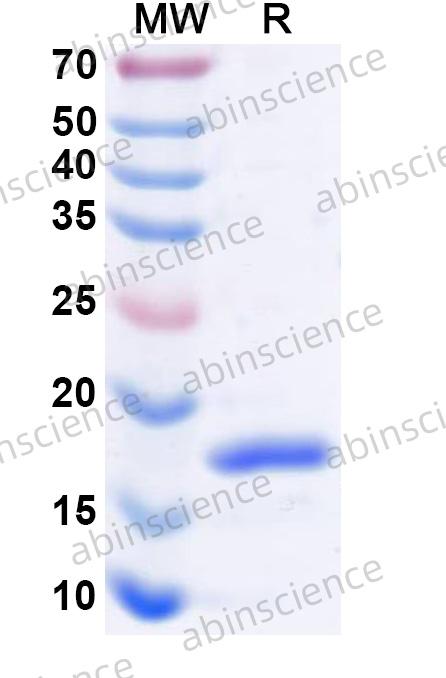
Recombinant Mouse MDK/Midkine Protein, N-His (MB964012) expressed in E. coli. Purity: >90% as determined by SDS-PAGE..
Highlights
|
| Système d'expression | E. coli |
| Numéro d'accès | P12025 |
| Longueur de protéine | Lys23-Asp140 |
| Applications | ELISA, Immunogen, SDS-PAGE, WB, Bioactivity testing in progress |
| Espèces | Mus musculus (Mouse) |
| Nature | Recombinant |
| Niveau d'endotoxines | Please contact with the lab for this information. |
| Pureté | >90% as determined by SDS-PAGE. |
| Forme | Lyophilized |
| Tampon de stockage | Lyophilized from a solution in PBS pH 7.4, 1 mM EDTA, 4% Trehalose, 1% Mannitol. Reférez-vous aux informations spécifiques sur le tampon dans la copie papier du datasheet ou dans le COA spécifique au lot. |
| Reconstitution | Reconstitute in sterile water for a stock solution. A copy of datasheet will be provided with the products, please refer to it for details. |
| Expédition | In general, proteins are provided as lyophilized powder/frozen liquid. They are shipped out with dry ice/blue ice unless customers require otherwise. |
| Stabilité et stockage | Use a manual defrost freezer and avoid repeated freeze thaw cycles. Store at 2 to 8°C for frequent use. Store at -20 to -80°C for twelve months from the date of receipt. |
| Noms alternatifs | MK, Mdk, Midkine, Mk, Retanoic acid-responsive protein, Retinoic acid-induced differentiation factor |
| Contexte | Midkine is a ~15 kDa protein. Secreted protein that functions as a cytokine and growth factor and mediates its signal through cell-surface proteoglycan and non-proteoglycan receptors. Binds cell-surface proteoglycan receptors via their chondroitin sulfate (CS) groups. Thereby regulates many processes like inflammatory response, cell proliferation, cell adhesion, cell growth, cell survival, tissue regeneration, cell differentiation and cell migration. Participates in inflammatory processes by exerting two different activities. Firstly, mediates neutrophils and macrophages recruitment to the sites of inflammation both by direct action by cooperating namely with ITGB2 via LRP1 and by inducing chemokine expression. 1. Ichihara-Tanaka, K. et al. (2006) The Journal of biological chemistry 281, 30857-64. PMID: 16901907 2. Zou, P. et al. (2006) Journal of neurochemistry 99, 1470-9. PMID: 17230638 3. Horiba, M. et al. (2000) The Journal of clinical investigation 105, 489-95. PMID: 10683378 4. Ochiai, K. et al. (2004) Liver international : official journal of the International Association for the Study of the Liver 24, 484-91. PMID: 15482347 5. Kawai, H. et al. (2004) The American journal of pathology 165, 1603-12. PMID: 15509530 6. Horiba, M. et al. (2006) Circulation 114, 1713-20. PMID: 17015789 7. Takenaka, H. et al. (2009) American journal of physiology. Heart and circulatory physiology 296, H462-9. PMID: 19060126 8. Weckbach, LT. et al. (2014) Blood 123, 1887-96. PMID: 24458438 9. Haffner-Luntzer, M. et al. (2014) PloS one 9, e116282. PMID: 25551381 |
| Note | For research use only |
SDS-PAGE for Mouse MDK/Midkine Recombinant Protein (N-His)
Contactez-nous pour les devis personnalisés, les demandes en gros et tout autre problème.
Courrier : [email protected]
+86-027-65523339
Bâtiment C, No. 666, Rue Shendunsi, Wuhan, 430206, Chine


