
 中文
 English
 한국어
 日本語
 Español
 Français
 Русский

| Каталожный номер | MV460012 |
|---|---|
| Описание |
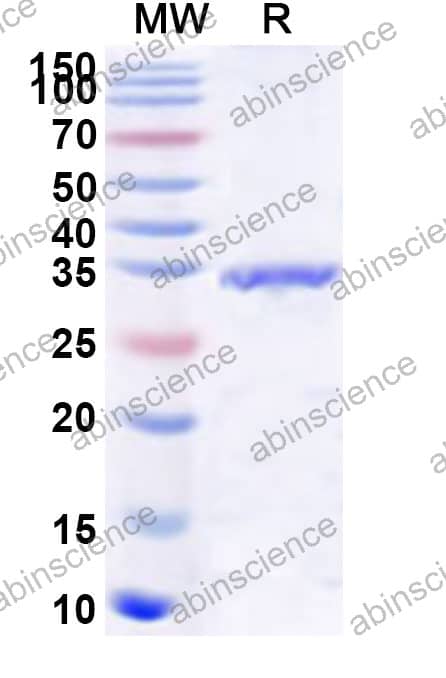
Recombinant Mouse RIPK3 Protein, N-His (MV460012) expressed in E. coli, spanning Met1-Leu320. Purity: >90% by SDS-PAGE.
Highlights
|
| Система экспрессии | E. coli |
| Номер доступа | Q9QZL0 |
| Длина белка | Met1-Leu320 |
| Применения | ELISA, Immunogen, SDS-PAGE, WB, Bioactivity testing in progress |
| Виды | Mus musculus (Mouse) |
| Характер | Recombinant |
| Уровень эндотоксинов | Please contact with the lab for this information. |
| Чистота | >90% as determined by SDS-PAGE. |
| Прогнозируемая молекулярная масса | 37.49 kDa |
| Форма | Lyophilized |
| Буфер хранения | Lyophilized from a solution in PBS pH 7.4, 1 mM EDTA, 4% Trehalose, 1% Mannitol. Пожалуйста, обратитесь к конкретной информации о буфере в печатной версии даташита или в индивидуальном сертификате качества (COA) для партии. |
| Реконституция | Reconstitute in sterile water for a stock solution. Adjust the volume of sterile water so that, after reconstitution, the final stock concentration matches the value indicated on the product label or datasheet. RECONSTITUTION PROTOCOL 1. Allow the product to be reconstituted and the reconstitution diluent to reach room temperature. 2. Tap or briefly centrifuge the product vial before opening to dislodge any lyophilized material that may be dispersed on the wall or cap of the vial. 3. Use the diluent and stock concentration recommended in the product datasheet. If preparing a stock concentration higher than recommended, contact Technical Service. 4. After adding the diluent, re-cap the vial and invert gently by hand or place on a slow rocking platform to allow the reconstitution diluent to coat all the surfaces inside the vial. Note: Do not mix by vortexing or by pipetting the material up and down. 5. Allow the vial to sit at room temperature with gentle agitation for at least 15 minutes before aliquotting or using. 6. Store the reconstituted material in single use aliquots in polypropylene or siliconized tubes. Aliquots of 10 μL or larger are recommended. |
| Доставка | In general, proteins are provided as lyophilized powder/frozen liquid. They are shipped out with dry ice/blue ice unless customers require otherwise. |
| Устойчивость и хранение | Use a manual defrost freezer and avoid repeated freeze thaw cycles. Store at 2 to 8°C for frequent use. Store at -20 to -80°C for twelve months from the date of receipt. |
| Альтернативные названия | Receptor-interacting serine/threonine-protein kinase 3; 2.7.11.1; RIP-like protein kinase 3; Receptor-interacting protein 3; RIP-3; mRIP3; Ripk3; Rip3 |
| Фон | Receptor-interacting serine/threonine-protein kinase 3 is a ~53 kDa protein. Serine/threonine-protein kinase that activates necroptosis and apoptosis, two parallel forms of cell death. Necroptosis, a programmed cell death process in response to death-inducing TNF family members, is triggered by RIPK3 following activation by ZBP1. Activated RIPK3 forms a necrosis-inducing complex and mediates phosphorylation of MLKL, promoting MLKL localization to the plasma membrane and execution of programmed necrosis characterized by calcium influx and plasma membrane damage. In addition to TNF-induced necroptosis, necroptosis can also take place in the nucleus in response to orthomyxoviruses infection: following ZBP1 activation, which senses double-stranded Z-RNA structures, nuclear RIPK3 catalyzes phosphorylation and activation of MLKL, promoting disruption of the nuclear envelope and leakage of cellular DNA into the cytosol. Also regulates apoptosis: apoptosis depends on RIPK1, FADD and CASP8, and is independent of MLKL and RIPK3 kinase activity. 1. Nogusa, S. et al. (2016) Cell host & microbe 20, 13-24. PMID: 27321907 2. Thapa, RJ. et al. (2016) Cell host & microbe 20, 674-681. PMID: 27746097 3. Kuriakose, T. et al. (2016) Science immunology 1. PMID: 27917412 4. Sridharan, H. et al. (2017) EMBO reports 18, 1429-1441. PMID: 28607035 5. Zhang, T. et al. (2020) Cell 180, 1115-1129.e13. PMID: 32200799 6. Jiao, H. et al. (2020) Nature 580, 391-395. PMID: 32296175 7. Rebsamen, M. et al. (2009) EMBO reports 10, 916-22. PMID: 19590578 8. Upton, JW. et al. (2012) Cell host & microbe 11, 290-7. PMID: 22423968 9. Murphy, JM. et al. (2013) Immunity 39, 443-53. PMID: 24012422 10. Kaiser, WJ. et al. (2013) The Journal of biological chemistry 288, 31268-79. PMID: 24019532 |
| Примечание | For research use only |
SDS-PAGE for Recombinant Mouse RIPK3 Protein, N-His
Свяжитесь с нами для индивидуальных предложений, оптовых запросов и других вопросов.
Почта: [email protected]
+86-027-65523339
Building C, No. 666, Shen Dun Si Lu, Wuhan, 430206, China


