
 中文
中文 English
 한국어
한국어 日本語
日本語 Español
 Français
 Русский
| 카탈로그 번호 | HP491014 | ||||||||
|---|---|---|---|---|---|---|---|---|---|
| 설명 |
Anti-Human RPTOR Polyclonal Antibody (HP491014) is a rabbit polyclonal antibody detecting RPTOR in ELISA, IHC, WB. Suitable for Human and Mouse.
Highlights
|
||||||||
| 종 반응성 | Human, Mouse | ||||||||
| 응용 분야 | ELISA, IHC, WB | ||||||||
| 숙주 종 | Rabbit | ||||||||
| 이소타입 | IgG | ||||||||
| 클론성 | Polyclonal | ||||||||
| 면역원 | E. coli - derived recombinant Human RPTOR (Arg1012-Arg1335). | ||||||||
| 타겟 | KIAA1303, Raptor, RAPTOR, RPTOR, Regulatory-associated protein of mTOR, p150 target of rapamycin (TOR)-scaffold protein | ||||||||
| 정제 | Purified by antigen affinity column. | ||||||||
| 등록번호 | Q8N122 | ||||||||
| RRID | Anti-Human RPTOR Polyclonal Antibody (abinScience Cat# HP491014, RRID:AB_3730613) |
||||||||
| 형태 | Liquid | ||||||||
| 저장 완충액 | 0.01M PBS, pH 7.4, 50% Glycerol, 0.05% Proclin 300. 데이터시트 인쇄본 또는 로트별 COA에 기재된 구체적인 완충액 정보를 참조하세요. |
||||||||
| 제품 사용 정보 |
| ||||||||
| 안정성 및 저장 | Use a manual defrost freezer and avoid repeated freeze thaw cycles. Store at 2 to 8°C for frequent use. Store at -20 to -80°C for twelve months from the date of receipt. | ||||||||
| 배경 | Regulatory-associated protein of mTOR (RPTOR) is a ~149 kDa protein. Component of the mechanistic target of rapamycin complex 1 (mTORC1), an evolutionarily conserved central nutrient sensor that stimulates anabolic reactions and macromolecule biosynthesis to promote cellular biomass generation and growth. In response to nutrients, growth factors or amino acids, mTORC1 is recruited to the lysosome membrane and promotes protein, lipid and nucleotide synthesis by phosphorylating several substrates, such as ribosomal protein S6 kinase (RPS6KB1 and RPS6KB2) and EIF4EBP1 (4E-BP1). In the same time, it inhibits catabolic pathways by phosphorylating the autophagy initiation components ULK1 and ATG13, as well as transcription factor TFEB, a master regulators of lysosomal biogenesis and autophagy. The mTORC1 complex is inhibited in response to starvation and amino acid depletion. Within the mTORC1 complex, RPTOR acts both as a molecular adapter, which (1) mediates recruitment of mTORC1 to lysosomal membranes via interaction with small GTPases Rag (RagA/RRAGA, RagB/RRAGB, RagC/RRAGC and/or RagD/RRAGD), and a (2) substrate-specific adapter, which promotes substrate specificity by binding to TOS motif-containing proteins and direct them towards the active site of the MTOR kinase domain for phosphorylation. 1. Kim, DH. et al. (2002) Cell 110, 163-75. PMID: 12150925 2. Hara, K. et al. (2002) Cell 110, 177-89. PMID: 12150926 3. Schalm, SS. et al. (2003) Current biology : CB 13, 797-806. PMID: 12747827 4. Coffman, K. et al. (2014) The Journal of biological chemistry 289, 4723-34. PMID: 24403073 5. Yuan, HX. et al. (2015) Genes & development 29, 2362-76. PMID: 26588989 6. Son, SM. et al. (2020) Nature communications 11, 3148. PMID: 32561715 7. Xu, C. et al. (2023) Molecular cell 83, 3027-3040.e11. PMID: 37541260 | ||||||||
| 참고사항 | For research use only. |
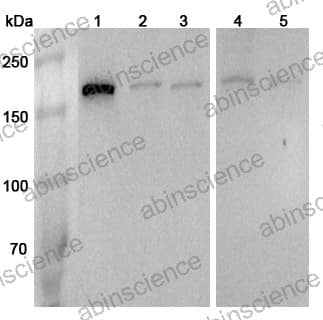
Western blot analysis was performed using anti-RPTOR polyclonal antibody at 1μg/ml on various samples.
Lane 1: NIH3T3 cell lysate
Lane 2: Hela cell lysate
Lane 3: 293T cell lysate
Lane 4: PC12 cell lysate
+86-027-65523339
중국 우한시 심둔사로 666번지 C동, 우한, 430206


