
 中文
中文 English
 한국어
한국어 日本語
日本語 Español
 Français
 Русский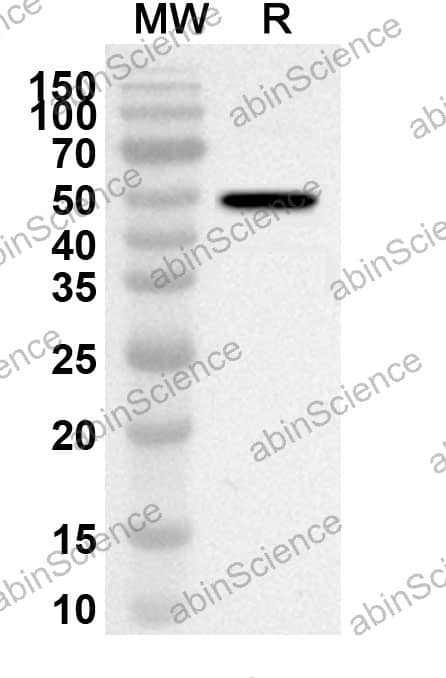


| 카탈로그 번호 | HW521022 |
|---|---|
| 설명 |
Recombinant Human GSK3B Protein, N-GST (HW521022) expressed in E. coli, spanning Met1-Thr420. Purity: >90% by SDS-PAGE.
Highlights
|
| 발현 시스템 | E. coli |
| 등록번호 | P49841 |
| 단백질 길이 | Met1-Thr420 |
| 응용 분야 | ELISA, Immunogen, SDS-PAGE, WB, Bioactivity testing in progress |
| 종 | Homo sapiens (Human) |
| 성질 | Recombinant |
| 내독소 수준 | Please contact with the lab for this information. |
| 순도 | >90% as determined by SDS-PAGE. |
| 예측 분자량 | 73.57 kDa |
| 형태 | Lyophilized |
| 저장 완충액 | Lyophilized from a solution in PBS pH 7.4, 0.02% NLS, 1 mM EDTA, 4% Trehalose, 1% Mannitol. 데이터시트 인쇄본 또는 로트별 COA에 기재된 구체적인 완충액 정보를 참조하세요. |
| 재구성 | Reconstitute in sterile water for a stock solution. Adjust the volume of sterile water so that, after reconstitution, the final stock concentration matches the value indicated on the product label or datasheet. RECONSTITUTION PROTOCOL 1. Allow the product to be reconstituted and the reconstitution diluent to reach room temperature. 2. Tap or briefly centrifuge the product vial before opening to dislodge any lyophilized material that may be dispersed on the wall or cap of the vial. 3. Use the diluent and stock concentration recommended in the product datasheet. If preparing a stock concentration higher than recommended, contact Technical Service. 4. After adding the diluent, re-cap the vial and invert gently by hand or place on a slow rocking platform to allow the reconstitution diluent to coat all the surfaces inside the vial. Note: Do not mix by vortexing or by pipetting the material up and down. 5. Allow the vial to sit at room temperature with gentle agitation for at least 15 minutes before aliquotting or using. 6. Store the reconstituted material in single use aliquots in polypropylene or siliconized tubes. Aliquots of 10 μL or larger are recommended. |
| 배송 | In general, proteins are provided as lyophilized powder/frozen liquid. They are shipped out with dry ice/blue ice unless customers require otherwise. |
| 안정성 및 저장 | Use a manual defrost freezer and avoid repeated freeze thaw cycles. Store at 2 to 8°C for frequent use. Store at -20 to -80°C for twelve months from the date of receipt. |
| 대체 이름 | Glycogen synthase kinase-3 beta, GSK3B, Serine/threonine-protein kinase GSK3B, GSK-3 beta |
| 배경 | Glycogen synthase kinase-3 beta (GSK3B) is a ~46 kDa protein. Constitutively active protein kinase that acts as a negative regulator in the hormonal control of glucose homeostasis, Wnt signaling and regulation of transcription factors and microtubules, by phosphorylating and inactivating glycogen synthase (GYS1 or GYS2), EIF2B, CTNNB1/beta-catenin, APC, AXIN1, DPYSL2/CRMP2, JUN, NFATC1/NFATC, MAPT/TAU and MACF1. Requires primed phosphorylation of the majority of its substrates. In skeletal muscle, contributes to insulin regulation of glycogen synthesis by phosphorylating and inhibiting GYS1 activity and hence glycogen synthesis. May also mediate the development of insulin resistance by regulating activation of transcription factors. Regulates protein synthesis by controlling the activity of initiation factor 2B (EIF2BE/EIF2B5) in the same manner as glycogen synthase. 1. Frame, S. et al. (2001) Molecular cell 7, 1321-7. PMID: 11430833 2. Dajani, R. et al. (2003) The EMBO journal 22, 494-501. PMID: 12554650 3. Cho, JH. et al. (2004) Journal of neurochemistry 88, 349-58. PMID: 14690523 4. Yin, L. et al. (2006) Science (New York, N.Y.) 311, 1002-5. PMID: 16484495 5. Boyle, WJ. et al. (1991) Cell 64, 573-84. PMID: 1846781 6. Zaoui, K. et al. (2010) Proceedings of the National Academy of Sciences of the United States of America 107, 18517-22. PMID: 20937854 7. Beals, CR. et al. (1997) Science (New York, N.Y.) 275, 1930-4. PMID: 9072970 8. Welsh, GI. et al. (1993) The Biochemical journal 294 ( Pt 3), 625-9. PMID: 8397507 |
| 참고사항 | For research use only. |
SDS-PAGE for Recombinant Human GSK3B Protein, N-GST
+86-027-65523339
중국 우한시 심둔사로 666번지 C동, 우한, 430206


