
 中文
中文 English
 한국어
한국어 日本語
日本語 Español
 Français
 Русский

| Número de catálogo | HB192014 | ||||||||
|---|---|---|---|---|---|---|---|---|---|
| Reactividad de especies | Human, Mouse, Rat | ||||||||
| Aplicaciones | ELISA, IHC, WB | ||||||||
| Especie huésped | Rabbit | ||||||||
| Clonalidad | Polyclonal | ||||||||
| Isotipo | IgG | ||||||||
| Inmunógeno | E. coli - derived recombinant Human BRD2 (Arg74-Gln182). | ||||||||
| Objetivo | Really interesting new gene 3 protein, KIAA9001, O27.1.1, BRD2, RING3, Bromodomain-containing protein 2 | ||||||||
| Purificación | Purified by antigen affinity column. | ||||||||
| Número de acceso | P25440 | ||||||||
| Forma | Liquid | ||||||||
| Buffer de almacenamiento | 0.01M PBS, pH 7.4, 50% Glycerol, 0.05% Proclin 300. Consulte la información específica del buffer en la copia impresa del datasheet o en el COA específico del lote. |
||||||||
| Información de uso del producto |
| ||||||||
| Estabilidad y almacenamiento | Use a manual defrost freezer and avoid repeated freeze thaw cycles. Store at 2 to 8°C for frequent use. Store at -20 to -80°C for twelve months from the date of receipt. | ||||||||
| Fondo | Bromodomain-containing protein 2 (BRD2) is a ~88 kDa protein. Chromatin reader protein that specifically recognizes and binds histone H4 acetylated at 'Lys-5' and 'Lys-12' (H4K5ac and H4K12ac, respectively), thereby controlling gene expression and remodeling chromatin structures. Recruits transcription factors and coactivators to target gene sites, and activates RNA polymerase II machinery for transcriptional elongation. Plays a key role in genome compartmentalization via its association with CTCF and cohesin: recruited to chromatin by CTCF and promotes formation of topologically associating domains (TADs) via its ability to bind acetylated histones, contributing to CTCF boundary formation and enhancer insulation. Also recognizes and binds acetylated non-histone proteins, such as STAT3. Involved in inflammatory response by regulating differentiation of naive CD4(+) T-cells into T-helper Th17: recognizes and binds STAT3 acetylated at 'Lys-87', promoting STAT3 recruitment to chromatin. 1. Nakamura, Y. et al. (2007) The Journal of biological chemistry 282, 4193-201. PMID: 17148447 2. Huang, H. et al. (2007) BMC structural biology 7, 57. PMID: 17848202 3. LeRoy, G. et al. (2008) Molecular cell 30, 51-60. PMID: 18406326 4. Umehara, T. et al. (2010) The Journal of biological chemistry 285, 7610-8. PMID: 20048151 5. Umehara, T. et al. (2010) FEBS letters 584, 3901-8. PMID: 20709061 6. Filippakopoulos, P. et al. (2010) Nature 468, 1067-73. PMID: 20871596 7. Cheung, KL. et al. (2017) Molecular cell 65, 1068-1080.e5. PMID: 28262505 8. Xie, L. et al. (2022) Nature genetics 54, 481-491. PMID: 35410381 | ||||||||
| Nota | For research use only. |
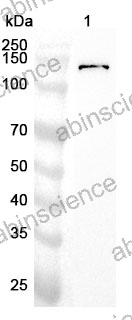
Lane 1: C2C12 cell lysate
Contáctenos para cotizaciones personalizadas, solicitudes en masa y cualquier otro problema.
Correo: [email protected]
+86-027-65523339
Edificio C, No. 666, Calle Shendunsi, Wuhan, 430206, China


