
 中文
 English
 한국어
 日本語
 Español
 Français
 Русский


| カタログ番号 | HT205025 |
|---|---|
| 説明 |
Anti-Human CD284/TLR4 Monoclonal Antibody (1A057) [1A057] (HT205025) is a mouse monoclonal antibody detecting CD284 in ELISA, IHC, WB. Suitable for Human.
Highlights
|
| 種反応性 | Human |
| アプリケーション | ELISA, IHC, WB |
| 宿主種 | Mouse |
| クローン性 | Monoclonal |
| アイソタイプ | IgG3 |
| クローンID | 1A057 |
| 免疫原 | Mammalian cells - derived recombinant Human CD284 / TLR4 (Met1-Lys631). |
| ターゲット | Toll-like receptor 4, TLR4, CD284, hToll, |
| エンドトキシンレベル | < 10 EU/mg |
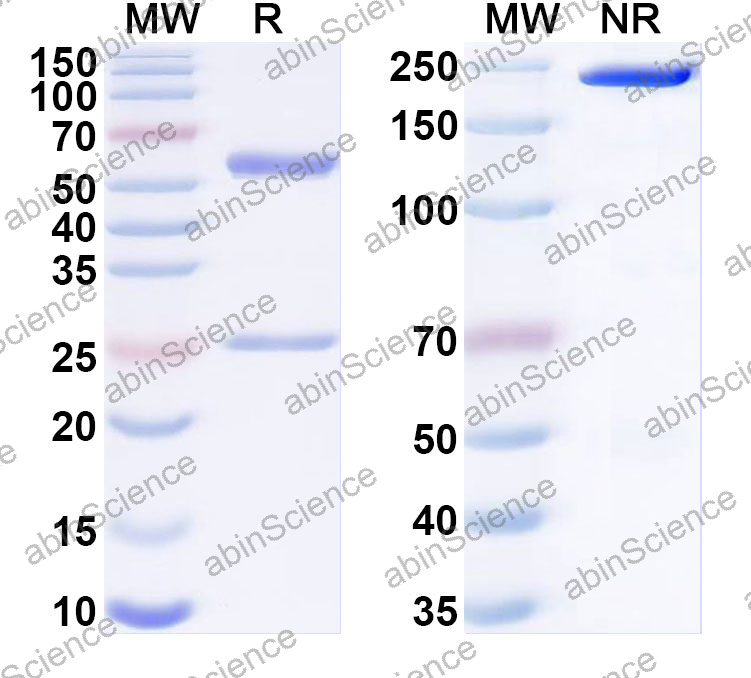
| 純度 | >95% as determined by SDS-PAGE. |
| 精製 | Protein A/G purified from cell culture supernatant. |
| 形態 | Liquid |
| 保存バッファー | 0.01M PBS pH 7.4. データシートのハードコピーまたはロット固有のCOAに記載された具体的なバッファー情報を参照してください。 |
| 安定性と保存 | Use a manual defrost freezer and avoid repeated freeze thaw cycles. Store at 2 to 8°C for frequent use. Store at -20 to -80°C for twelve months from the date of receipt. |
| 背景 | Toll-like receptor 4 (CD284/TLR4) is a ~95 kDa protein. Transmembrane receptor that functions as a pattern recognition receptor recognizing pathogen- and damage-associated molecular patterns (PAMPs and DAMPs) to induce innate immune responses via downstream signaling pathways. At the plasma membrane, cooperates with LY96 to mediate the innate immune response to bacterial lipopolysaccharide (LPS). Also involved in LPS-independent inflammatory responses triggered by free fatty acids, such as palmitate, and Ni(2+). Mechanistically, acts via MYD88, TIRAP and TRAF6, leading to NF-kappa-B activation, cytokine secretion and the inflammatory response. Alternatively, CD14-mediated TLR4 internalization via endocytosis is associated with the initiation of a MYD88-independent signaling via the TICAM1-TBK1-IRF3 axis leading to type I interferon production. 1. Arbour, NC. et al. (2000) Nature genetics 25, 187-91. PMID: 10835634 2. Bulut, Y. et al. (2005) The Journal of biological chemistry 280, 20961-7. PMID: 15809303 3. Jung, SB. et al. (2006) Infection and immunity 74, 2686-96. PMID: 16622205 4. Georgel, P. et al. (2007) Virology 362, 304-13. PMID: 17292937 5. Kim, F. et al. (2007) Circulation research 100, 1589-96. PMID: 17478729 6. Stewart, CR. et al. (2010) Nature immunology 11, 155-61. PMID: 20037584 7. Schmidt, M. et al. (2010) Nature immunology 11, 814-9. PMID: 20711192 8. Estruch, M. et al. (2013) Atherosclerosis 229, 356-62. PMID: 23880187 9. Tatematsu, M. et al. (2016) Journal of immunology (Baltimore, Md. : 1950) 196, 3865-76. PMID: 27022195 10. Xiahou, Z. et al. (2017) Nature communications 8, 950. PMID: 29038465 |
| 注意事項 | For research use only. |
SDS-PAGE for Anti-Human CD284/TLR4 Monoclonal Antibody (1A057)
+86-027-65523339
中国武漢市深敦寺路666号C棟、武漢、430206


