
 中文
 English
 한국어
 日本語
 Español
 Français
 Русский


| カタログ番号 | HY313035 |
|---|---|
| 説明 |
Anti-Human CFTR Monoclonal Antibody (1A510) [1A510] (HY313035) is a mouse monoclonal antibody detecting CFTR in ELISA, IHC, WB. Suitable for Human.
Highlights
|
| 種反応性 | Human |
| アプリケーション | ELISA, IHC, WB |
| 宿主種 | Mouse |
| クローン性 | Monoclonal |
| アイソタイプ | IgG |
| クローンID | 1A510 |
| 免疫原 | E. coli - derived recombinant human CFTR (Ile1203-Ser1426). |
| ターゲット | Cystic fibrosis transmembrane conductance regulator, CFTR, ATP-binding cassette sub-family C member 7, Channel conductance-controlling ATPase, EC:5.6.1.6, cAMP-dependent chloride channel, CFTR |
| エンドトキシンレベル | Please contact with the lab for this information. |
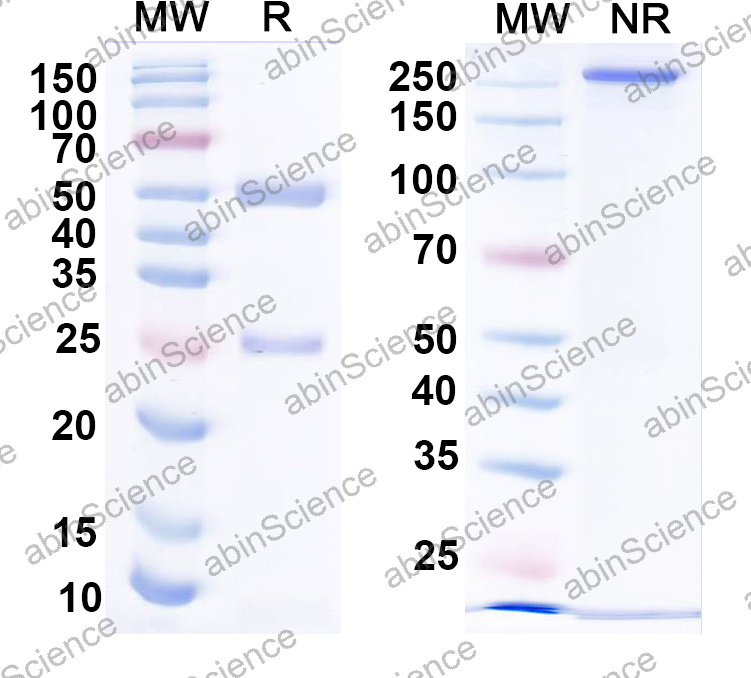
| 純度 | >95% as determined by SDS-PAGE. |
| 精製 | Protein A/G purified from cell culture supernatant. |
| アクセッション番号 | P13569 |
| 形態 | Liquid |
| 保存バッファー | 0.01M PBS pH 7.4. データシートのハードコピーまたはロット固有のCOAに記載された具体的なバッファー情報を参照してください。 |
| 安定性と保存 | Use a manual defrost freezer and avoid repeated freeze thaw cycles. Store at 2 to 8°C for frequent use. Store at -20 to -80°C for twelve months from the date of receipt. |
| 背景 | Cystic fibrosis transmembrane conductance regulator (CFTR) is a ~168 kDa protein. Epithelial ion channel that plays an important role in the regulation of epithelial ion and water transport and fluid homeostasis. Mediates the transport of chloride ions across the cell membrane. Possesses an intrinsic ATPase activity and utilizes ATP to gate its channel; the passive flow of anions through the channel is gated by cycles of ATP binding and hydrolysis by the ATP-binding domains. The ion channel is also permeable to HCO(3)(-); selectivity depends on the extracellular chloride concentration. In vitro, mediates ATP-dependent glutathione flux. 1. Shah, VS. et al. (2016) Science (New York, N.Y.) 351, 503-7. PMID: 26823428 2. Ostedgaard, LS. et al. (2000) Proceedings of the National Academy of Sciences of the United States of America 97, 5657-62. PMID: 10792060 3. Ramjeesingh, M. et al. (2001) Biochemistry 40, 10700-6. PMID: 11524016 4. Cheng, J. et al. (2002) The Journal of biological chemistry 277, 3520-9. PMID: 11707463 5. Hallows, KR. et al. (2003) American journal of physiology. Cell physiology 284, C1297-308. PMID: 12519745 6. Silvis, MR. et al. (2003) The Journal of biological chemistry 278, 11554-60. PMID: 12529365 7. Chappe, V. et al. (2003) The Journal of physiology 548, 39-52. PMID: 12588899 8. Kogan, I. et al. (2003) The EMBO journal 22, 1981-9. PMID: 12727866 9. Shcheynikov, N. et al. (2004) The Journal of biological chemistry 279, 21857-65. PMID: 15010471 10. Mense, M. et al. (2006) The EMBO journal 25, 4728-39. PMID: 17036051 |
| 注意事項 | For research use only. |
SDS-PAGE for Anti-Human CFTR Monoclonal Antibody (1A510)
お問い合わせ
+86-027-65523339
中国武漢市深敦寺路666号C棟、武漢、430206


