
 中文
中文 English
 한국어
한국어 日本語
日本語 Español
 Français
 Русский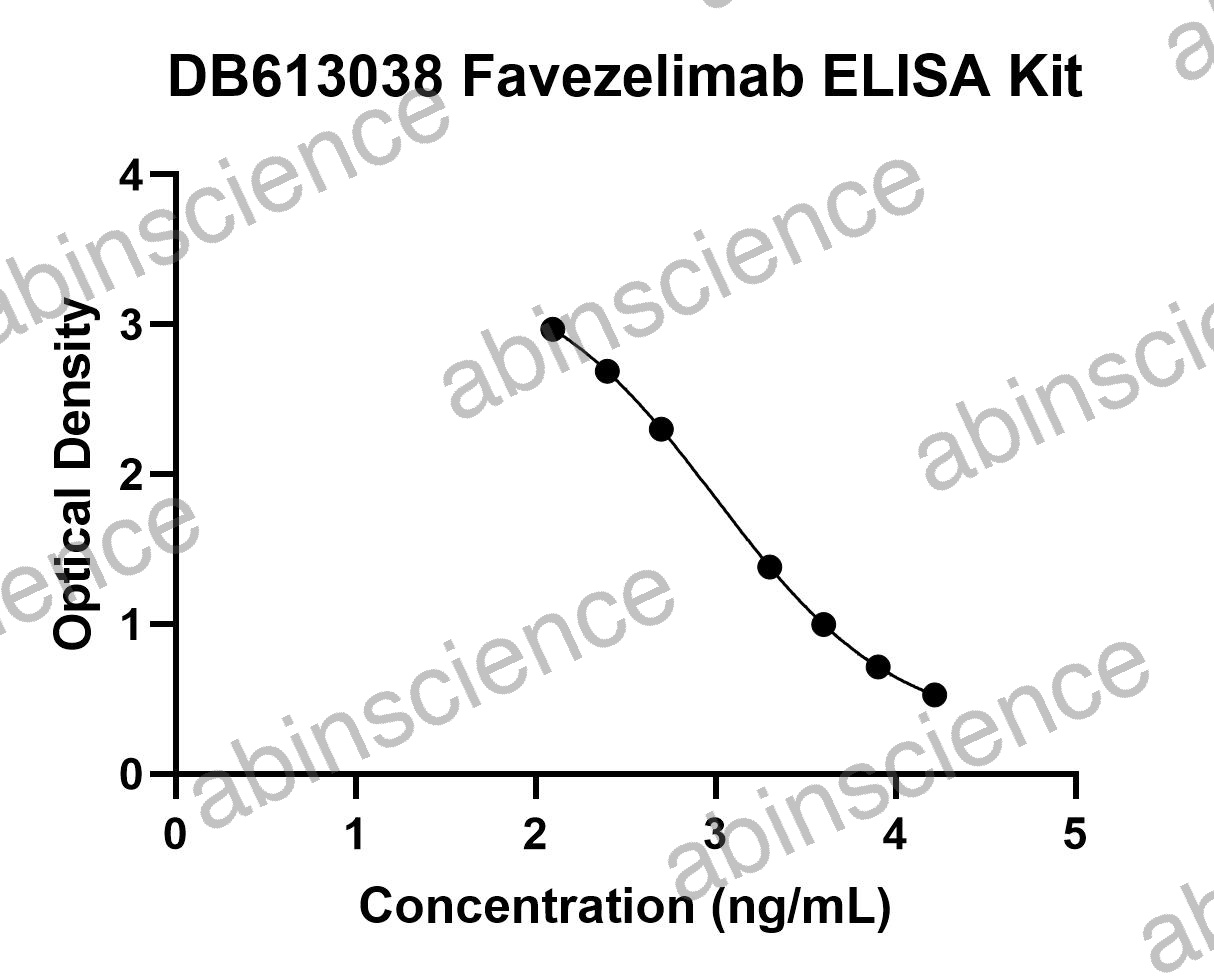
| Numéro de catalogue | DB613038 |
|---|---|
| Description |
Favezelimab ELISA Kit (DB613038) — Quantitative sandwich ELISA for Favezelimab. Sample: Plasma, Serum. Range: 0.31-5 μg/mL. Sensitivity: 0.156 μg/ml.
Highlights
|
| Type d'échantillon | Plasma, Serum |
| Sensibilité | 0.156 μg/ml |
| Plage | 0.31-5 μg/mL |
| Numéro d'accès | P18627 |
| Applications | ELISA |
| Méthode de détection | Colorimetric |
| Type de test | Quantitative |
| Retraitement | 80-120% |
| Expédition | 2-8 ℃ |
| Stabilité et stockage | The stability of ELISA kit is determined by the loss rate of activity. The loss rate of this kit is less than 10% prior to the expiration date under appropriate storage condition. |
| Spécifications | Favezelimab |
| Noms alternatifs | MK-4280, Mavezelimab (PL123) |
| Contexte | Lymphocyte activation gene 3 protein (Favezelimab) is a ~57 kDa protein. Inhibitory receptor on antigen activated T-cells. Delivers inhibitory signals upon binding to ligands, such as MHC class II, its main ligand present at the surface of antigen-presenting cells (APCs), and FGL1, which is secreted by hepatocytes and certain types of tumor cells. Ligand-binding initiates a signaling that inhibits the T-cell receptor (TCR) in the immunological synapse, preventing T-cell activation. Mechanistically, ligand-binding promotes (1) ubiquitination of the KIEELE motif, unleashing the RRFSALE motif from the membrane and (2) leading to the formation of condensates with the TCR component CD3E, thereby disrupting the association between CD3E and LCK and preventing TCR activation. May inhibit antigen-specific T-cell activation in synergy with PDCD1/PD-1. 1. Camisaschi, C. et al. (2010) Journal of immunology (Baltimore, Md. : 1950) 184, 6545-51. PMID: 20421648 2. Ming, Q. et al. (2022) Nature immunology 23, 1031-1041. PMID: 35761082 3. Huard, B. et al. (1994) European journal of immunology 24, 3216-21. PMID: 7805750 4. Huard, B. et al. (1996) European journal of immunology 26, 1180-6. PMID: 8647185 5. Wang, J. et al. (2019) Cell 176, 334-347.e12. PMID: 30580966 6. MacLachlan, BJ. et al. (2021) European journal of immunology 51, 331-341. PMID: 32920841 7. Petersen, J. et al. (2024) Science immunology 9, eads5122. PMID: 39671469 8. Huard, B. et al. (1995) European journal of immunology 25, 2718-21. PMID: 7589152 10. Jiang, Y. et al. (2025) Cell 188, 2354-2371.e18. PMID: 40101708 |
| Note | For Research Use Only. |
Standard Curve of Favezelimab ELISA Kit


Contactez-nous pour les devis personnalisés, les demandes en gros et tout autre problème.
Courrier : [email protected]
+86-027-65523339
Bâtiment C, No. 666, Rue Shendunsi, Wuhan, 430206, Chine


