
 中文
中文 English
 한국어
한국어 日本語
日本語 Español
 Français
 Русский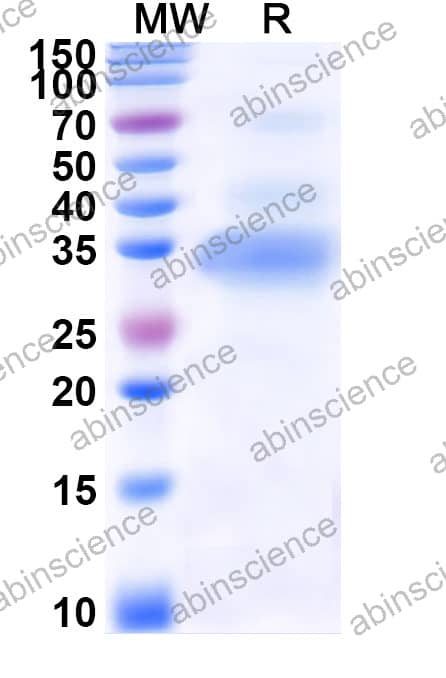
| Número de catálogo | HV480011 |
|---|---|
| Descripción |
Recombinant Human CD270/TNFRSF14 Protein, C-His (HV480011) expressed in Mammalian Cells, spanning Met1-Val202. Purity: >90% by SDS-PAGE.
Highlights
|
| Sistema de expresión | Mammalian cells |
| Número de acceso | Q92956 |
| Longitud de proteína | Met1-Val202 |
| Aplicaciones | ELISA, Immunogen, SDS-PAGE, WB, Bioactivity testing in progress |
| Especies | Homo sapiens (Human) |
| Naturaleza | Recombinant |
| Nivel de endotoxinas | Please contact with the lab for this information. |
| Pureza | >90% as determined by SDS-PAGE. |
| Peso molecular predicho | 22.51 kDa |
| Forma | Lyophilized |
| Buffer de almacenamiento | Lyophilized from a solution in PBS pH 7.4, 1 mM EDTA, 4% Trehalose, 1% Mannitol. Consulte la información específica del buffer en la copia impresa del datasheet o en el COA específico del lote. |
| Reconstitución | Reconstitute in sterile water for a stock solution. Adjust the volume of sterile water so that, after reconstitution, the final stock concentration matches the value indicated on the product label or datasheet. RECONSTITUTION PROTOCOL 1. Allow the product to be reconstituted and the reconstitution diluent to reach room temperature. 2. Tap or briefly centrifuge the product vial before opening to dislodge any lyophilized material that may be dispersed on the wall or cap of the vial. 3. Use the diluent and stock concentration recommended in the product datasheet. If preparing a stock concentration higher than recommended, contact Technical Service. 4. After adding the diluent, re-cap the vial and invert gently by hand or place on a slow rocking platform to allow the reconstitution diluent to coat all the surfaces inside the vial. Note: Do not mix by vortexing or by pipetting the material up and down. 5. Allow the vial to sit at room temperature with gentle agitation for at least 15 minutes before aliquotting or using. 6. Store the reconstituted material in single use aliquots in polypropylene or siliconized tubes. Aliquots of 10 μL or larger are recommended. |
| Envío | In general, proteins are provided as lyophilized powder/frozen liquid. They are shipped out with dry ice/blue ice unless customers require otherwise. |
| Estabilidad y almacenamiento | Use a manual defrost freezer and avoid repeated freeze thaw cycles. Store at 2 to 8°C for frequent use. Store at -20 to -80°C for twelve months from the date of receipt. |
| Nombres alternativos | HVEA, HVEM, Herpes virus entry mediator A, Tumor necrosis factor receptor superfamily member 14, Tumor necrosis factor receptor-like 2, HveA, TNFRSF14, CD270, TR2, Herpesvirus entry mediator A |
| Fondo | Tumor necrosis factor receptor superfamily member 14 (CD270/TNFRSF14) is a ~30 kDa protein. Receptor for four distinct ligands: The TNF superfamily members TNFSF14/LIGHT and homotrimeric LTA/lymphotoxin-alpha and the immunoglobulin superfamily members BTLA and CD160, altogether defining a complex stimulatory and inhibitory signaling network. Signals via the TRAF2-TRAF3 E3 ligase pathway to promote immune cell survival and differentiation. Participates in bidirectional cell-cell contact signaling between antigen presenting cells and lymphocytes. In response to ligation of TNFSF14/LIGHT, delivers costimulatory signals to T cells, promoting cell proliferation and effector functions. Interacts with CD160 on NK cells, enhancing IFNG production and anti-tumor immune response. 1. Tamada, K. et al. (2000) Journal of immunology (Baltimore, Md. : 1950) 164, 4105-10. PMID: 10754304 2. Cai, G. et al. (2008) Nature immunology 9, 176-85. PMID: 18193050 3. Šedý, JR. et al. (2013) Journal of immunology (Baltimore, Md. : 1950) 191, 828-36. PMID: 23761635 4. Mauri, DN. et al. (1998) Immunity 8, 21-30. PMID: 9462508 5. Cheung, TC. et al. (2009) Journal of immunology (Baltimore, Md. : 1950) 183, 7286-96. PMID: 19915044 6. Hsu, H. et al. (1997) The Journal of biological chemistry 272, 13471-4. PMID: 9153189 7. Marsters, SA. et al. (1997) The Journal of biological chemistry 272, 14029-32. PMID: 9162022 |
| Nota | For research use only. |
SDS-PAGE for Recombinant Human CD270/TNFRSF14 Protein, C-His
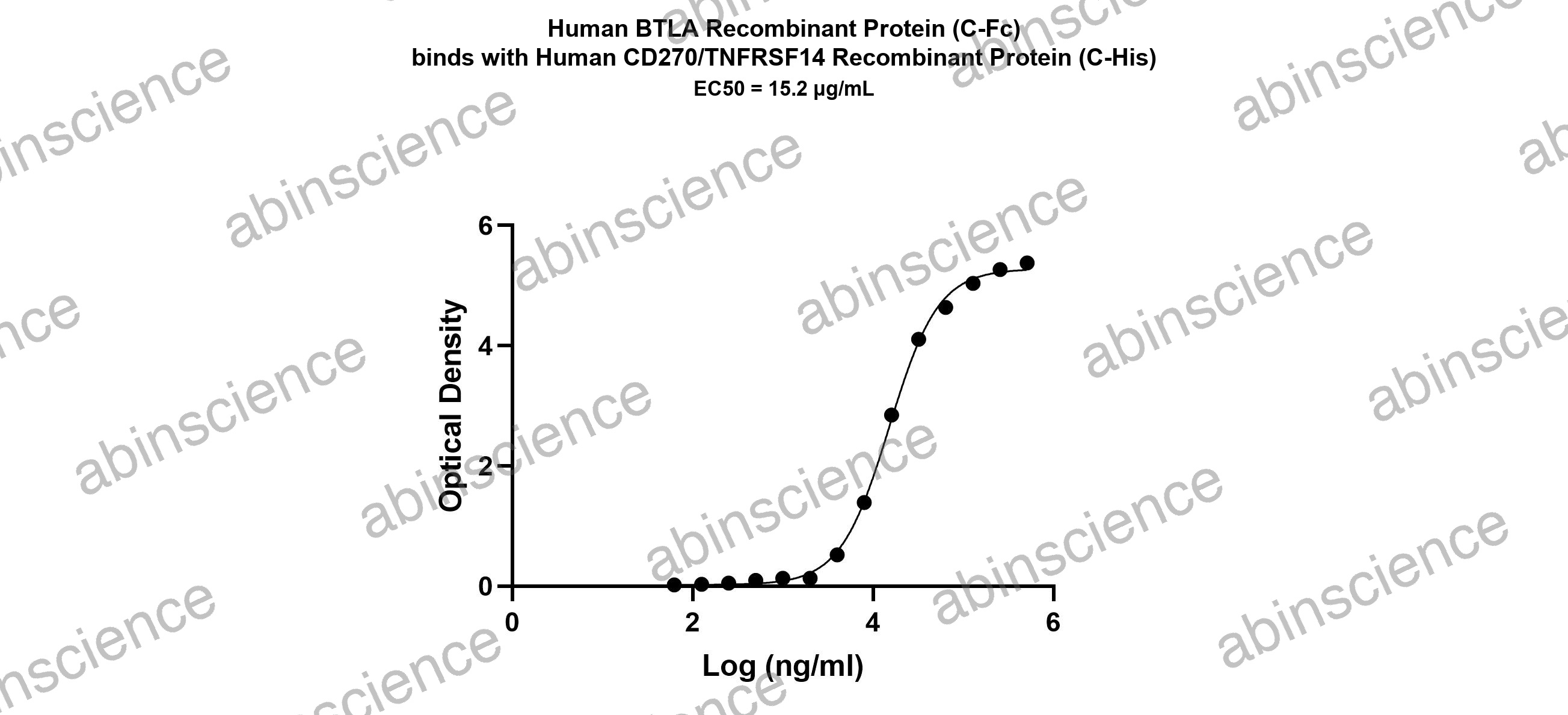
Immobilized HV375021 Human BTLA Recombinant Protein (C-Fc) at 2 μg/mL(100 μL/well) can bind HV480011 Human CD270/TNFRSF14 Recombinant Protein (C-His), the EC 50 is 15.2 μg/mL.


Contáctenos para cotizaciones personalizadas, solicitudes en masa y cualquier otro problema.
Correo: [email protected]
+86-027-65523339
Edificio C, No. 666, Calle Shendunsi, Wuhan, 430206, China


