
 中文
中文 English
 한국어
한국어 日本語
日本語 Español
 Français
 Русский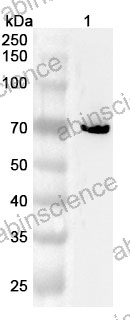

| Numéro de catalogue | HC385012 |
|---|---|
| Description |
Recombinant Human STK3 Protein, N-His (HC385012) expressed in E. coli, spanning Ser15-Asn280. Purity: >90% by SDS-PAGE.
Highlights
|
| Système d'expression | E. coli |
| Numéro d'accès | Q13188 |
| Longueur de protéine | Ser15-Asn280 |
| Applications | ELISA, Immunogen, SDS-PAGE, WB, Bioactivity testing in progress |
| Espèces | Homo sapiens (Human) |
| Nature | Recombinant |
| Niveau d'endotoxines | Please contact with the lab for this information. |
| Pureté | >90% as determined by SDS-PAGE. |
| Masse moléculaire prédite | 32.32 kDa |
| Forme | Lyophilized |
| Tampon de stockage | Lyophilized from a solution in PBS pH 7.4, 0.02% NLS, 1 mM EDTA, 4% Trehalose, 1% Mannitol. Reférez-vous aux informations spécifiques sur le tampon dans la copie papier du datasheet ou dans le COA spécifique au lot. |
| Reconstitution | Reconstitute in sterile water for a stock solution. Adjust the volume of sterile water so that, after reconstitution, the final stock concentration matches the value indicated on the product label or datasheet. RECONSTITUTION PROTOCOL 1. Allow the product to be reconstituted and the reconstitution diluent to reach room temperature. 2. Tap or briefly centrifuge the product vial before opening to dislodge any lyophilized material that may be dispersed on the wall or cap of the vial. 3. Use the diluent and stock concentration recommended in the product datasheet. If preparing a stock concentration higher than recommended, contact Technical Service. 4. After adding the diluent, re-cap the vial and invert gently by hand or place on a slow rocking platform to allow the reconstitution diluent to coat all the surfaces inside the vial. Note: Do not mix by vortexing or by pipetting the material up and down. 5. Allow the vial to sit at room temperature with gentle agitation for at least 15 minutes before aliquotting or using. 6. Store the reconstituted material in single use aliquots in polypropylene or siliconized tubes. Aliquots of 10 μL or larger are recommended. |
| Expédition | In general, proteins are provided as lyophilized powder/frozen liquid. They are shipped out with dry ice/blue ice unless customers require otherwise. |
| Stabilité et stockage | Use a manual defrost freezer and avoid repeated freeze thaw cycles. Store at 2 to 8°C for frequent use. Store at -20 to -80°C for twelve months from the date of receipt. |
| Noms alternatifs | STK3, MST2/N, MST-2, STE20-like kinase MST2, Mammalian STE20-like protein kinase 2, Serine/threonine-protein kinase Krs-1, Serine/threonine-protein kinase 3, KRS1, MST2, MST2/C |
| Contexte | Serine/threonine-protein kinase 3 (STK3) is a ~56 kDa protein. Stress-activated, pro-apoptotic kinase which, following caspase-cleavage, enters the nucleus and induces chromatin condensation followed by internucleosomal DNA fragmentation. Key component of the Hippo signaling pathway which plays a pivotal role in organ size control and tumor suppression by restricting proliferation and promoting apoptosis. The core of this pathway is composed of a kinase cascade wherein STK3/MST2 and STK4/MST1, in complex with its regulatory protein SAV1, phosphorylates and activates LATS1/2 in complex with its regulatory protein MOB1, which in turn phosphorylates and inactivates YAP1 oncoprotein and WWTR1/TAZ. Phosphorylation of YAP1 by LATS2 inhibits its translocation into the nucleus to regulate cellular genes important for cell proliferation, cell death, and cell migration. STK3/MST2 and STK4/MST1 are required to repress proliferation of mature hepatocytes, to prevent activation of facultative adult liver stem cells (oval cells), and to inhibit tumor formation. 1. Lee, KK. et al. (2001) The Journal of biological chemistry 276, 19276-85. PMID: 11278283 2. Creasy, CL. et al. (1995) Gene 167, 303-6. PMID: 8566796 3. Taylor, LK. et al. (1996) Proceedings of the National Academy of Sciences of the United States of America 93, 10099-104. PMID: 8816758 4. Chan, EH. et al. (2005) Oncogene 24, 2076-86. PMID: 15688006 5. Callus, BA. et al. (2006) The FEBS journal 273, 4264-76. PMID: 16930133 6. Ni, L. et al. (2013) Structure (London, England : 1993) 21, 1757-68. PMID: 23972470 7. Kwan, J. et al. (2016) Genes & development 30, 2696-2709. PMID: 28087714 8. Bae, SJ. et al. (2017) eLife 6. PMID: 29063833 9. Tang, Y. et al. (2019) Cell discovery 5, 3. PMID: 30622739 |
| Note | For research use only. |
SDS-PAGE for Recombinant Human STK3 Protein, N-His
Contactez-nous pour les devis personnalisés, les demandes en gros et tout autre problème.
Courrier : [email protected]
+86-027-65523339
Bâtiment C, No. 666, Rue Shendunsi, Wuhan, 430206, Chine


