
 中文
中文 English
 한국어
한국어 日本語
日本語 Español
 Français
 Русский
| Catalog No. | HC385014 | ||||||||
|---|---|---|---|---|---|---|---|---|---|
| Species reactivity | Human, Mouse, Rat | ||||||||
| Applications | ELISA, IHC, WB | ||||||||
| Host species | Rabbit | ||||||||
| Clonality | Polyclonal | ||||||||
| Isotype | IgG | ||||||||
| Immunogen | E. coli - derived recombinant Human STK3 (Ser15-Asn280). | ||||||||
| Target | STK3, MST2/N, MST-2, STE20-like kinase MST2, Mammalian STE20-like protein kinase 2, Serine/threonine-protein kinase Krs-1, Serine/threonine-protein kinase 3, KRS1, MST2, MST2/C | ||||||||
| Purification | Purified by antigen affinity column. | ||||||||
| Accession | Q13188 | ||||||||
| Form | Liquid | ||||||||
| Storage buffer | 0.01M PBS, pH 7.4, 50% Glycerol, 0.05% Proclin 300. Please refer to the specific buffer information in the hardcopy of datasheet or the lot-specific COA. |
||||||||
| Product Usage Information |
| ||||||||
| Stability and Storage | Use a manual defrost freezer and avoid repeated freeze thaw cycles. Store at 2 to 8°C for frequent use. Store at -20 to -80°C for twelve months from the date of receipt. | ||||||||
| Background | Serine/threonine-protein kinase 3 (STK3) is a ~56 kDa protein. Stress-activated, pro-apoptotic kinase which, following caspase-cleavage, enters the nucleus and induces chromatin condensation followed by internucleosomal DNA fragmentation. Key component of the Hippo signaling pathway which plays a pivotal role in organ size control and tumor suppression by restricting proliferation and promoting apoptosis. The core of this pathway is composed of a kinase cascade wherein STK3/MST2 and STK4/MST1, in complex with its regulatory protein SAV1, phosphorylates and activates LATS1/2 in complex with its regulatory protein MOB1, which in turn phosphorylates and inactivates YAP1 oncoprotein and WWTR1/TAZ. Phosphorylation of YAP1 by LATS2 inhibits its translocation into the nucleus to regulate cellular genes important for cell proliferation, cell death, and cell migration. STK3/MST2 and STK4/MST1 are required to repress proliferation of mature hepatocytes, to prevent activation of facultative adult liver stem cells (oval cells), and to inhibit tumor formation. 1. Lee, KK. et al. (2001) The Journal of biological chemistry 276, 19276-85. PMID: 11278283 2. Creasy, CL. et al. (1995) Gene 167, 303-6. PMID: 8566796 3. Taylor, LK. et al. (1996) Proceedings of the National Academy of Sciences of the United States of America 93, 10099-104. PMID: 8816758 4. Chan, EH. et al. (2005) Oncogene 24, 2076-86. PMID: 15688006 5. Callus, BA. et al. (2006) The FEBS journal 273, 4264-76. PMID: 16930133 6. Ni, L. et al. (2013) Structure (London, England : 1993) 21, 1757-68. PMID: 23972470 7. Kwan, J. et al. (2016) Genes & development 30, 2696-2709. PMID: 28087714 8. Bae, SJ. et al. (2017) eLife 6. PMID: 29063833 9. Tang, Y. et al. (2019) Cell discovery 5, 3. PMID: 30622739 | ||||||||
| Note | For research use only. |
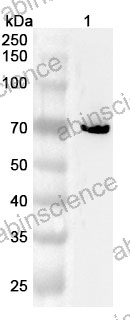
Lane 1: Mouse brain lysate
Contact us for custom quotes, bulk requests and any other issues.
Mail: [email protected]
+86-27-65523339
Building C, No. 666, Shen Dun Si Lu, Wuhan, 430206, China


