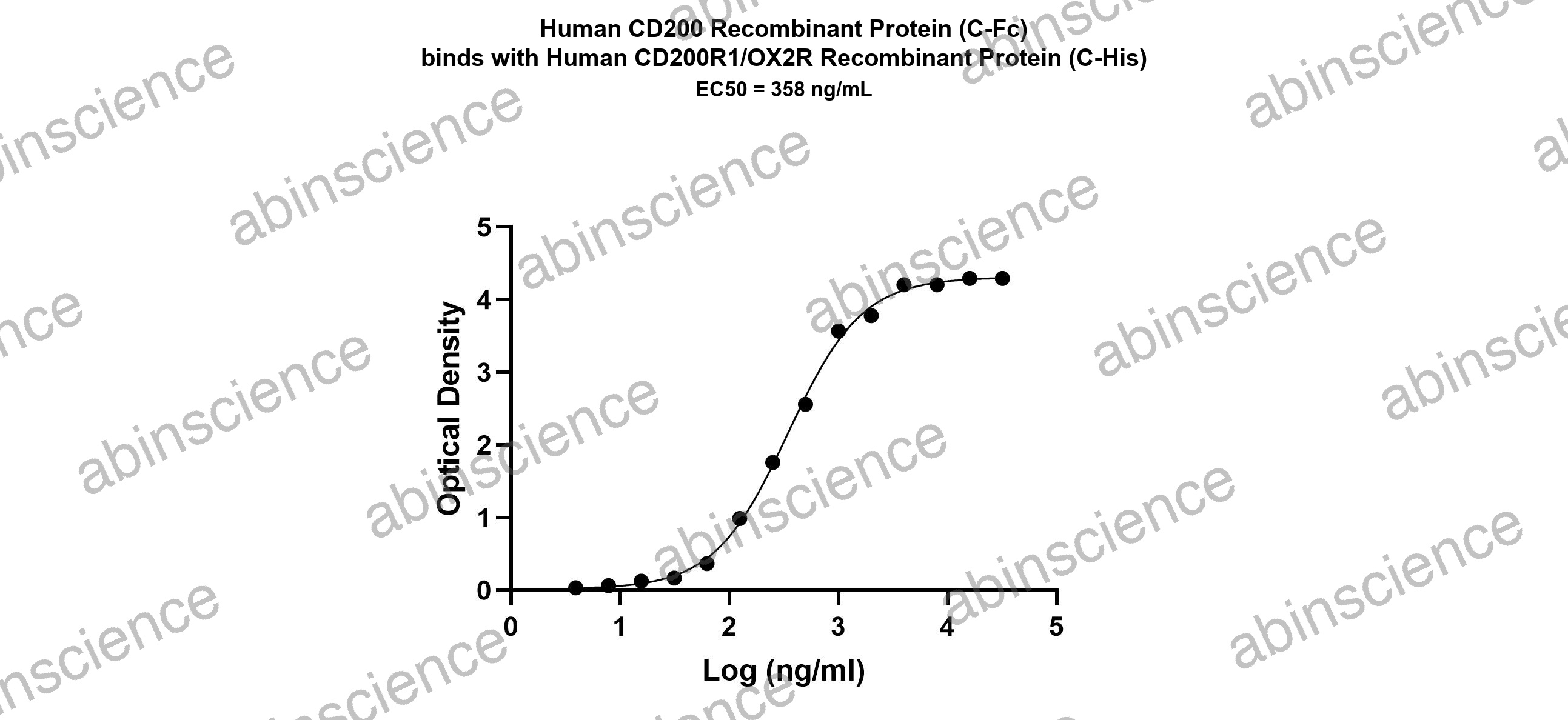
CD200R1 (OX2R / MOX2R) is an inhibitory receptor expressed on myeloid cells — including macrophages, dendritic cells, and microglia — that delivers an immune-suppressive signal upon engagement by its ligand CD200 (OX-2). The CD200/CD200R1 axis functions as a myeloid immune checkpoint, distinct from the PD-1/PD-L1 and CTLA-4 T-cell checkpoints, making it an emerging therapeutic target in immuno-oncology and neuroinflammation. abinScience offers recombinant CD200R1 and CD200 proteins, anti-CD200R1 antibodies, and ELISA kits.
CD200R1 Biology and Therapeutic Relevance
CD200R1 is a ~35 kDa type I transmembrane glycoprotein of the immunoglobulin superfamily. It is selectively expressed on myeloid lineage cells — monocytes, macrophages, dendritic cells, mast cells, and microglia — as well as on some T-cell subsets. Its ligand CD200 is broadly expressed on neurons, endothelial cells, and tumor cells. CD200R1 lacks an ITIM motif; instead, it signals through a unique NPxY phosphotyrosine motif that recruits the adaptor proteins Dok1/Dok2 and the Ras-GAP, leading to suppression of MAPK/ERK signaling and inhibition of myeloid cell activation.
In the tumor microenvironment, CD200 overexpression on tumor cells engages CD200R1 on tumor-associated macrophages (TAMs), promoting an immunosuppressive M2-like phenotype and suppressing anti-tumor myeloid activation. Blocking the CD200/CD200R1 axis with anti-CD200 or anti-CD200R1 antibodies can reprogram TAMs toward a pro-inflammatory M1 phenotype, enhancing anti-tumor immunity. In the CNS, the CD200/CD200R1 interaction maintains microglial quiescence — disruption of this axis is implicated in Alzheimer's disease, Parkinson's disease, and neuroinflammatory disorders.
Key Research Applications
Myeloid Checkpoint Drug Discovery Recombinant CD200R1 and CD200 proteins for screening anti-CD200R1 blocking antibodies by SPR/BLI, competitive ELISA, and myeloid cell-based activation assays. A next-generation checkpoint approach complementary to PD-1/CTLA-4 blockade.
TAM Reprogramming Studies Anti-CD200R1 blocking antibodies and CD200-Fc proteins for studying macrophage polarization (M1/M2 switching), cytokine release (TNF-α, IL-12, IL-10), and phagocytosis in co-culture assays with tumor cells.
Neuroinflammation Research Anti-CD200R1 and anti-CD200 antibodies for studying microglial activation in neurodegenerative disease models. CD200R1 expression on microglia is a key indicator of microglial quiescence vs activation state.
Flow Cytometry & Myeloid Profiling Anti-CD200R1 antibodies for identifying and characterizing CD200R1⁺ myeloid populations (macrophages, DCs, microglia) in tumor tissue, blood, and CNS samples by multi-color flow cytometry.
CD200R1 Product Selection Guide
| Application |
Recommended Product |
Format |
| SPR/BLI binding kinetics |
Recombinant CD200R1 protein |
Avi-tagged or biotinylated |
| CD200/CD200R1 blocking assay |
CD200R1-Fc + CD200 protein |
Fc-chimera |
| Macrophage activation assay |
Anti-CD200R1 blocking antibody |
Unconjugated, low endotoxin |
| Macrophage suppression (agonist) |
Recombinant CD200-Fc protein |
Fc-chimera (bivalent) |
| Flow cytometry / myeloid profiling |
Anti-CD200R1 antibody |
PE or APC conjugated |
| IHC / microglial staining |
Anti-CD200R1 monoclonal antibody |
Unconjugated |
| CD200R1 ELISA / quantification |
CD200R1 ELISA kit |
Sandwich ELISA |
CD200R1 FAQs
What is the difference between CD200 and CD200R1?
CD200 (OX-2) is the ligand — a broadly expressed transmembrane protein found on neurons, endothelial cells, B cells, and tumor cells. CD200R1 (OX-2R) is the receptor — selectively expressed on myeloid cells (macrophages, DCs, microglia). CD200 binding to CD200R1 delivers an inhibitory signal to the myeloid cell, suppressing activation. For checkpoint blockade in oncology, the therapeutic approach is typically to block CD200R1 (or CD200) with an antibody, preventing CD200-mediated immunosuppression of tumor-associated macrophages.
How does the CD200/CD200R1 axis differ from PD-1/PD-L1?
PD-1/PD-L1 is a T-cell checkpoint — it suppresses effector T-cell function. CD200/CD200R1 is a myeloid checkpoint — it suppresses macrophage, DC, and microglial activation. The two axes regulate different arms of the immune system. In tumors with heavy myeloid infiltration (e.g., glioblastoma, pancreatic cancer), targeting the CD200/CD200R1 axis may be more effective than PD-1 blockade alone. Combination strategies targeting both T-cell and myeloid checkpoints are under active investigation.
What about CD200R1L (CD200RLa/b)?
Mice express additional CD200R family members (CD200R2/R3/R4, also called CD200RLa-d) that do not exist in humans. These mouse-specific receptors bind different ligands and have activating rather than inhibitory functions. Only CD200R1 is conserved between human and mouse and functions as the inhibitory receptor for CD200. When designing preclinical studies, ensure your anti-CD200R1 antibody is specific to CD200R1 and does not cross-react with the mouse-specific CD200R family members.
How do I measure CD200R1 signaling in macrophages?
The most common functional readout is cytokine release from stimulated macrophages. Activate macrophages with LPS or IFN-γ in the presence or absence of CD200-Fc protein (agonist) or anti-CD200R1 blocking antibody. Measure TNF-α, IL-6, and IL-12 (suppressed by CD200R1 engagement) and IL-10 (may be enhanced) by ELISA or multiplex assay. You can also assess phagocytosis, ROS production, or NO release as functional readouts of myeloid activation state.
Why is CD200/CD200R1 relevant to neuroinflammation?
Neurons constitutively express CD200, which engages CD200R1 on microglia to maintain them in a resting surveillance state. Loss of neuronal CD200 (as occurs in neurodegeneration) or downregulation of microglial CD200R1 leads to uncontrolled microglial activation and chronic neuroinflammation. Reduced CD200R1 expression on microglia has been reported in Alzheimer's disease, Parkinson's disease, and multiple sclerosis brain tissue. CD200-Fc agonist protein is used in preclinical models to suppress neuroinflammation.
Key References
1. Hoek RM, et al. (2000) Down-regulation of the macrophage lineage through interaction with OX2 (CD200). Science. 290(5497):1768-1771. PMID: 11099416
2. Gorczynski RM. (2012) CD200:CD200R-mediated regulation of immunity. ISRN Immunol. 2012:682168. DOI: 10.5402/2012/682168
3. Walker DG, et al. (2009) Decreased expression of CD200 and CD200 receptor in Alzheimer's disease: a potential mechanism leading to chronic inflammation. Exp Neurol. 215(1):5-19. PMID: 18938162


 中文
中文 English
 한국어
한국어 日本語
日本語 Español
 Français
 Русский