Prostate cancer is the second most diagnosed malignancy and the fifth leading cause of cancer death in men globally. Androgen receptor (AR) signaling drives disease initiation and progression, and androgen deprivation therapy (ADT) remains the backbone of systemic treatment. However, progression to castration-resistant prostate cancer (CRPC) involves AR amplification, splice variant expression (AR-V7), and activation of bypass pathways including PI3K-AKT. Emerging therapies include PARP inhibitors for BRCA1/2-mutant tumors, PSMA-targeted radioligand therapy (¹⁷⁷Lu-PSMA-617), and next-generation AR pathway inhibitors (enzalutamide, apalutamide, darolutamide).
Research Use Only (RUO)Not intended for diagnostic or therapeutic procedures.
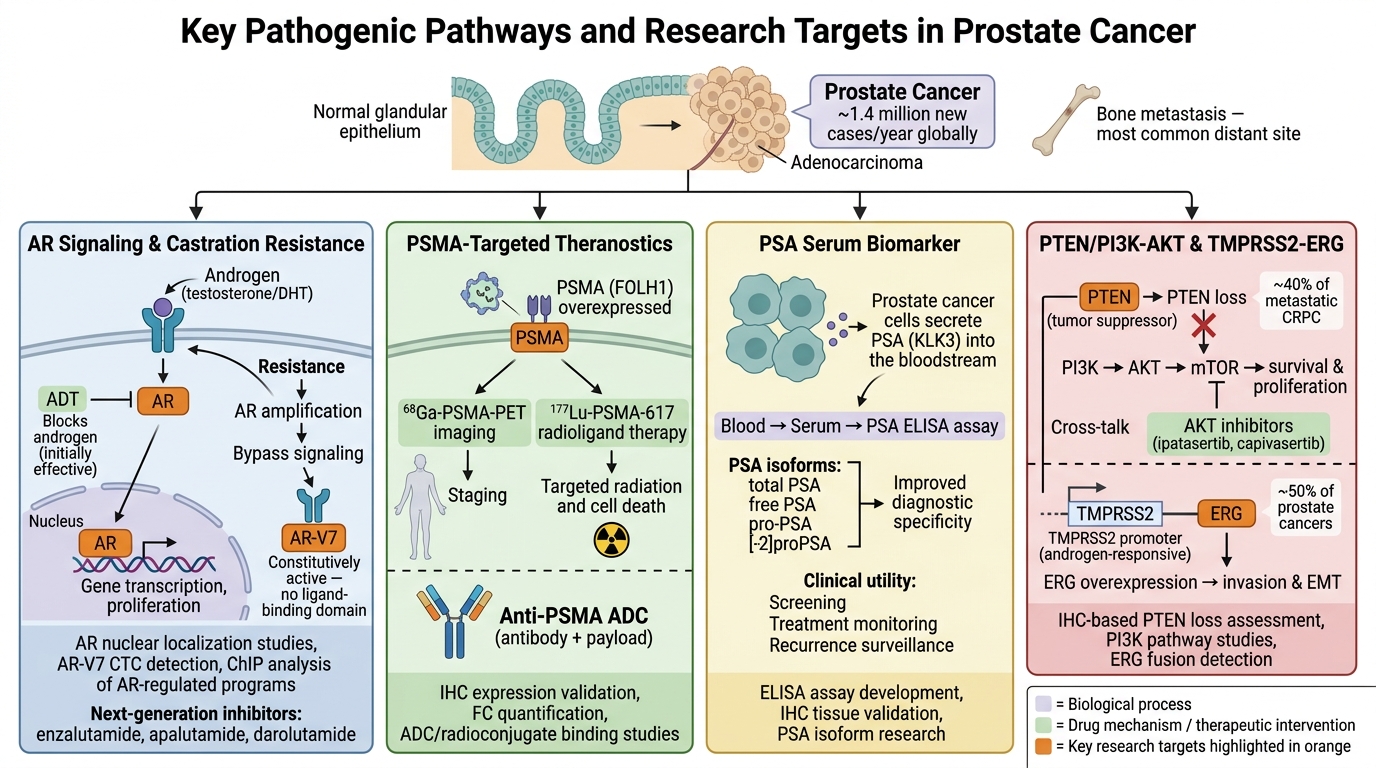
Fig. 1 Key pathogenic pathways and research targets in prostate cancer. AR signaling & castration resistance, PSMA-targeted theranostics, PSA serum biomarker, and PTEN/PI3K-AKT pathway. abinScience product targets highlighted in orange.
abinScience provides validated antibodies, recombinant proteins, and ELISA kits for key prostate cancer research targets. All products are manufactured by our parent company AtaGenix Laboratories under ISO quality systems. Browse products below or contact us for custom antibody development.
Androgen Receptor (AR) — The androgen receptor is the central oncogenic driver in prostate cancer. AR splice variants — particularly AR-V7 — mediate resistance to enzalutamide and abiraterone and serve as a treatment-specific biomarker in circulating tumor cells. Anti-AR antibodies enable nuclear localization studies, AR-V7 detection for therapy selection research, and chromatin immunoprecipitation analysis of AR-regulated gene programs.
→ Browse AR antibodies & proteins
PSMA (FOLH1) — Prostate-specific membrane antigen is highly overexpressed on prostate cancer cells and represents the target for both PET imaging (⁶⁸Ga-PSMA) and radioligand therapy (¹⁷⁷Lu-PSMA-617), establishing a theranostic paradigm unique to prostate cancer. Anti-PSMA antibodies support IHC expression validation, flow cytometric quantification, and ADC/radioconjugate binding studies.
→ Browse PSMA antibodies & proteins
PSA (KLK3) — Prostate-specific antigen remains the most widely used serum biomarker for prostate cancer screening and treatment monitoring. Anti-PSA antibodies and recombinant PSA proteins support ELISA assay development, IHC tissue validation, and research into PSA isoforms (free PSA, pro-PSA, [-2]proPSA) for improved diagnostic specificity.
→ Browse PSA antibodies & proteins
PTEN — PTEN loss occurs in approximately 40% of metastatic CRPC and activates PI3K-AKT signaling. PTEN status serves as a key biomarker for AKT inhibitor sensitivity (e.g., ipatasertib, capivasertib) and is associated with AR pathway cross-talk. Anti-PTEN antibodies enable IHC-based loss assessment and PI3K pathway activation studies.
→ Browse PTEN antibodies & proteins
TMPRSS2-ERG — The TMPRSS2-ERG gene fusion is present in approximately 50% of prostate cancers and represents the most frequent genomic alteration in this malignancy. ERG overexpression driven by the androgen-responsive TMPRSS2 promoter contributes to invasion and epithelial-mesenchymal transition. Anti-ERG antibodies enable IHC-based fusion detection as a surrogate for molecular testing, and support research into ERG-driven transcriptional programs.
→ Browse ERG antibodies & proteins
1. Sartor O, de Bono J, Chi KN, et al. Lutetium-177–PSMA-617 for metastatic castration-resistant prostate cancer. N Engl J Med. 2021;385(12):1091-1103. DOI
2. de Bono J, Mateo J, Fizazi K, et al. Olaparib for metastatic castration-resistant prostate cancer. N Engl J Med. 2020;382(22):2091-2102. DOI
3. The Cancer Genome Atlas Research Network. The molecular taxonomy of primary prostate cancer. Cell. 2015;163(4):1011-1025. DOI
4. Scher HI, Lu D, Schreiber NA, et al. Association of AR-V7 on circulating tumor cells as a treatment-specific biomarker with efficacy of abiraterone and enzalutamide in men with prostate cancer. JAMA Oncol. 2016;2(11):1441-1449. DOI
5. Tomlins SA, Rhodes DR, Perner S, et al. Recurrent fusion of TMPRSS2 and ETS transcription factor genes in prostate cancer. Science. 2005;310(5748):644-648. DOI
Human
ELISA, FCM, Neutralization
Human
IgG1, kappa
Iv0158
Human
FCM
Human
IgG1
J591
Human
ELISA, Bioactivity: FACS, Functional assay, Research in vivo
Human
IgG1-kappa
Human
ELISA, Bioactivity: FACS, Functional assay, Research in vivo
Human
IgG1-scFv-CH/G1-kappa
Human
ELISA, Bioactivity: FACS, Functional assay, Research in vivo
Human
Ig(G4-kappa_G4-lambda)
Human
ELISA, Bioactivity: FACS, Functional assay, Research in vivo
Human
(scFv-heavy-kappa)-(scFv-heavy-lambda)-scFc
Human
ELISA, Bioactivity: FACS, Functional assay, Research in vivo
Human
IgG1-Kappa
Human
ELISA, Bioactivity: FACS, Functional assay, Research in vivo
Human
IgG1-kappa
Human
ELISA, Bioactivity: FACS, Functional assay, Research in vivo
Human
IgG1-kappa
Human, Mouse, Rat
IHC, WB
Mouse
IgG2a, kappa
N357/6