Please ensure Javascript is enabled for purposes of website accessibility
Home > Research Area > Neuroscience > Parkinson's disease

Parkinson’s Disease Research Reagents

Parkinson’s disease (PD) is the second most common neurodegenerative disorder, characterized by dopaminergic neuron loss in the substantia nigra and intracellular α-synuclein aggregation (Lewy bodies). Current therapeutic strategies target LRRK2 kinase inhibition, GBA modulation, and α-synuclein immunotherapy — requiring validated research reagents for biomarker development, target validation, and disease mechanism studies.

Research Use Only (RUO)Not intended for diagnostic or therapeutic procedures.

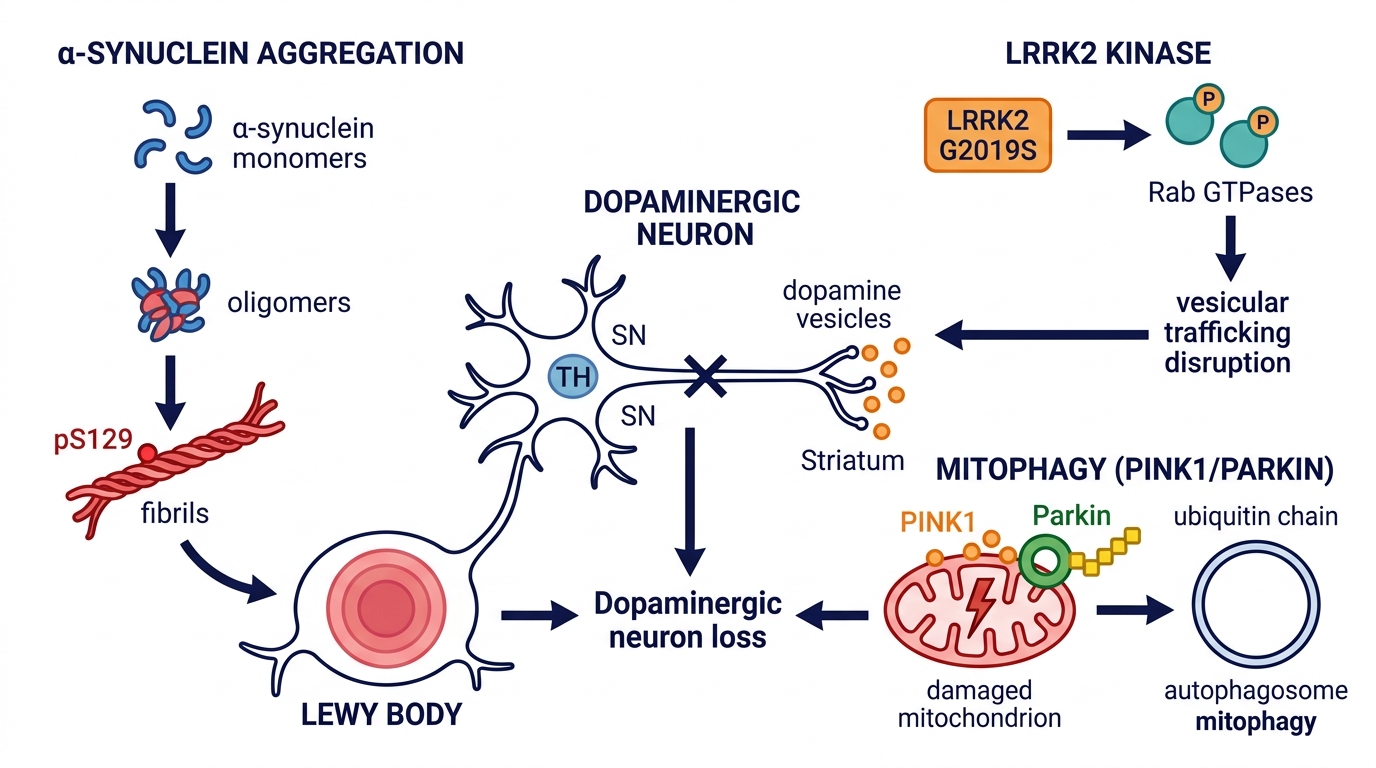
Parkinson’s Disease Research Reagents - key pathogenic pathways and research targets

Fig. 1 Key pathogenic pathways and research targets. abinScience product targets highlighted in orange.

abinScience provides validated antibodies, recombinant proteins, and ELISA kits for key Parkinson’s disease research targets. All products are manufactured by our parent company AtaGenix Laboratories under ISO quality systems. Browse products below or contact us for custom antibody development.

Key Research Targets

α-Synuclein (SNCA) — Misfolded α-synuclein aggregates into Lewy bodies and propagates prion-like across neurons. Anti-α-synuclein antibodies support seed amplification assay (SAA) development, IHC Lewy body staging, and anti-synuclein immunotherapy research (prasinezumab, cinpanemab).
→ Browse α-synuclein antibodies & proteins

LRRK2 — LRRK2 G2019S is the most common genetic cause of familial PD, with gain-of-function kinase activity driving lysosomal dysfunction and neuroinflammation. Anti-LRRK2 antibodies and recombinant LRRK2 proteins enable kinase activity measurement and inhibitor screening.
→ Browse LRRK2 antibodies & proteins

PINK1 & Parkin (PRKN) — PINK1/Parkin-mediated mitophagy is impaired in autosomal recessive PD. Anti-PINK1 and anti-Parkin antibodies support mitochondrial quality control research, ubiquitin phosphorylation assays, and mitophagy pathway studies.
→ Browse PINK1/Parkin antibodies

GBA/GCase — GBA1 mutations are the strongest genetic risk factor for sporadic PD, reducing glucocerebrosidase (GCase) activity and promoting α-synuclein accumulation. Anti-GBA antibodies and recombinant GCase proteins support enzyme activity assays and substrate reduction therapy research.
→ Browse GBA/GCase antibodies & proteins

Tyrosine Hydroxylase (TH) — TH is the rate-limiting enzyme in dopamine biosynthesis and the standard marker for dopaminergic neuron survival in PD models. Anti-TH antibodies are essential for IHC quantification of substantia nigra neuron loss in preclinical studies.

References

1. Bloem BR, Okun MS, Klein C. Parkinson’s disease. Lancet. 2021;397(10291):2284-2303. DOI

2. Siderowf A, et al. Assessment of heterogeneity among participants in the Parkinson’s Progression Markers Initiative cohort using α-synuclein seed amplification. JAMA Neurol. 2023;80(4):407-414. DOI

3. Deniston CK, et al. Structure of LRRK2 in Parkinson’s disease and model for microtubule interaction. Nature. 2020;588(7837):344-349. DOI

4. Sidransky E, et al. Multicenter analysis of glucocerebrosidase mutations in Parkinson’s disease. N Engl J Med. 2009;361(17):1651-1661. DOI

35 product results for "Parkinson's disease"

Options+
Options
Confirm
  • Product types
    0 selected
    Research Biosimilar (5)
    Antibodies (22)
    Proteins (8)
  • Expression system
    0 selected
    Mammalian cells (5)
    E. coli (8)
  • Target
    0 selected
    RAB5A (1)
    RAB10 (1)
    PARK7 (1)
    LRRK2/Dardarin (5)
    RAB7A (1)
    RAB5C (1)
    SPINK1 (1)
    SNCA/Alpha-synuclein (16)
  • Species
    0 selected
    Mus musculus (Mouse) (1)
    Human (9)
    Homo sapiens (Human) (7)
  • Applications
    0 selected
    FCM (5)
    SDS-PAGE (8)
    IF (5)
    Immunogen (8)
    WB (26)
    IHC (12)
    Bioactivity testing in progress (7)
    ELISA (30)
    Bioactivity: FACS (5)
    Functional assay (5)
    Neutralization (4)
    Research in vivo (5)
  • Reactivity
    0 selected
    Human (22)
    Mouse (5)
    Rat (5)
  • Host species
    0 selected
    Human (7)
    Mouse (13)
    Alpaca (1)
    Rabbit (6)
  • Clonality
    0 selected
    Monoclonal (21)
    Polyclonal (6)
  • Conjugate
    0 selected
    PE (1)
    Unconjugated (18)
    FITC (1)
    APC (1)
    PerCP (1)