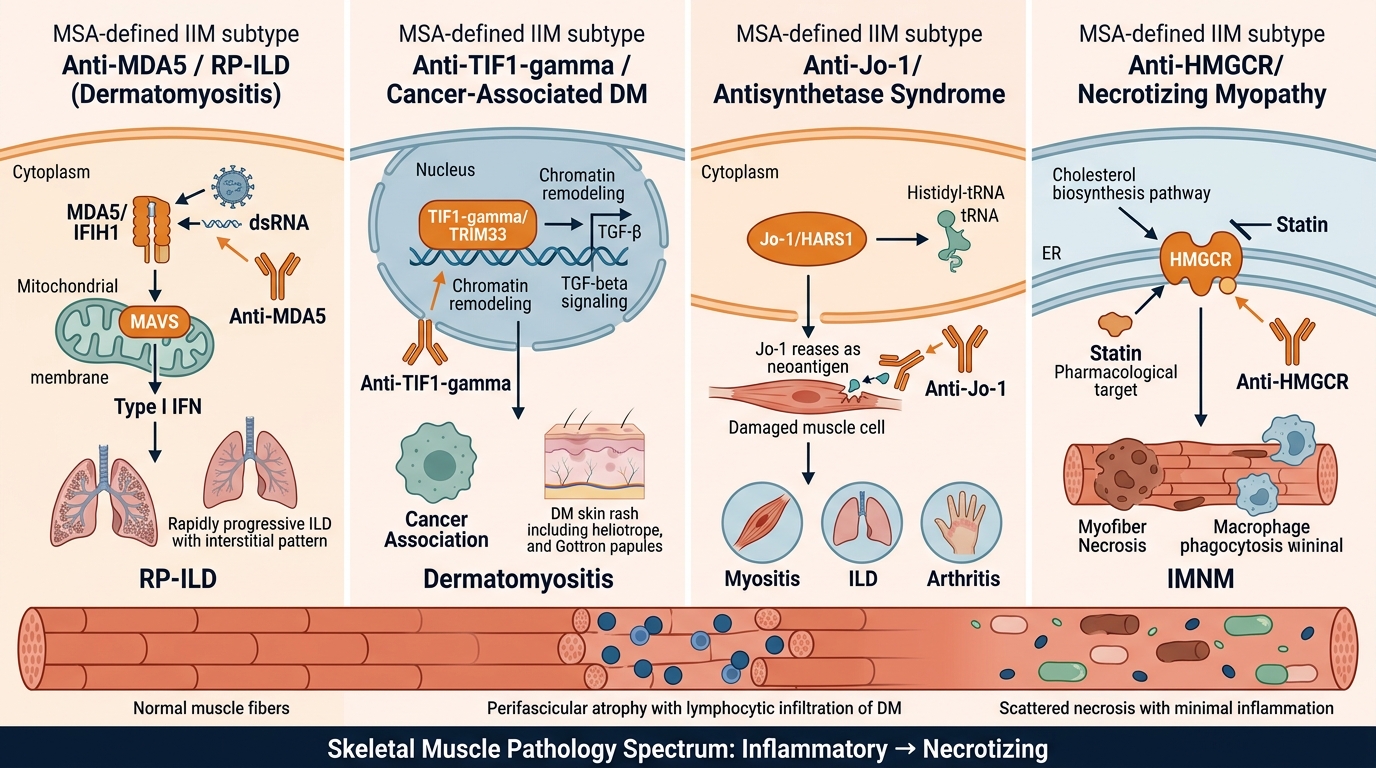
Idiopathic inflammatory myopathies (IIM) are a heterogeneous group of autoimmune diseases characterized by muscle weakness and distinct extra-muscular manifestations. Myositis-specific autoantibodies (MSA) define clinically distinct phenotypes with different prognoses and treatment responses: anti-MDA5 (CADM-140) identifies dermatomyositis with rapidly progressive interstitial lung disease (RP-ILD, especially prevalent in East Asian populations); anti-TIF1-γ (TRIM33) is strongly associated with cancer-associated dermatomyositis; anti-Jo-1 (HARS1) defines antisynthetase syndrome (myositis, ILD, arthritis, mechanic's hands); and anti-HMGCR identifies statin-associated immune-mediated necrotizing myopathy (IMNM). MSA profiling is now essential for prognosis prediction, malignancy screening, ILD risk stratification, and treatment strategy selection. Treatment includes corticosteroids, immunosuppressants, rituximab, IVIG (recently validated for DM), and JAK inhibitors.
Research Use Only (RUO)Not intended for diagnostic or therapeutic procedures.
Fig. 1 Key pathogenic pathways in idiopathic inflammatory myopathies. MSA define distinct clinical phenotypes: MDA5 (RP-ILD), TIF1-γ (cancer-DM), Jo-1 (antisynthetase), HMGCR (necrotizing myopathy). Key research targets highlighted in orange.
abinScience offers the most comprehensive MDA5/IFIH1 product panel available (22 products: 4 polyclonal antibodies, 4 recombinant antibody clones, and 14 recombinant proteins with multiple tags), plus TRIM33/TIF1-γ antibodies and proteins, Jo-1/HARS1 antibodies, and HMGCR reagents for MSA diagnostic ELISA development. All products are manufactured by our parent company AtaGenix Laboratories under ISO quality systems. Browse products below or contact us for custom antibody development.
MDA5 / IFIH1 (CADM-140) — Anti-MDA5 autoantibodies identify a clinically distinct dermatomyositis subset with rapidly progressive interstitial lung disease (RP-ILD) carrying >50% mortality, particularly prevalent in East Asian populations. MDA5 (melanoma differentiation-associated gene 5) is a cytoplasmic RIG-I-like receptor that detects viral dsRNA and activates type I IFN signaling. abinScience offers the deepest MDA5/IFIH1 product panel available: 4 polyclonal antibodies, 4 recombinant antibody clones (SAA2091, SAA2092, SAA2313, SAA2314), and 14 recombinant proteins with diverse tags (N-His, N-Strep, C-His, N-GST, N-His-SUMO) for anti-MDA5 diagnostic ELISA development, MDA5 epitope mapping, titer monitoring, and innate immune pathway research.
→ Browse MDA5 / IFIH1 antibodies & proteins
TIF1-γ / TRIM33 — Anti-TIF1-γ autoantibodies are the strongest serological marker for cancer-associated dermatomyositis, with malignancy rates of 40–80% in adult DM patients. TRIM33 is a transcriptional corepressor involved in TGF-β signaling and chromatin remodeling. Anti-TRIM33 polyclonal antibodies (2 lots), anti-TRIM33 recombinant antibody (clone SAA1438), and human TRIM33/TIF1-γ recombinant proteins (2 variants) support anti-TIF1-γ diagnostic ELISA development, malignancy screening research, and TIF1-γ autoantigen characterization.
→ Browse TIF1-γ / TRIM33 antibodies & proteins
Jo-1 / HARS1 (Histidyl-tRNA Synthetase) — Anti-Jo-1 is the most prevalent MSA in IIM (~20–30%), defining the antisynthetase syndrome characterized by myositis, ILD, non-erosive arthritis, mechanic's hands, and Raynaud phenomenon. Jo-1/HARS1 is a cytoplasmic aminoacyl-tRNA synthetase that can be released during muscle damage and presented as a neoantigen. Anti-Jo-1 polyclonal antibody and anti-HARS1/Jo-1 recombinant antibody (clone SAA2345) support anti-Jo-1 diagnostic assay development and aminoacyl-tRNA synthetase autoantigen research.
→ Browse Jo-1 / HARS1 antibodies
HMGCR — Anti-HMGCR autoantibodies define statin-associated immune-mediated necrotizing myopathy (IMNM), characterized by severe proximal weakness, markedly elevated CK, and myofiber necrosis without significant inflammation on biopsy. HMGCR (3-hydroxy-3-methylglutaryl-CoA reductase) is the rate-limiting enzyme of cholesterol biosynthesis and the pharmacological target of statins. Anti-HMGCR polyclonal antibody and human HMGCR recombinant protein (N-His) support anti-HMGCR diagnostic ELISA development and statin-induced autoimmunity research.
→ Browse HMGCR antibodies & proteins
1. Lundberg IE, et al. Idiopathic inflammatory myopathies. Nat Rev Dis Primers. 2021;7(1):86. DOI
2. Betteridge Z, et al. Myositis-specific autoantibodies: an important tool to support diagnosis of myositis. Nat Rev Rheumatol. 2022;18(7):391-408. DOI
3. Aggarwal R, et al. Trial of intravenous immune globulin in dermatomyositis. N Engl J Med. 2022;387(14):1264-1278. DOI
Human
ELISA, Bioactivity: FACS, Functional assay, Research in vivo
Human
[V-kappa]2-Fc
Human
ELISA, FCM, WB
Human
IgG1, kappa
SAA2005
Human
ELISA, Bioactivity: FACS, Functional assay, Research in vivo
Human
IgG1, kappa
Human
ELISA, Bioactivity: FACS, Functional assay, Research in vivo
Human
IgG
ARGX-111
Human
ELISA, Bioactivity: FACS, Functional assay, Research in vivo
Human
IgG
REGN5093
Human
ELISA, Bioactivity: FACS, Functional assay, Research in vivo
Human
Fab'-IgG1-kappa
Human
ELISA, Bioactivity: FACS, Functional assay, Research in vivo
Human
IgG1-kappa
Human
ELISA, Bioactivity: FACS, Functional assay, Research in vivo
Human
IgG1-Fc
Human
ELISA, Bioactivity: FACS, Functional assay, Research in vivo
Human
IgG4-kappa
Human
ELISA, Bioactivity: FACS, Functional assay, Research in vivo
Human
Fab-G1-kappa-[Fc-G1]