Please ensure Javascript is enabled for purposes of website accessibility
Home > Research Area > Oncology Research > Breast Cancer

Breast Cancer Research Reagents

Breast cancer is the most frequently diagnosed cancer worldwide, with approximately 2.3 million new cases annually. Molecular subtyping into luminal A/B (HR+/HER2−), HER2-enriched, and triple-negative (TNBC) categories has fundamentally reshaped treatment paradigms. The therapeutic landscape now encompasses endocrine therapy, HER2-targeted agents (trastuzumab, T-DXd), CDK4/6 inhibitors (palbociclib, ribociclib, abemaciclib), PARP inhibitors for BRCA-mutant disease, immune checkpoint blockade for PD-L1+ TNBC, and antibody-drug conjugates with cross-subtype activity (trastuzumab deruxtecan, sacituzumab govitecan).

Research Use Only (RUO)Not intended for diagnostic or therapeutic procedures.

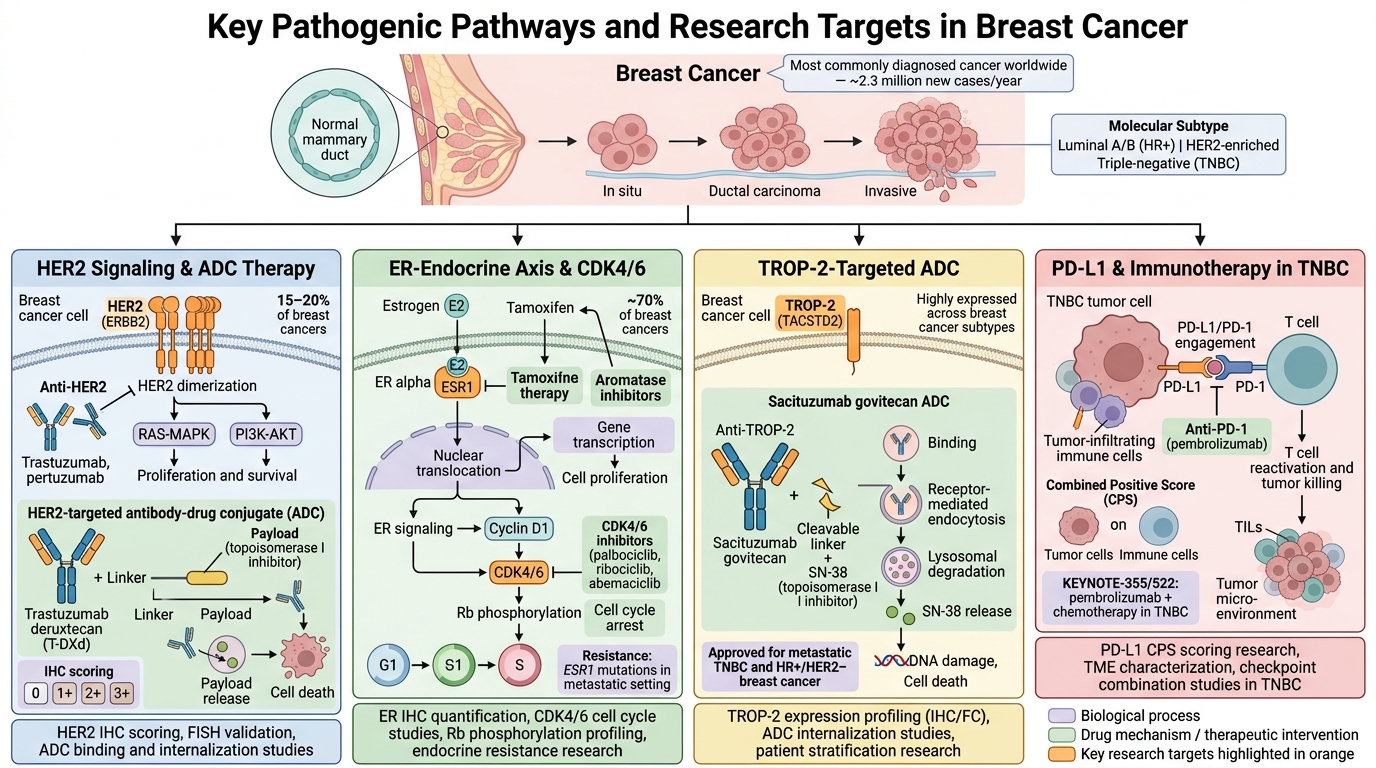
Breast Cancer Research Reagents — key pathogenic pathways and research targets including HER2 signaling, ER-CDK4/6 axis, TROP-2 ADC therapy, and PD-L1 immune checkpoint in TNBC

Fig. 1 Key pathogenic pathways and research targets in breast cancer. HER2 signaling & ADC therapy, ER-endocrine axis & CDK4/6 inhibition, TROP-2-targeted ADC, and PD-L1/immune checkpoint in TNBC. Key research targets highlighted in orange.

abinScience provides validated antibodies, recombinant proteins, and ELISA kits for key breast cancer research targets. All products are manufactured by our parent company AtaGenix Laboratories under ISO quality systems. Browse products below or contact us for custom antibody development.

Key Research Targets

HER2 (ERBB2, CD340) — HER2 overexpression or gene amplification occurs in 15–20% of breast cancers and defines a distinct aggressive subtype responsive to HER2-targeted therapy. Anti-HER2 antibodies and recombinant HER2 proteins support IHC scoring (0/1+/2+/3+), FISH validation, and antibody-drug conjugate (T-DXd) binding and internalization studies essential for companion diagnostic development.
→ Browse HER2 antibodies & proteins

Estrogen Receptor (ERα, ESR1) — ERα positivity (present in ~70% of breast cancers) drives hormone-dependent tumor growth via estrogen-responsive gene transcription. Anti-ER antibodies enable IHC-based receptor quantification for endocrine therapy eligibility (tamoxifen, aromatase inhibitors), ESR1 mutation detection in metastatic disease, and research into endocrine resistance mechanisms.
→ Browse ER antibodies & proteins

CDK4/6 — Cyclin-dependent kinases 4 and 6 phosphorylate Rb to drive G1-to-S cell cycle progression downstream of ER signaling. CDK4/6 inhibitors (palbociclib, ribociclib, abemaciclib) have transformed HR+/HER2− metastatic breast cancer treatment. Anti-CDK4 and anti-CDK6 antibodies support cell cycle arrest studies, Rb phosphorylation profiling, and research into CDK4/6 inhibitor resistance mechanisms.
→ Browse CDK4/CDK6 antibodies & proteins

TROP-2 (TACSTD2) — TROP-2 is a transmembrane glycoprotein highly expressed across breast cancer subtypes, serving as the target for sacituzumab govitecan (anti-TROP-2 ADC), approved for metastatic TNBC and HR+/HER2− breast cancer. Anti-TROP-2 antibodies enable expression profiling by IHC and flow cytometry, ADC internalization studies, and patient stratification research.
→ Browse TROP-2 antibodies & proteins

PD-L1 (CD274) in TNBC — PD-L1 expression on tumor-infiltrating immune cells identifies TNBC patients eligible for immune checkpoint blockade (pembrolizumab + chemotherapy, per KEYNOTE-355). Anti-PD-L1 antibodies and functional blocking reagents support combined positive score (CPS) research, tumor microenvironment characterization, and immune checkpoint combination studies in triple-negative breast cancer.
→ Browse PD-L1 antibodies & proteins

References

1. Sung H, Ferlay J, Siegel RL, et al. Global cancer statistics 2020: GLOBOCAN estimates. CA Cancer J Clin. 2021;71(3):209-249. DOI

2. Modi S, Saura C, Yamashita T, et al. Trastuzumab deruxtecan in previously treated HER2-positive breast cancer. N Engl J Med. 2020;382(7):610-621. DOI

3. Bardia A, Hurvitz SA, Tolaney SM, et al. Sacituzumab govitecan in metastatic triple-negative breast cancer. N Engl J Med. 2021;384(16):1529-1541. DOI

4. Turner NC, Ro J, André F, et al. Palbociclib in hormone-receptor–positive advanced breast cancer. N Engl J Med. 2015;373(3):209-219. DOI

5. Cortes J, Rugo HS, Cescon DW, et al. Pembrolizumab plus chemotherapy in advanced triple-negative breast cancer. N Engl J Med. 2022;387(3):217-226. DOI

338 product results for "Breast Cancer"

Options+
Options
Confirm