Please ensure Javascript is enabled for purposes of website accessibility
Home > Research Area > Oncology Research > Lung Cancer

Lung Cancer Research Reagents

Lung cancer remains the most lethal malignancy globally, causing an estimated 1.8 million deaths annually. Non-small cell lung cancer (NSCLC) accounts for approximately 85% of cases and is classified into adenocarcinoma, squamous cell carcinoma, and large cell carcinoma subtypes, each with distinct molecular drivers and therapeutic vulnerabilities. The treatment landscape has been revolutionized by targeted kinase inhibitors (EGFR, ALK, ROS1, RET, MET, KRAS G12C) and immune checkpoint blockade (anti-PD-1/PD-L1), with comprehensive genomic profiling and PD-L1 tumor proportion score (TPS) now guiding first-line treatment decisions.

Research Use Only (RUO)Not intended for diagnostic or therapeutic procedures.

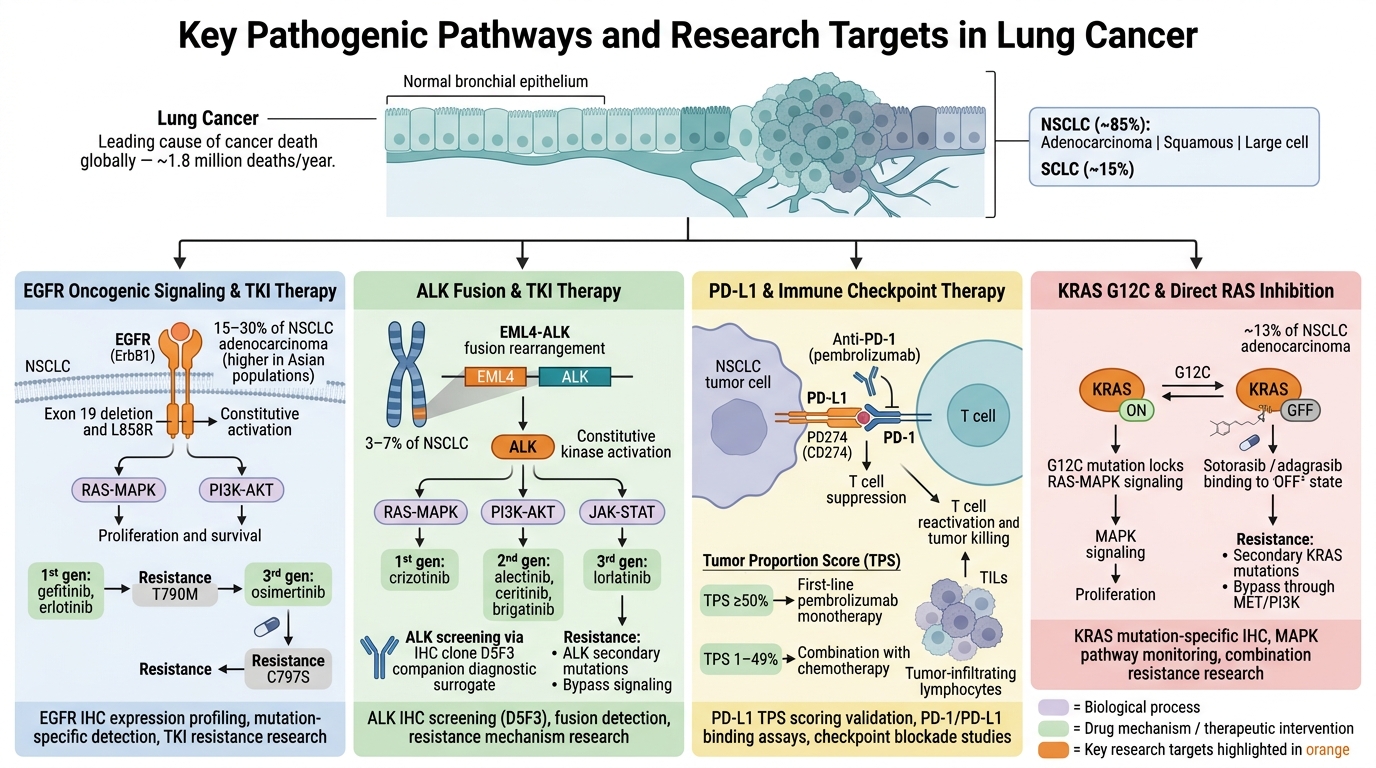
Lung Cancer Research Reagents — key pathogenic pathways and research targets including EGFR mutations, ALK fusions, PD-L1 immune checkpoint, and KRAS G12C

Fig. 1 Key pathogenic pathways and research targets in lung cancer. EGFR oncogenic signaling & TKI therapy, ALK fusion-driven signaling, PD-L1/PD-1 immune checkpoint axis, and KRAS G12C targeted inhibition. Key research targets highlighted in orange.

abinScience provides validated antibodies, recombinant proteins, and ELISA kits for key lung cancer research targets. All products are manufactured by our parent company AtaGenix Laboratories under ISO quality systems. Browse products below or contact us for custom antibody development.

Key Research Targets

EGFR (ErbB1, HER1) — EGFR activating mutations (exon 19 deletions, L858R) drive oncogenic signaling through RAS-MAPK and PI3K-AKT pathways in approximately 15–30% of NSCLC adenocarcinomas (higher in Asian populations). Three generations of EGFR TKIs (gefitinib/erlotinib → afatinib → osimertinib) target successive resistance mutations (T790M, C797S). Anti-EGFR antibodies support IHC expression profiling, mutation-specific detection, and resistance mechanism research.
→ Browse EGFR antibodies & proteins

ALK (Anaplastic Lymphoma Kinase) — EML4-ALK fusion rearrangements occur in 3–7% of NSCLC and define a distinct molecular subtype responsive to ALK tyrosine kinase inhibitors (crizotinib → alectinib → lorlatinib). Anti-ALK antibodies (clone D5F3) enable IHC screening as a companion diagnostic surrogate and support research into resistance mechanisms including ALK secondary mutations and bypass signaling.
→ Browse ALK antibodies & proteins

PD-L1 (CD274) — PD-L1 expression measured by tumor proportion score (TPS) determines eligibility for first-line pembrolizumab monotherapy (TPS ≥50%) or combination immunotherapy in NSCLC. Anti-PD-L1 antibodies and recombinant proteins support TPS scoring validation, PD-1/PD-L1 binding assays, and functional checkpoint blockade studies critical for immunotherapy development.
→ Browse PD-L1 antibodies & proteins

KRAS G12C — KRAS G12C mutations occur in approximately 13% of NSCLC adenocarcinomas and represent the first directly druggable RAS pathway alteration, with sotorasib and adagrasib receiving regulatory approvals. Anti-KRAS antibodies (including mutation-specific clones) enable immunohistochemical detection, downstream MAPK pathway activation monitoring, and combination therapy resistance research.
→ Browse KRAS antibodies & proteins

References

1. Herbst RS, Morgensztern D, Boshoff C. The biology and management of non-small cell lung cancer. Nature. 2018;553(7689):446-454. DOI

2. Reck M, Rodríguez-Abreu D, Robinson AG, et al. Pembrolizumab versus chemotherapy for PD-L1–positive non–small-cell lung cancer. N Engl J Med. 2016;375(19):1823-1833. DOI

3. The Cancer Genome Atlas Research Network. Comprehensive molecular profiling of lung adenocarcinoma. Nature. 2014;511(7511):543-550. DOI

4. Skoulidis F, Li BT, Dy GK, et al. Sotorasib for lung cancers with KRAS p.G12C mutation. N Engl J Med. 2021;384(25):2371-2381. DOI

5. Mok TS, Wu Y-L, Thongprasert S, et al. Gefitinib or carboplatin–paclitaxel in pulmonary adenocarcinoma. N Engl J Med. 2009;361(10):947-957. DOI

713 product results for "Lung Cancer"

Options+
Options
Confirm