A new year marks a new beginning. Multiple groundbreaking achievements in antibody and protein research supported by abinScience technology have been successfully published in top journals such as Communications Biology and Nature Communications. The research focuses on key directions, including B cell development and maturation, cancer cachexia, and chronic rhinitis, covering core areas such as disease mechanism analysis and target screening. The high-purity recombinant proteins and antibodies provided by abinScience have offered critical material support for relevant scientific research, facilitating core breakthroughs in multiple studies. In this issue of Literature Express, let us review these important research advances from frontline laboratories together.
Title: A small molecule VDAC ligand inhibits ERAD and induces selective cancer cell death via disruption of calcium homeostasis
Journal: Nature Communications
Impact Factor: 15.7
Author Affiliation: University of Maryland School of Medicine
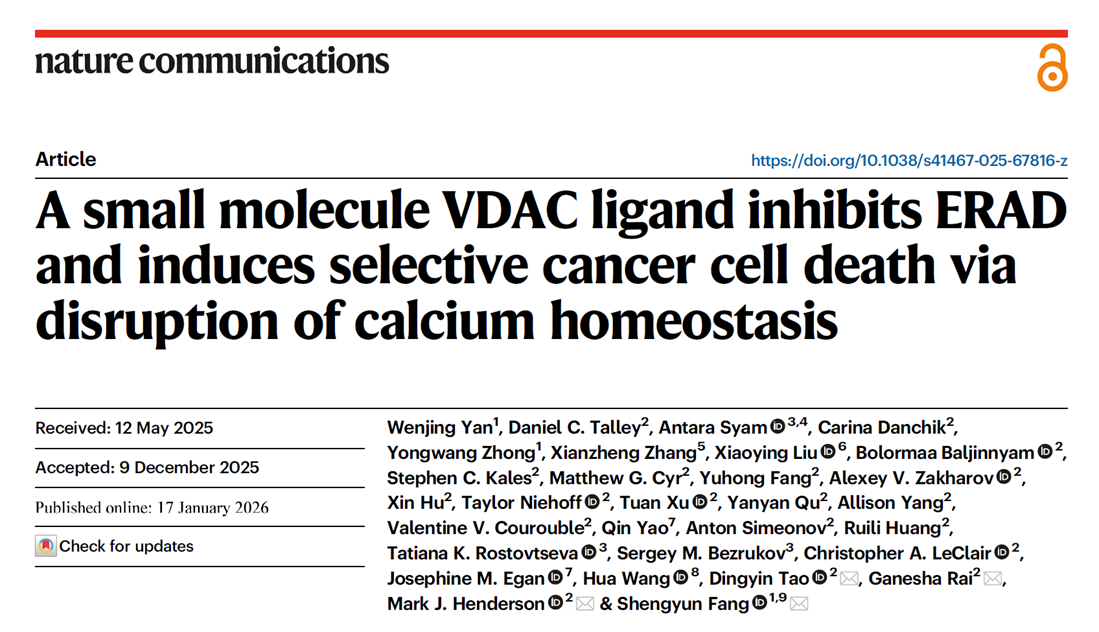
A small molecule VDAC ligand inhibits ERAD and induces selective cancer cell death via disruption of calcium homeostasis
Endoplasmic Reticulum-Associated Degradation (ERAD) is a key mechanism for maintaining cellular protein homeostasis, and its dysregulation is closely associated with diseases such as cancer. However, research on small-molecule modulators of ERAD remains scarce. This study identified the small-molecule compound NCATS-SM0225 (225) through high-throughput screening, which binds to all three isoforms of the Voltage-Dependent Anion Channel (VDAC), unexpectedly revealing the critical role of VDAC in ERAD and ER autophagy. 225 mediates calcium influx and activation of the IP3R-MCU pathway via VDAC, leading to imbalances in cytoplasmic, endoplasmic reticulum, and mitochondrial calcium homeostasis. It enhances VDAC1-IP3R interaction and activates the PERK-STIM1 axis, promoting the degradation of key ERAD factors such as HERP1 and OS9, ultimately inducing selective cancer cell death without affecting normal cells. In the A375 melanoma xenograft model, 225 significantly inhibited tumor growth with no obvious toxicity. This study elucidates a novel mechanism by which VDAC regulates ERAD, providing a new VDAC-targeted strategy for cancer therapy.
abinScience provided recombinant human VDAC1 protein (Cat. No.: HB031012) for Microscale Thermophoresis (MST) experiments to directly verify the interaction between compound 225 and VDAC1: The histidine tag was conjugated with fluorescent dye to determine the equilibrium dissociation constant (KD=3.13 μM) between the two, confirming the direct binding relationship between 225 and VDAC1. This experimental result serves as key evidence for identifying the molecular target of 225, laying the foundation for subsequent revelation of the core mechanism that "225 regulates calcium homeostasis and ERAD by binding to VDAC".
Title: Multiscale Quantum Dots-Based Material Platform for High-Performance Immunosensing of Rhinitis Biomarkers
Journal: Materials Today Bio
Impact Factor: 10.2
Author Affiliation: School of Microelectronics, Huazhong University of Science and Technology
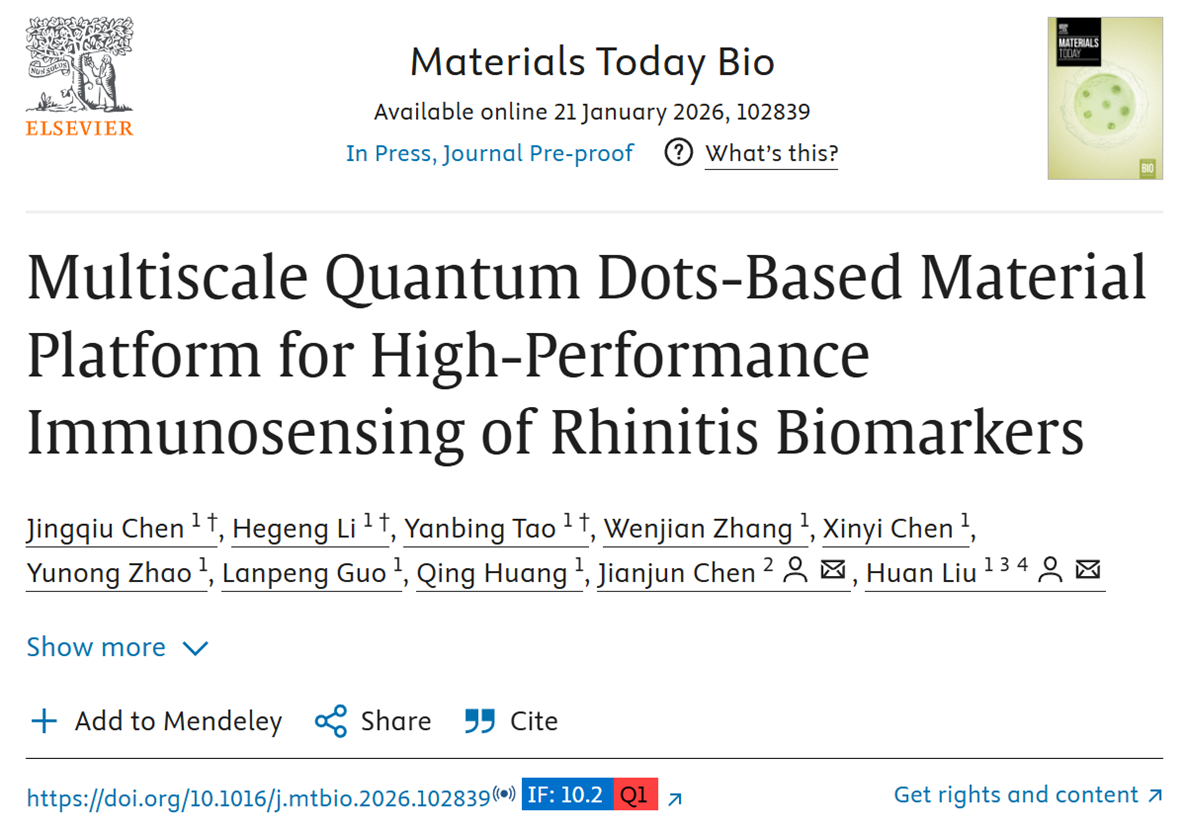
Rhinitis, as a common chronic respiratory disease, requires rapid and portable diagnostic tools to assist in diagnosis and treatment. Eosinophil Cationic Protein (ECP) and Neutrophil Myeloperoxidase (MPO) are key biomarkers for this condition. This study developed an electrochemical immunosensor based on lead sulfide (PbS) colloidal quantum dots (CQDs), utilizing the electrical signal transduction and interfacial charge transfer properties of CQDs to achieve highly sensitive detection of ECP and MPO. The sensor optimized serum sample processing protocols, tolerates hemolysis effects, and requires samples to be tested within 1 hour at room temperature or stored at -20°C, with spiked recoveries ranging from 88.90% to 113.00%. When applied to detect nasal secretion samples from 40 rhinitis patients, the correlation coefficients with ELISA method were 0.969 (ECP) and 0.960 (MPO), respectively, with a single sample detection time of only 35 seconds. This sensor provides a rapid, reliable, and non-invasive detection solution for rhinitis, holding significant application potential in Point-of-Care Testing (POCT) and home self-testing.
abinScience supplied ECP antigen (Cat. No.: HY452012) and MPO antigen (Cat. No.: HY413012) for this study. These antigens were used: first, to construct the calibration curve of the sensor, determine the linear detection range and sensitivity, and provide a standard basis for quantitative analysis; second, to perform serum sample spiked recovery experiments to verify the detection accuracy and reliability of the sensor; and third, to assist in optimizing sample processing conditions (such as hemolysis, storage duration, and preservation temperature), ensuring the applicability of the sensor in clinical sample detection and providing necessary reference materials for performance verification and clinical application evaluation of the sensor.
Title: The FGL1-LAG-3 axis attenuates melanoma-induced cachexia in mice
Journal: Cancer & Metabolism
Impact Factor: 5.3
Author Affiliation: Qilu Medical University
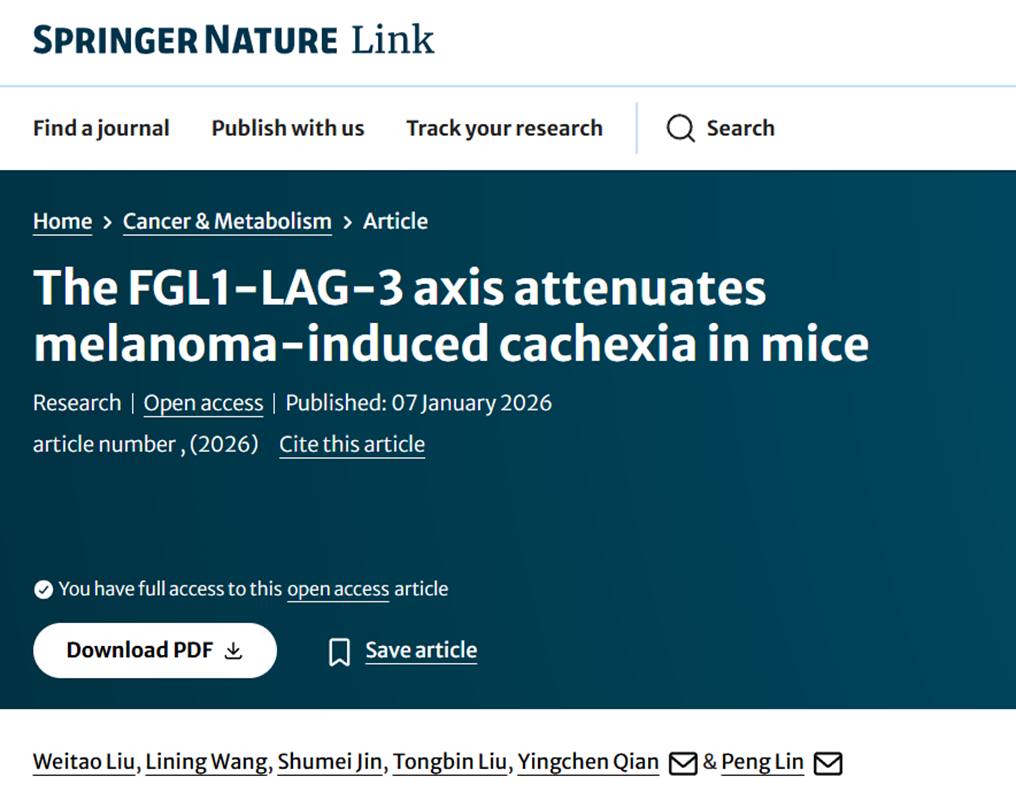
Cancer cachexia is a metabolic syndrome that causes death in 20% of cancer patients, characterized by adipose and skeletal muscle wasting, yet no approved therapeutic drugs are available. Using the B16F10 melanoma cachexia mouse model, this study found that fibrinogen-like protein 1 (FGL1) was significantly upregulated in white adipose tissue (WAT) and liver. Further experiments showed that intraperitoneal injection of FGL1-Fc protein in the middle and late stages reduced weight loss and adipose and muscle wasting in mice and reversed abnormal expression of genes related to lipid metabolism and muscle degradation without affecting tumor growth. Mechanistically, the anti-cachectic effect of FGL1 depends on its binding to Lymphocyte Activation Gene 3 (LAG-3), which alleviates systemic inflammation by inhibiting CD8+ T cell activity in WAT and reducing serum IL-6 and corticosterone levels. This study reveals that the FGL1-LAG-3 axis is a key regulatory pathway in melanoma-associated cachexia, providing an important target for the development of novel therapeutic strategies.
abinScience provided the core experimental material, the FGL1-Fc protein (Cat. No.: HC338011), for the research. It was used for intraperitoneal injection in B16F10 tumor-bearing mice, serving as a key tool to verify the biological function of FGL1: Administration at different time windows (early treatment starting on day 7, middle-late treatment starting on day 14) clarified that middle-late administration not only did not promote tumor growth but also effectively exerted anti-cachectic effects; combined with LAG-3 blocking antibody experiments, it was confirmed that the protective effect of FGL1 is mediated by LAG-3.
Title: Single-cell analysis reveals multi-faceted features of B cell development, together with age-associated B cell subpopulations
Journal: Communications Biology
Impact Factor: 5.1
Author Affiliation: Guangdong Provincial Institute of Cardiovascular Diseases

B cell development and maturation are crucial for adaptive immunity, yet traditional low-dimensional research struggles to fully resolve their heterogeneity, gene regulation, and microenvironmental interactions. This study integrated single-cell transcriptome and BCR sequencing data from bone marrow, tonsils, and peripheral blood, identifying 18 B cell subsets and revealing the dynamic gene regulation, cell interaction characteristics, and age-associated subsets during development. The study found that immature B cells have low transcriptional activity, naive B cell proliferation and activation are tissue-limited, and memory B cells exhibit two compatible developmental models; myeloid cells regulate B cell development through TNF signaling and adhesion pathways, and identified an age-associated B cell subset expressing S100A8/A9 and C1q, confirming that the secretory function of S100A8/A9 is associated with the senescence-associated secretory phenotype (SASP). This study provides a comprehensive resource for understanding B cell development, immune aging, and related therapeutic strategies.
abinScience provided two antibody products for the research: Anti-Mouse Kappa chain antibody (Cat. No.: MB980013) and Anti-Mouse Lambda chain antibody (Cat. No.: MP678013). These antibodies were used for immunofluorescence staining of mouse bone marrow, combined with other antibodies to label early B cells (CD19+ Kappa-Lambda-CD43±) and myeloid cells (CD11B+). Confocal microscopy was used to observe their spatial proximity, providing direct morphological evidence for the cellular interaction between myeloid cells and B cells.


 中文
中文 English
 한국어
한국어 日本語
日本語 Español
 Français
 Русский


