A 14-Colour Panel Enabling the Simultaneous Detection of Three Key Cell Populations
OMIP-019 was developed to enable the efficient and coordinated analysis of γδ T cells, invariant natural killer T (iNKT) cells and haematopoietic precursor cells. By integrating a 14-colour marker panel, this OMIP achieves both quantitative assessment and in-depth phenotypic characterisation within a single assay, providing a comprehensive tool for studies at the interface of immunity and haematopoiesis.
Technical Demands in Immunology and Haematopoietic Research
Understanding the functional interplay between γδ T cells, iNKT cells and haematopoietic precursors is essential for dissecting immune regulation and haematopoietic homeostasis. However, conventional flow cytometry strategies typically focus on individual cell types in isolation. Such fragmented approaches require multiple panels and experimental runs, increasing experimental complexity while often compromising data comparability. These limitations make it challenging to perform integrated analyses of the immune–haematopoietic axis.
Core Concept and Innovation of OMIP-019
Rather than simply expanding marker numbers, OMIP-019 introduces a rationally designed 14-colour panel that enables the concurrent identification and phenotypic profiling of three functionally interconnected cell populations. By combining highly specific identification tools with markers for differentiation, activation and migratory potential, OMIP-019 provides a standardised and efficient framework for comprehensive immune–haematopoietic studies.
γδ T cells, invariant natural killer T cells and haematopoietic precursor cells play central roles in immune bridging, lipid antigen recognition and haematopoietic maintenance, respectively. As such, they represent critical targets in both immunological and haematological research. OMIP-019 was specifically designed to support the simultaneous quantification and phenotypic analysis of these three populations through a carefully optimised 14-colour marker configuration.
1. OMIP-019 Panel
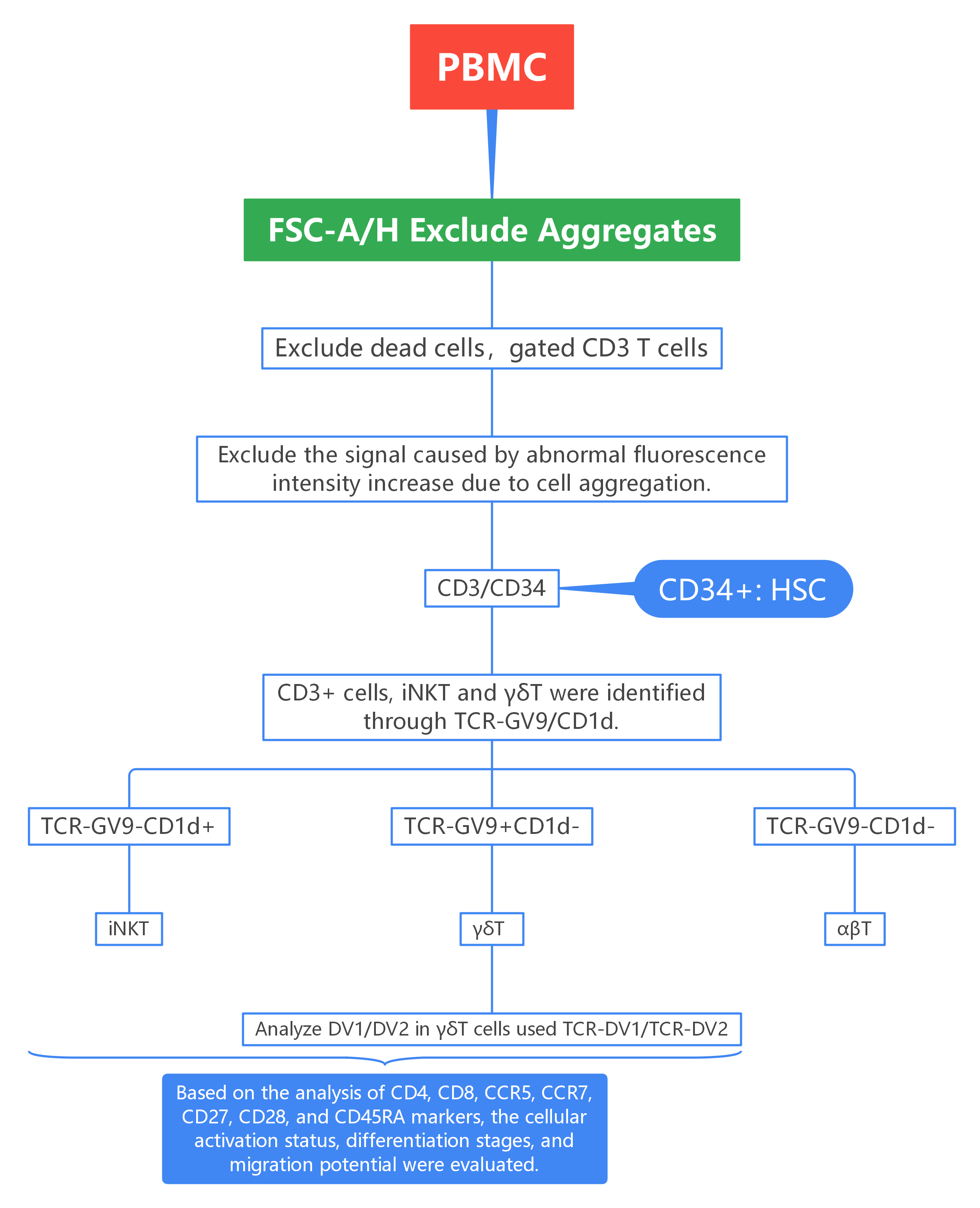
2. Gate Logic
1
Identification of the Main Cell Population
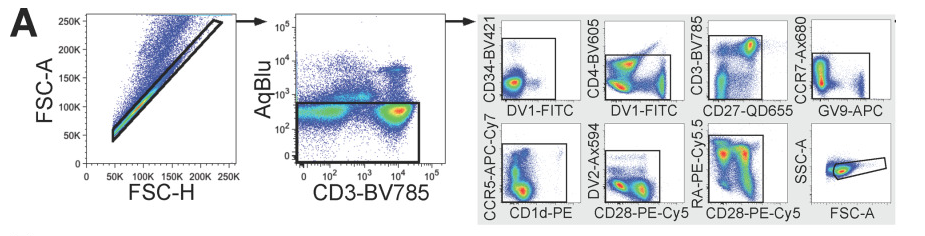
Initial gating was performed using FSC/SSC parameters to exclude aggregates. Non-viable cells and non-specific fluorescence arising from dye binding were removed, allowing the selection of viable CD3-positive T cells.
2
Definition of Target Cell Populations
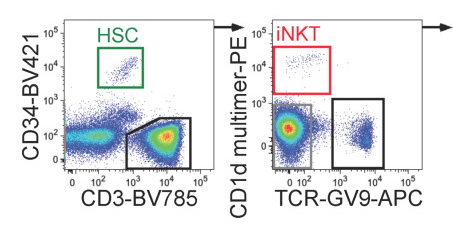
Using CD3/CD34 together with CD1d/PBS-57 and TCR-GV9, the following populations were identified: Haematopoietic stem and progenitor cells (CD34+); iNKT cells (CD3+ CD34− TCR-GV9− CD1d/PBS-57+); γδ T cells (CD3+ CD34− TCR-GV9+ CD1d/PBS-57−).
3
Phenotypic Analysis of iNKT Cells
The activation status, differentiation stage and migratory capacity of iNKT cells were evaluated based on the expression of CD4, CD8, CCR5, CCR7, CD27, CD28 and CD45RA.
4
Subsetting and Phenotypic Analysis of γδ T Cells
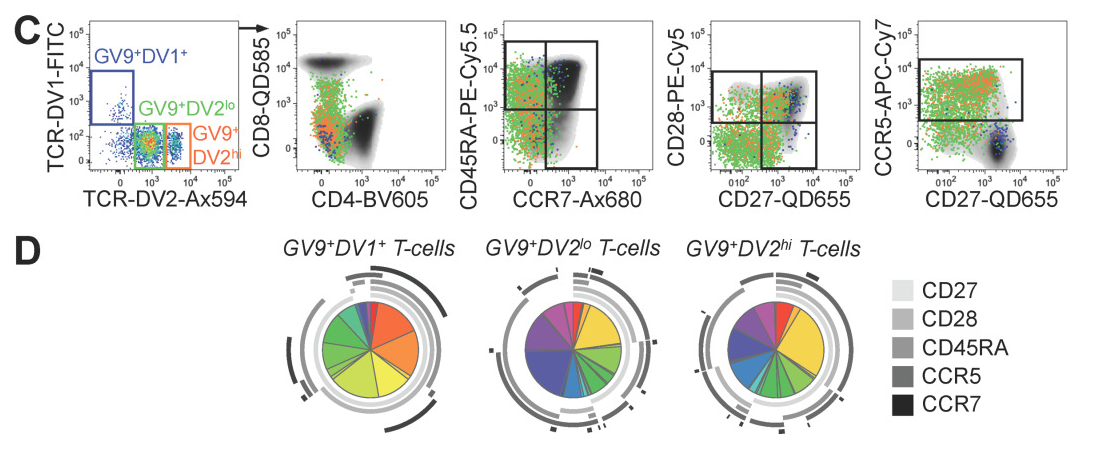
γδ T cells were further subdivided using TCR-DV1 and TCR-DV2 expression. Functional phenotypes were then assessed using CD4, CD8, CCR5, CCR7, CD27, CD28 and CD45RA.
3. Experimental Results
1). FSC/SSC-based exclusion of aggregates and removal of dead cells and non-specific dye-associated fluorescence enabled the identification of viable CD3-positive T cells.
2). Combined CD3/CD34 and CD1d/PBS-57/TCR-GV9 gating allowed the clear delineation of haematopoietic precursor cells, iNKT cells and γδ T cells.
3). The activation, differentiation and migratory profiles of iNKT cells were characterised based on CD4, CD8, CCR5, CCR7, CD27, CD28 and CD45RA expression.
4). γδ T-cell subsets defined by TCR-DV1 and TCR-DV2 were further analysed for functional state, differentiation stage and migratory potential using the same phenotypic markers.
4. Panel Interpretation
4.1 Integrating Functional Relationships Between Three Key Cell Types
OMIP-019 is not a simple aggregation of detection targets. Instead, it is grounded in the intrinsic functional connections between the immune and haematopoietic systems. Haematopoietic precursor cells represent the cellular origin of all blood lineages, γδ T cells act as a bridge between innate and adaptive immunity, and iNKT cells serve as rapid responders to lipid antigens. By enabling the simultaneous analysis of these three populations, OMIP-019 captures the coordinated state of the immune–haematopoietic axis. This integrated approach avoids the complexity and poor comparability associated with multi-panel strategies and provides a more coherent framework for investigating immune dysregulation and haematopoietic abnormalities.
4.2 A Stepwise Design Combining Specific Identification and Deep Phenotyping
The experimental design of OMIP-019 follows a structured progression from precise cell identification to functional interpretation. Target populations are first defined using highly specific tools such as CD34 for haematopoietic precursors, CD1d/PBS-57 multimers for iNKT cells and TCR-GV9 for γδ T cells. Subsequent subdivision into functional subsets is achieved using TCR-DV1/DV2 and CD4/CD8, followed by phenotypic characterisation with differentiation and migration markers including CD45RA and CCR7. The use of PBS-57 enhances the stability and specificity of iNKT cell detection, while Boolean gating strategies integrate multiple markers to move beyond simple enumeration towards functional state inference. This tiered design ensures both specificity and depth in phenotypic analysis.
5. Applications
Functional studies of the immune–haematopoietic axis Long-term immune memory research Mechanistic studies of infectious diseases Evaluation of cancer immunotherapy responses Autoimmune disease research Vaccine development and immune monitoring Investigation of haematopoietic dysfunction
Overall, OMIP-019 has wide applications in immunological and haematological research, particularly in exploring the functional interplay, phenotypic characteristics and regulatory mechanisms of γδ T cells, iNKT cells and haematopoietic progenitor cells, providing important data in both healthy and disease states.
6. Conclusion
Centred on a 14-colour flow cytometry panel, OMIP-019 enables the simultaneous and precise detection of γδ T cells, iNKT cells and haematopoietic precursor cells, together with comprehensive phenotypic characterisation. By overcoming the limitations of single-cell-type analyses and emphasising functional interconnections, this panel balances specificity with analytical depth. OMIP-019 therefore represents a standardised and efficient technical solution for both fundamental research and translational studies in immunology and haematopoiesis, with broad scientific relevance and application potential.
Get OMIP-019 Compatible Flow Cytometry Antibodies
abinScience provides validated flow cytometry antibodies covering key targets in this panel, supporting your research on γδ T cells, iNKT cells, and hematopoietic progenitor cells
References
[1] Mahnke YD, Beddall MH, Roederer M. OMIP-019: quantification of human γδT-cells, iNKT-cells, and hematopoietic precursors. Cytometry A. 2013 Aug;83(8):676-8.

About Us
As a strategic venture of AtaGenix (established 2011), abinScience was founded in 2023 to deliver premium life science reagents that accelerate discovery. Our flow cytometry antibody products cover commonly used detection markers, with a wide variety to meet the research needs of multiple species (Human/Mouse/Rat/Dog/Hamster/Monkey, etc.). We provide stable and reliable support for scientific research.
Explore abinScience Flow Cytometry Antibodies


 中文
中文 English
 한국어
한국어 日本語
日本語 Español
 Français
 Русский