In recent years, Spectral Flow Cytometry has emerged as one of the most highly discussed innovations in the flow cytometry field. From instrument manufacturers' marketing materials to academic conferences and technical training courses, claims like "40+ color detection capabilities," "no compensation required," and "solving spillover issues" appear frequently.
Among these, the phrase "no compensation required" has become one of the most hallmark claims associated with spectral flow cytometry.
However, this framing has led to several misconceptions. Some researchers believe that spectral flow cytometry has completely eliminated the issue of fluorescence signal overlap, while others assume that while conventional flow relies on compensation, spectral flow entirely obviates the need for any signal correction.
This is not the case.Spectral overlap of fluorescence is an unavoidable physical phenomenon inherent in all fluorescence detection technologies. Spectral flow cytometry does not eliminate spectral overlap; instead, it processes overlapping signals differently than conventional compensation. Grasping this distinction is key to truly understanding the difference between spectral and conventional flow cytometry.
1. Conventional VS Spectral Flow Cytometry: How Do Detection Methods Differ?
To understand the relationship between compensation and unmixing, we must first look at how both technologies acquire fluorescence signals.
Conventional Flow: Detecting Specific Wavelength Bands
In conventional flow cytometry, a fluorochrome generates an emission spectrum spanning a wide range of wavelengths upon excitation. Taking FITC as an example, its emission spectrum is not concentrated at a single wavelength but forms a continuous emission curve across approximately 500–600 nm. However, conventional flow cytometers do not record the entire emission spectrum. Instead, the instruments use optical bandpass filters to capture a specific wavelength window from the full spectrum—for instance, a 530/30 nm detection channel primarily collects light signals in the 515–545 nm range, which are then measured by a photomultiplier tube (PMT). Consequently, conventional flow cytometry only utilizes a small fraction of the complete spectral information for each individual fluorochrome.
Spectral Flow: Recording the Full Emission Spectrum
Spectral flow cytometry adopts a fundamentally different data acquisition strategy. Instead of relying on a "one filter, one detector" configuration, it disperses the emission spectrum continuously across an array of multiple detectors, recording the signal distribution of the fluorochrome across its entire emission range. In other words, while conventional flow yields discrete data points from a few isolated channels, spectral flow captures a much more comprehensive and continuous spectral profile.
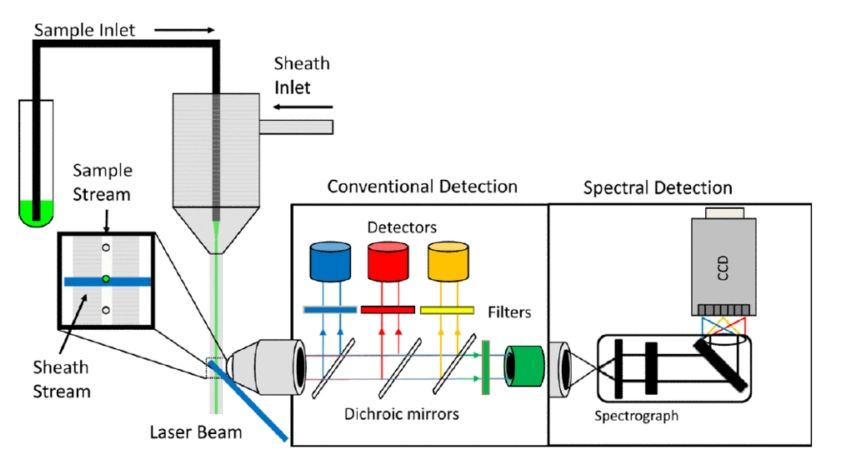
Figure 1. Comparison of detection principles between conventional and spectral flow cytometry
2. Why Does Spillover Occur Across All Flow Cytometry Technologies?
Regardless of whether conventional or spectral flow is used, a fluorochrome's emission spectrum is never confined to a single wavelength; it always presents as a continuous distribution with a defined spectral width.Consequently, spectral overlap between different fluorochromes is inevitable. For example, besides covering its primary detection region, the emission spectrum of FITC leaks into PE-related detection channels, just as the emission spectrum of PE can spill into other adjacent channels.This phenomenon—where light from one fluorochrome enters a non-target detection channel due to overlapping emission spectra—is known as spillover.
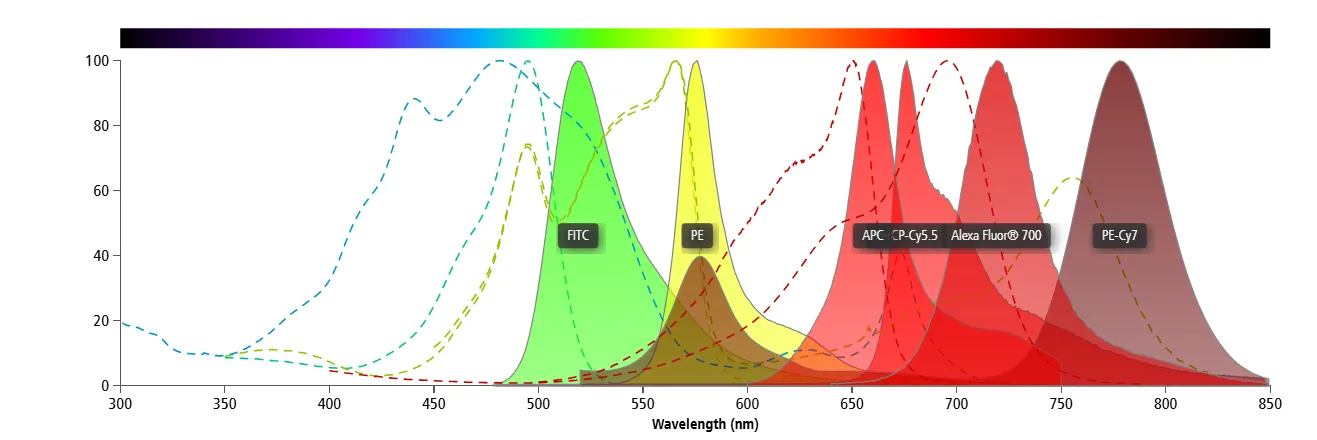
Figure 2. Spectral overlap between different fluorochromes
Spectral overlap is dictated by the intrinsic physical properties of fluorescent molecules and does not disappear with shifts in detection technology. Therefore, as long as fluorochromes are utilized, signal correction remains an absolute necessity. The only difference lies in the method of calculation.
3. How Conventional Flow Cytometry Handles Spectral Overlap
Conventional flow cytometry addresses signal spillover using a method called compensation.The underlying principle of compensation is straightforward. By using single-stained controls, the instrument determines the proportion of signal from a specific fluorochrome that spills into other primary detection channels. A compensation matrix is then constructed to subtract these spillover signals from the respective channels.
For example: Suppose 20% of the FITC signal spills into the PE detection channel. When the PE channel detects a total signal of 1,000 units, the system uses the compensation matrix to calculate the contribution from FITC, subtracts it, and leaves the remainder as the true PE signal.At its core, compensation is a mathematical correction process aimed at restoring the true contribution of each individual fluorochrome from a mixed signal pool.
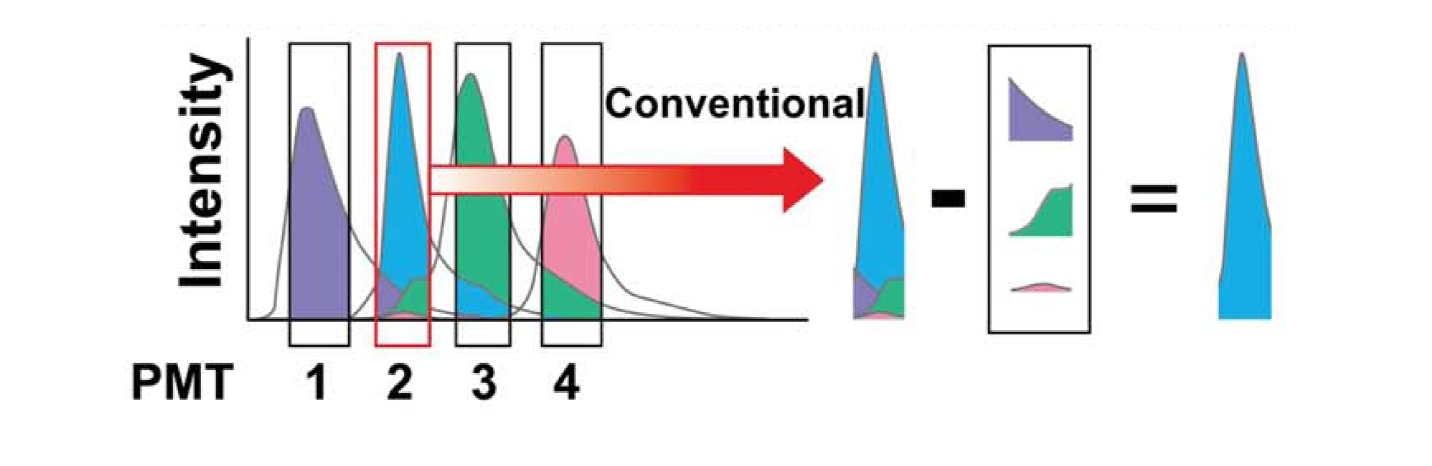
Figure 3. The principle of compensation
4. How Spectral Flow Cytometry Handles Spectral Overlap
Spectral flow cytometry utilizes a process known as spectral unmixing. Compared to conventionalcompensation, the objective of unmixing is identical: to identify and isolate the contributions of distinct fluorochromes from a convoluted, mixed fluorescent signal.
The key distinction lies in the volume of data utilized. conventional compensation calculates spillover based primarily on the signal relationships across a limited number of defined channels. Conversely, spectral unmixing leverages information across the entire emission spectrum.
The system first establishes a spectral reference library for each fluorochrome using single-stained controls. It then applies a mathematical algorithm to deconvolve the mixed spectrum obtained from the experimental sample against these references, ultimately determining the proportional contribution of each fluorochrome to the total spectrum.
Thus, spectral unmixing does not bypass signal correction; rather, it executes it with the benefit of far richer, multi-channel datasets.
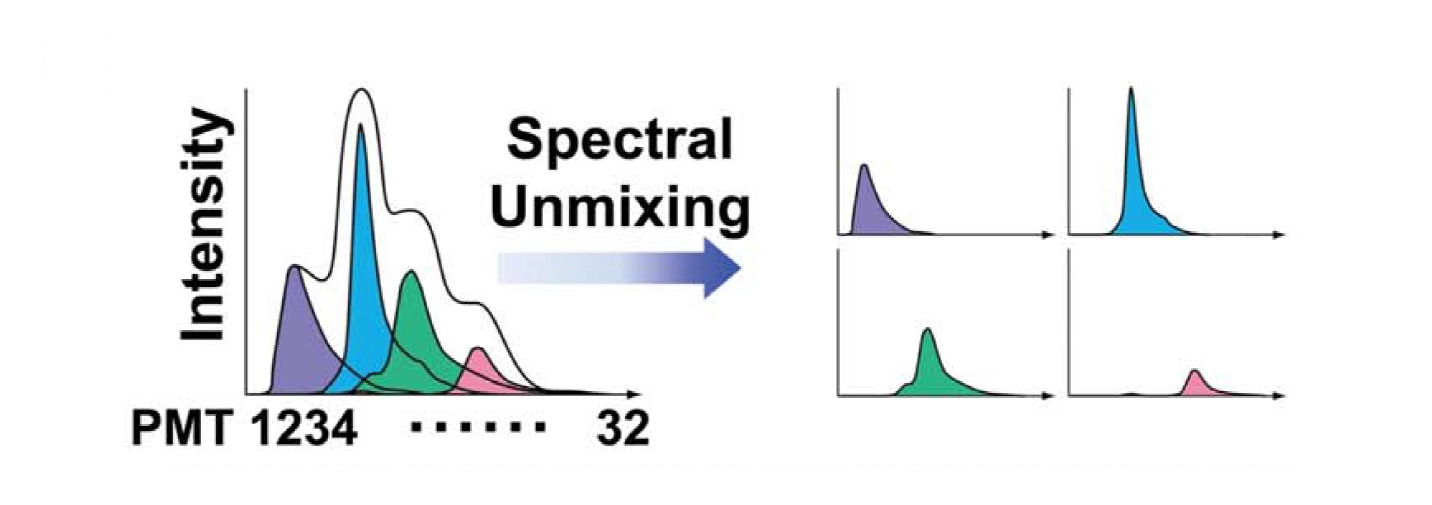
Figure 4. The principle of spectral unmixing
5. What Is the True Relationship Between Compensation and Unmixing?
In industry discussions, compensation and unmixing are frequently framed as two entirely disparate technologies. Mathematically, however, both are inverse problem solutions falling under the umbrella of signal deconvolution.Both share an identical goal:
Deconvoluting the total detected signal to reconstruct the true fluorescence contribution of each individual fluorochrome.
The differences lie in:
- Conventional Compensation: Relies on data from a restricted set of individual channels.
- Spectral Unmixing: Leverages data spanning the full emission spectrum across all detectors.
Consequently, spectral unmixing is not a rejection of compensation principles, but an expansion that applies a different data source and mathematical approach to achieve the same end. Viewed this way, spectral unmixing represents an evolution and extension of conventional compensation principles, rather than a total replacement.
6. Is Spectral Unmixing Universally Superior to Conventional Compensation?
The answer is not a simple yes. When two fluorochromes display heavily overlapping emission peaks but maintain distinct overall spectral profiles, spectral unmixing typically delivers significantly better resolution. A classic example is the PerCP-Cy5.5 / PE-Cy5.5 combination. Although their peak emission wavelengths are virtually identical, their full spectral signatures differ enough for spectral flow cytometers to successfully resolve them.
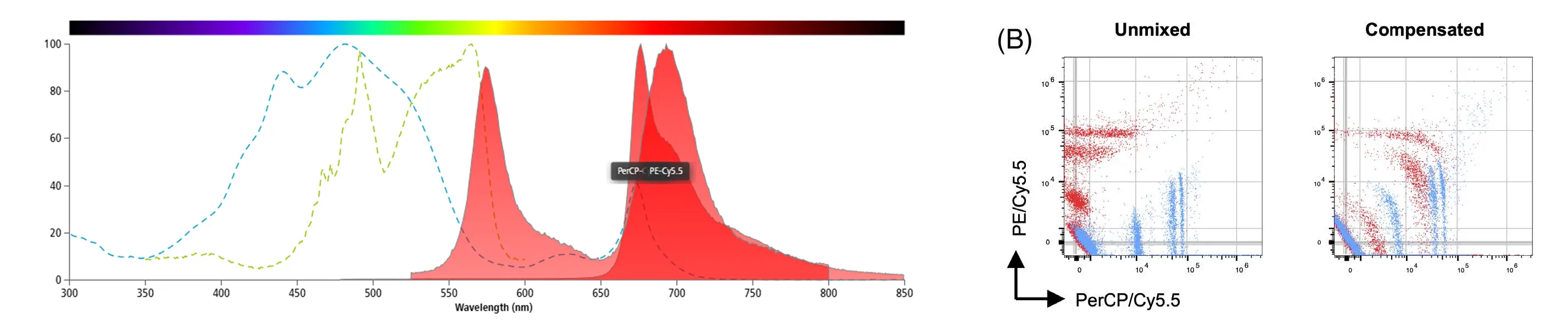
Figure 5. Spectra of PerCP-Cy5.5 and PE-Cy5.5, along with a performance comparison between spectral unmixing and conventional compensation
However, the scenario shifts drastically when dealing with fluorochrome pairs whose profiles are highly similar or nested within one another.Examples include:
- APC and APC-Cy7
- PE-CF594 and PE-Dazzle 594
In these pairings, the spectrum of the tandem or secondary fluorochrome often encompasses most features of the primary fluorochrome, or their spectral signatures are so heavily congruent that they yield very few distinct features for differentiation.
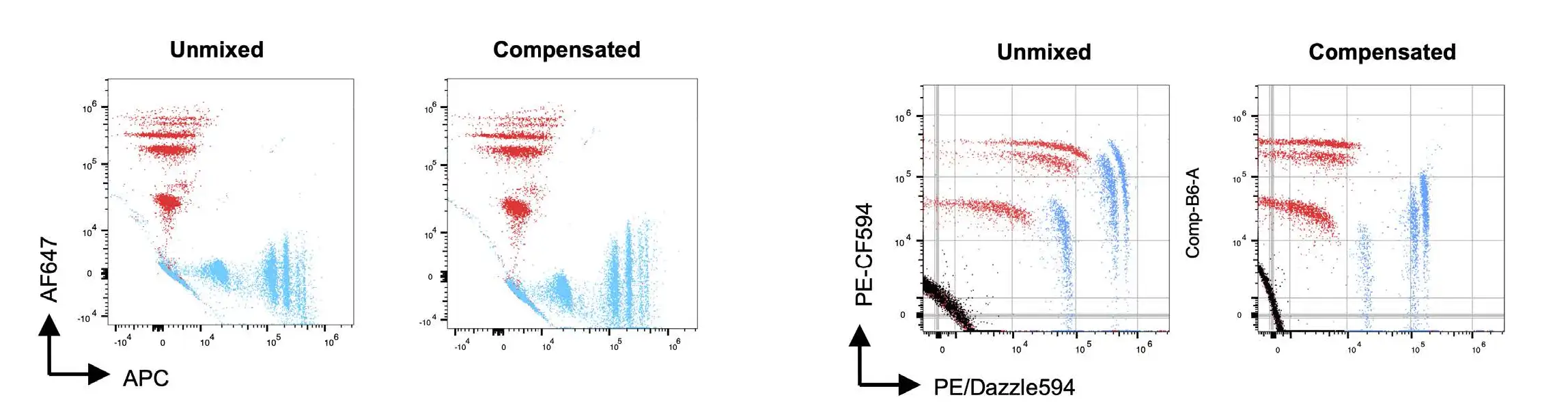
Figure 6. Spectral signatures and a comparison of unmixing vs. compensation results for APC/APC-Cy7 and PE-CF594/PE-Dazzle 594
Therefore, spectral unmixing cannot fully eradicate errors arising from the intrinsic similarity of the fluorochromes themselves; its performance advantages have definitive operational boundaries.
7. What Does "No Compensation Required" Actually Mean?
Based on the preceding analysis, it is clear that spectral flow cytometry neither eliminates fluorescence overlap nor eliminates the signal correction workflow.Rather, the term "no compensation required" more precisely means that users do not need to construct a conventional compensation matrix. However, the system still fundamentally requires preparing single-stained controls, building a spectral reference library, executing spectral unmixing algorithms, and correcting for fluorescence spectral overlap.
In fact, spectral flow cytometry demands a much higher quality of reference spectra than conventional compensation requires for its controls. Minor spectral shifts caused by lot-to-lot fluorochrome variations, tandem fluorochrome degradation, or changes in fixation protocols can significantly compromise unmixing accuracy. Therefore, "no compensation required" is far from synonymous with "no correction needed," and it certainly does not imply an absence of spillover.
Conclusion
The emergence of spectral flow cytometry introduces an advanced framework for signal resolution, yet it leaves the physical reality of fluorescence spectral overlap unchanged. Conventional compensation and spectral unmixing are not mutually exclusive technologies; they represent two distinct mathematical strategies designed to solve the same problem using different data depths. Recognizing this allows researchers to objectively evaluate the technological boundaries and true benefits of spectral flow, avoiding the industry pitfall of conflating "no compensation" with "no signal correction required."
Looking for Reliable Flow Cytometry Antibodies to Support your Experimental Workflows?
abinScience Flow Cytometry Antibodies are subjected to rigorous quality control to ensure consistent fluorescent performance and clear discrimination of cell populations, supporting robust and reproducible flow cytometry analyses.
Learn More about abinScience Flow Cytometry Antibodies
About Us
abinScience was founded in 2023 as a strategic venture of AtaGenix (established 2011), dedicated to delivering premium life science reagents that accelerate discovery.
abinScience flow cytometry antibody products cover commonly used detection markers, with a wide variety to meet the research needs of multiple species(
Human,
Mouse,
Rat,
Dog,
Hamster,
Monkey, etc.)We provide stable and reliable support for scientific research.

Reference:
- [1] Nolan, J. P., & Condello, D. (2013). Spectral flow cytometry. Current protocols in cytometry, Chapter 1, 1.27.1–1.27.13. https://doi.org/10.1002/0471142956.cy0127s63
- [2] Futamura, K., Sekino, M., Hata, A., Ikebuchi, R., Nakanishi, Y., Egawa, G., Kabashima, K., Watanabe, T., Furuki, M., & Tomura, M. (2015). Novel full-spectral flow cytometry with multiple spectrally-adjacent fluorescent proteins and fluorochromes and visualization of in vivo cellular movement. Cytometry. Part A : the journal of the International Society for Analytical Cytology, 87(9), 830–842. https://doi.org/10.1002/cyto.a.22725
- [3] Niewold, P., Ashhurst, T. M., Smith, A. L., & King, N. J. C. (2020). Evaluating spectral cytometry for immune profiling in viral disease. Cytometry. Part A : the journal of the International Society for Analytical Cytology, 97(11), 1165–1179. https://doi.org/10.1002/cyto.a.24211


 中文
中文 English
 한국어
한국어 日本語
日本語 Español
 Français
 Русский


