Date de publication :
2025-11-24 Nombre de vues : 551
OMIP is a column in the journal Cytometry PART A, published by ISAC (International Society for Flow Cytometry, founded in 1976). The articles are divided into two parts: online (supplementary materials containing various technical details) and offline (two-page electronic PDF documents containing experimental content). Since the first article was published in 2010, there have been 112 articles published to date, aiming to provide researchers with standardized flow cytometry detection protocols that can be directly applied.
The first article in the series, OMIP-001, focuses on the differentiation and functional states of human peripheral blood T cells, obtaining comprehensive information within limited channels using meticulously designed antibody combinations.
1. OMIP-001 Panel
|
Target
|
Fluorochrome
|
Function
|
|
CD3
|
APC-Cy7
|
T cell lineage
|
|
CD4
|
QD605
|
|
CD8
|
QD585
|
|
CD14
|
Pacific Blue
|
Exclude dead cells, B cells, monocytes, macrophages
|
|
CD19
|
Pacific Blue
|
|
Dead cells
|
VIVID
|
|
CD27
|
PE-Cy7
|
Memory cells, differentiation
|
|
CD28
|
PE-Cy5
|
|
CD45RO
|
QD545
|
|
CD57
|
QD705
|
|
CD127
|
PE
|
|
CCR7
|
Alexa 680
|
|
PD-1
|
QD655
|
|
IFN-γ
|
APC
|
Functional
|
|
TNF-α
|
Alexa 488
|
|
IL-4
|
Alexa 594
|
2. Gate Logic
3. Experimental Results
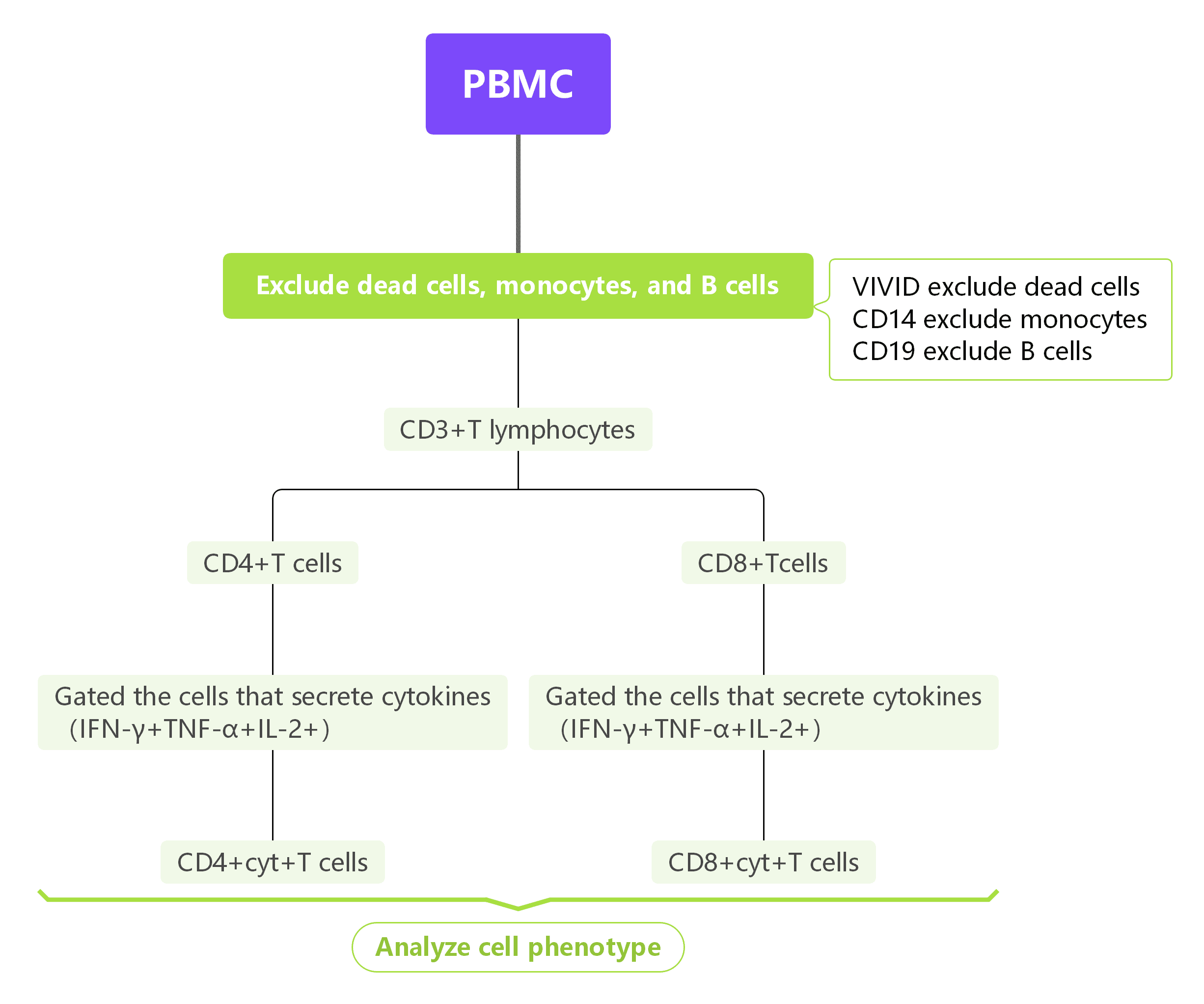
1). FSC-A/H are used to exclude aggregates, then lived CD3+ cells are gated by combining CD3+CD14-CD19-VIVID. Further, non-specific signals caused by dye aggregates are excluded using combinations of markers. FSC-A/SSC-A gates lymphocytes, and CD4+ and CD8+ T cells are subsequently isolated.

2). Within CD4+ and CD8+ T cells, cytokine secretion (IFN-γ, TNF-α, and IL-2) is assessed.
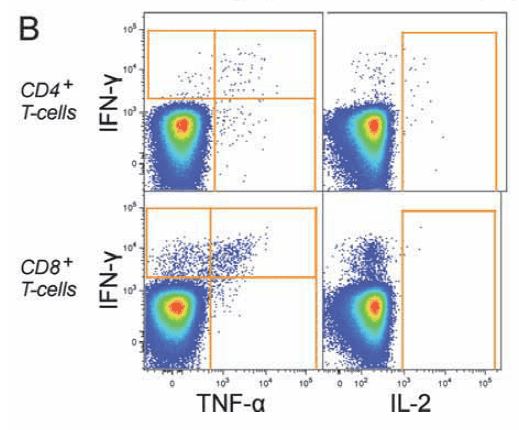
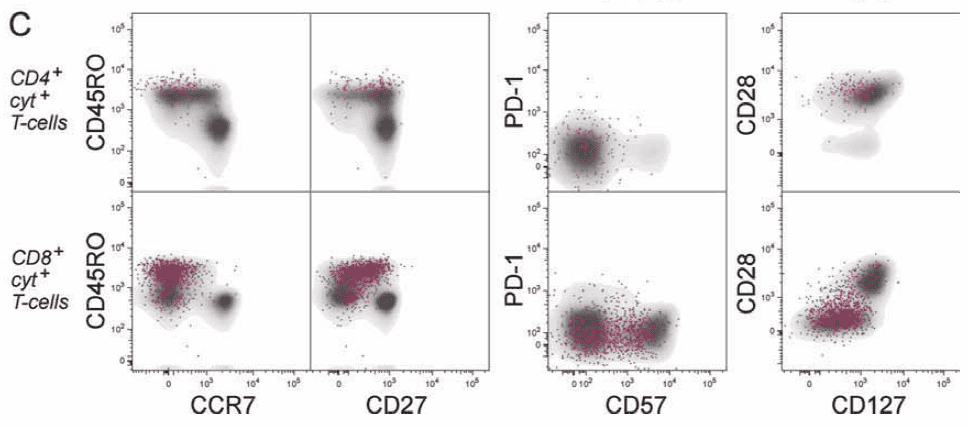
3). The Boolean gate function of FlowJo is used to identify all cytokine-positive (cyt+) cells, followed by evaluation of the HIV-1 antigen-specific T cell phenotype using different antibody combinations. (Grey: Total CD4+ or CD8+ T cells, Red: Cyt+ cells).
4. Protocol Interpretation
1). Functional Assessment (Overall Level)
Initially, cytokine secretion of IFN-γ, TNF-α, and IL-2 is assessed in total CD4+ and CD8+ T cells. These cytokines represent cytotoxic ability (IFN-γ), inflammatory effects (TNF-α), and long-term survival potential (IL-2). FlowJo’s Boolean gate function defines T cells secreting any of the cytokines as cytokine-positive (cyt+) cells, thereby offering an overall functional T cell profile.
2). Phenotypic Correlation (Population Refinement)
Cyt+ cells are then re-mapped to various surface marker combinations:
a). CD45RO/CCR7 → Dividing Naïve/TCM/TEM/TEMRA (long-term memory vs. short-term effect)
b). CD45RO/CD27 → Memory retention and co-stimulatory/proliferation potential (CD27+=high potential)
c). CD57/PD-1 → Distinguishing terminal effector (CD57+PD-1^low) vs. exhausted/suppressed (PD-1^high)
d). CD127/CD28 → Evaluating long-term survival and reactivation potential or functional limitation.
This strategy in OMIP-001 not only shows “how far T cells have differentiated” but also reveals:
a). Which memory subsets retain high functional potential?
b). Which senescent or exhausted populations can still secrete cytokines?
c). Which populations have an advantage in proliferation and regeneration?
5. Conclusion
OMIP-001’s uniqueness lies in its dual-layer logic of "phenotype + function":
1). The overall cytokine secretion ability of CD4+ and CD8+ T cells is first evaluated.
2). Boolean gates define the functional population.
3). Finally, phenotypic clustering allows interpretation of functional states across different subsets.
This progressive analysis provides researchers with not only a map of T cell differentiation trajectories but also an intuitive understanding of the functional potential at different stages. Therefore, it is applicable not only in basic immunology research but also in vaccine evaluation, chronic infection monitoring, and tumour immunology, showcasing its broad application potential.
References:
[1] Mahnke YD, Roederer M. OMIP-001: Quality and phenotype of Ag-responsive human T-cells. Cytometry A. 2010 Sep;77(9):819-20.
About Us
As a strategic venture of AtaGenix (established 2011), abinScience was founded in 2023 to deliver premium life science reagents that accelerate discovery. Our flow cytometry antibody products cover commonly used detection markers, with a wide variety to meet the research needs of multiple species (Human, Mouse, Rat, Dog, Hamster, Monkey, etc.). We provide stable and reliable support for scientific research. For more information on abinScience flow cytometry antibodies, please click:
abinScience Flow Cytometry (FACS) Antibodies


 中文
中文 English
 한국어
한국어 日本語
日本語 Español
 Français
 Русский


