The Depth and Breadth of Human NK Cell Phenotyping
As a core component of the innate immune system, Natural Killer (NK) cells play a critical role in generating rapid immune responses against virally infected or transformed cells. NK-cell functionality is highly dependent on the dynamic balance between activating and inhibitory surface receptors. In healthy individuals, NK cells demonstrate significant functional heterogeneity, reflected not only in differentiation stages but also in complex receptor co-expression patterns.
The Classical Framework of NK-Cell Phenotyping
In the study of human NK cells, subset classification based on CD56 (NCAM) and CD16 (FcγRIII) surface expression remains the gold standard for lineage identification. This framework has supported decades of global research, defining the basic functional characteristics of core NK-cell subsets. As research into NK-cell activation and fine subtyping progresses, there is an increasing need for more comprehensive standardized phenotyping protocols.
OMIP-029 Strategy and Methodological Value
OMIP-029 establishes a standardized multi-color panel for the precise phenotypic characterization of NK cells within human PBMC. This panel introduces CD2 to specifically anchor NK-cell populations with high cytotoxic potential. The panel integrates NKG2D, NKp30, and NKp46—alongside highly homologous inhibitory KIR receptors (KIR2DL1 and KIR2DL2), allowing for simultaneous monitoring of the activating-inhibitory balance. And, CCR7 and CD62L are utilized to evaluate maturation and lymphoid tissue homing.
OMIP-029 provides a highly integrated platform for the deep characterization of NK cells across differentiation, homing, and regulation dimensions. Furthermore, it allows researchers to investigate NK receptor expression patterns on CD4+ and CD8+ T cells through cross-lineage comparative analysis. This protocol fills gaps in comprehensive NCR system detection and provides a reliable tool for human immunosurveillance and oncology research.
1. OMIP-029 Panel
2. Gating Logic
1
Lymphocyte Identification
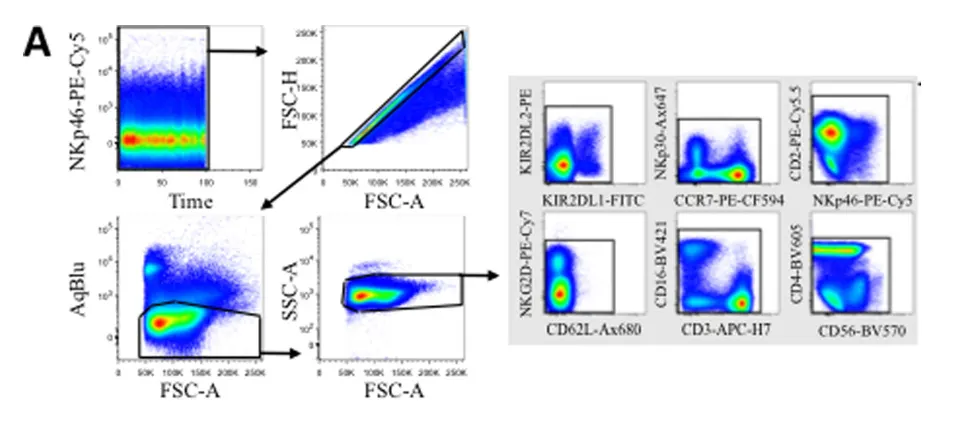
A time gate is used to exclude unstable signals, exclude doublets and dead cells, and the lymphocyte population is identified within the SSC-A/FSC-A plot.
2
CD2+ NK Cell Subsetting
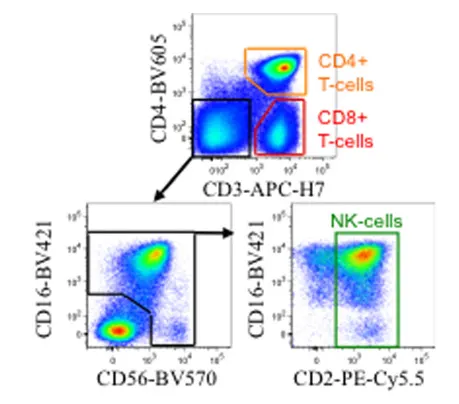
Use CD3/CD4 to gate out the CD3-, CD4+ and CD8+ cell populations. Then, using CD16/CD56, exclude the CD16-CD56- cells, identified CD2+ NK cells.
3
Functional Characterization
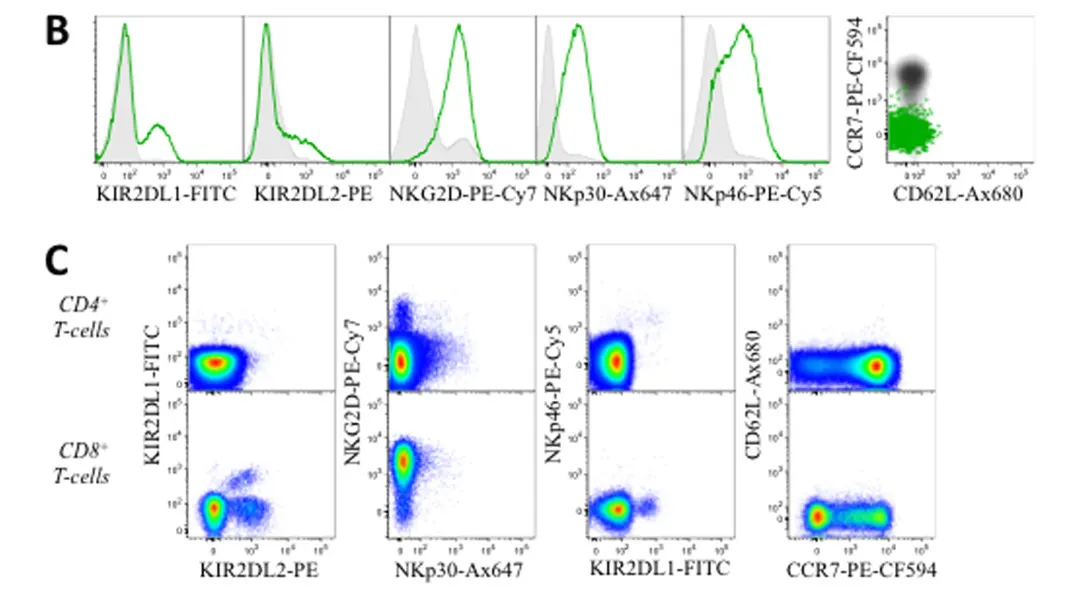
Within the CD2+ NK, CD4+ T, and CD8+ T populations, the expression of KIRs, NCRs, and differentiation markers is analyzed to determine activation-inhibition states and maturation stages.
3. Experimental Results
1). In PBMCs, unstable signals are first excluded via a Time gate, exclude doublets and dead cells, then gate out the lymphocyte population, and non-specific signals are excluded through channel combinations
2). CD3-, CD4+, and CD8+ populations are gated via CD3/CD4; CD16- / CD56- cells are excluded to isolate the CD2+ NK cell population.
3). In three distinct subsets (CD4+ T cells, CD8+ T cells, and CD2+ NK cells), the activation-inhibition balance is assessed via KIR2DL1, KIR2DL2, NKG2D, NKp30, and NKp46. CD62L and CD197 are utilized to analyze maturation and differentiation.
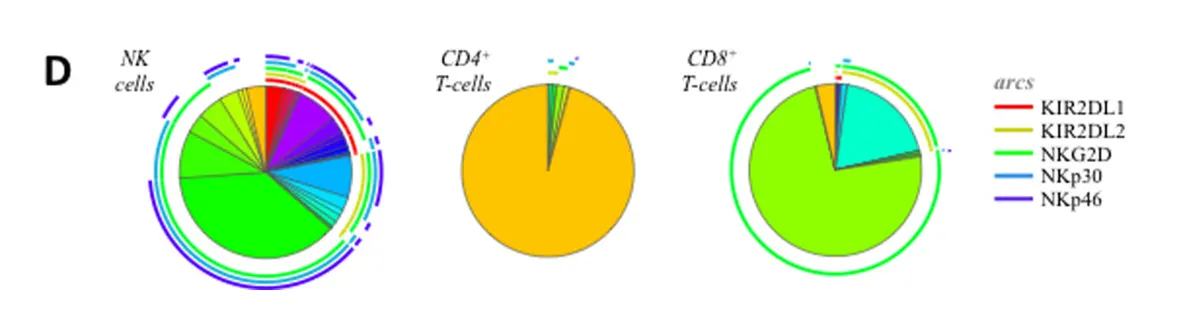
4). Through Boolean combinations (single-positive, double-positive, etc.) of the five markers (KIR2DL1, KIR2DL2, NKG2D, NKp30, NKp46), the activation-inhibition equilibrium of CD2+ NK cells is analyzed and compared against CD4+ and CD8+ T cell populations.
4. Panel Interpretation
4.1 Functional NK-Cell Enrichment via CD2 Gating
Unlike standard CD3-CD16+/CD56+ gating, OMIP-029 utilizes CD2 as a critical selection node. Biologically, CD2 is essential for NK-cell membrane nanotube formation and target cell adhesion. Applying this gate allows for the specific exclusion of CD2- NK sub-populations lacking effective cytotoxic capacity, ensuring that phenotypic data is directly linked to core NK-cell functions.
4.2 Optimizing KIR Detection for Diverse Cohorts
KIR family genes are highly polymorphic and homologous, posing a challenge for reliable detection across large populations. OMIP-029 optimizes this by using broad-spectrum antibody clones. Clone HP-MA4 recognizes KIR2DL1, KIR2DS1, KIR2DS3, and KIR2DS5, while clone DX27 binds KIR2DL2, KIR2DL3, and KIR2DS2. This strategy ensures stable detection of KIR expression levels in large-scale cohort studies regardless of individual KIR genotypes or MHC haplotypes.
5. Applications
Tumor immunosurveillance and clearance Antiviral immune response mechanisms ADCC (Antibody-Dependent Cellular Cytotoxicity) research Basic immune mechanism studies NK-cell maturation, differentiation, and tissue homing
6. Conclusion
OMIP-029 provides a highly optimized, standardized multi-color flow cytometry solution for human NK-cell phenotyping. By incorporating functional CD2 gating and broad-spectrum KIR detection, the panel enables a comprehensive assessment of NK-cell activation, inhibition, and homing while allowing for simultaneous T-cell analysis. This protocol is a foundational tool for both basic and clinical immunology research.
Get More Flow Cytometry Antibodies
abinScience offers high-quality Flow Cytometry Antibodies for NK cell-related differentiation and function, supporting research on NK cell functional heterogeneity.
References
[1] Mahnke YD, Beddall MH, Roederer M. OMIP-029: Human NK-cell phenotypization. Cytometry A. 2015 Nov;87(11):986-8. doi: 10.1002/cyto.a.22728.

About Us
As a strategic venture of AtaGenix (established 2011), abinScience was founded in 2023 to deliver premium life science reagents that accelerate discovery. Our flow cytometry antibody products cover commonly used detection markers, with a wide variety to meet the research needs of multiple species (Human/Mouse/Rat/Dog/Hamster/Monkey, etc.). We provide stable and reliable support for scientific research.
Explore abinScience Flow Cytometry Antibodies


 中文
中文 English
 한국어
한국어 日本語
日本語 Español
 Français
 Русский