
 中文
 English
 한국어
 日本語
 Español
 Français
 Русский

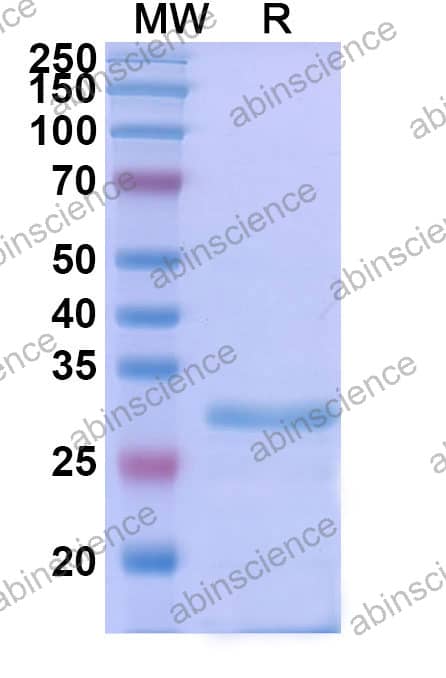

| 카탈로그 번호 | HV972024 | ||||||||
|---|---|---|---|---|---|---|---|---|---|
| 설명 |
Anti-CYGB Polyclonal Antibody (HV972024) is a rabbit polyclonal antibody detecting CYGB in ELISA, IHC, WB. Suitable for Human, Mouse, Rat.
Highlights
|
||||||||
| 종 반응성 | Human, Mouse, Rat | ||||||||
| 응용 분야 | ELISA, IHC, WB | ||||||||
| 숙주 종 | Rabbit | ||||||||
| 클론성 | Polyclonal | ||||||||
| 이소타입 | IgG | ||||||||
| 면역원 | E. coli - derived recombinant Human CYGB (Met1-Lys111). | ||||||||
| 타겟 | Histoglobin, CYGB, Stellate cell activation-associated protein, Cytoglobin, STAP, HGb | ||||||||
| 정제 | Purified by antigen affinity column. | ||||||||
| 등록번호 | Q8WWM9 | ||||||||
| 형태 | Liquid | ||||||||
| 저장 완충액 | 0.01M PBS, pH 7.4, 50% Glycerol, 0.05% Proclin 300. 데이터시트 인쇄본 또는 로트별 COA에 기재된 구체적인 완충액 정보를 참조하세요. |
||||||||
| 제품 사용 정보 |
| ||||||||
| 안정성 및 저장 | Use a manual defrost freezer and avoid repeated freeze thaw cycles. Store at 2 to 8°C for frequent use. Store at -20 to -80°C for twelve months from the date of receipt. | ||||||||
| 배경 | Cytoglobin (CYGB) is a ~21 kDa protein. Probable multifunctional globin with a hexacoordinated heme iron required for the catalysis of various reactions depending on redox condition of the cell as well as oxygen availability. Has a nitric oxide dioxygenase (NOD) activity and is most probably involved in cell-mediated and oxygen-dependent nitric oxide consumption. By scavenging this second messenger may regulate several biological processes including endothelium-mediated vasodilation and vascular tone. Under normoxic conditions functions as a nitric oxide dioxygenase (NOD) but under hypoxic conditions the globin may switch its function to that of a nitrite (NO2) reductase (NiR), generating nitric oxide. Could also have peroxidase and superoxide dismutase activities, detoxifying reactive oxygen species and protecting cells against oxidative stress. 1. Trent, JT. et al. (2002) The Journal of biological chemistry 277, 19538-45. PMID: 11893755 2. Asahina, K. et al. (2002) Biochimica et biophysica acta 1577, 471-5. PMID: 12359339 3. Sugimoto, H. et al. (2004) Journal of molecular biology 339, 873-85. PMID: 15165856 4. Halligan, KE. et al. (2009) The Journal of biological chemistry 284, 8539-47. PMID: 19147491 5. Gardner, AM. et al. (2010) The Journal of biological chemistry 285, 23850-7. PMID: 20511233 6. Liu, X. et al. (2017) Nature communications 8, 14807. PMID: 28393874 7. Amdahl, MB. et al. (2017) Biochemistry 56, 3993-4004. PMID: 28671819 8. Reeder, BJ. et al. (2018) Nitric oxide : biology and chemistry 72, 16-23. PMID: 29128400 9. Dat, NQ. et al. (2021) Hepatology (Baltimore, Md.) 73, 2527-2545. PMID: 33576020 10. Zweier, JL. et al. (2021) Proceedings of the National Academy of Sciences of the United States of America 118. PMID: 34930834 | ||||||||
| 참고사항 | For research use only. |
문의하기
+86-027-65523339
중국 우한시 심둔사로 666번지 C동, 우한, 430206


