
 中文
 English
 한국어
 日本語
 Español
 Français
 Русский
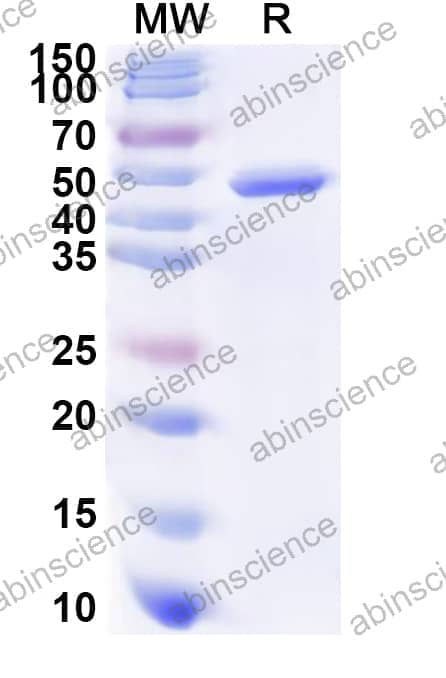

| 카탈로그 번호 | HA604014 | ||||||||
|---|---|---|---|---|---|---|---|---|---|
| 설명 |
Anti-Human UGT1A1 Polyclonal Antibody (HA604014) is a rabbit polyclonal antibody detecting UDP-glucuronosyltransferase 1A1; UGT1A1; 2.4.1.17; Bilirubin-specific UDPGT isozyme 1; hUG-BR1; UDP-glucuronosyltransferase 1-1; UDPGT 1-1; UGT1*1; UGT1-01; UGT1.1; UDP-glucuronosyltransferase 1A isoform 1; UGT1A1; GNT1; UGT1 in ELISA, IHC, WB. Suitable for Human.
Highlights
|
||||||||
| 종 반응성 | Human | ||||||||
| 응용 분야 | ELISA, IHC, WB | ||||||||
| 숙주 종 | Rabbit | ||||||||
| 클론성 | Polyclonal | ||||||||
| 이소타입 | IgG | ||||||||
| 면역원 | E. coli - derived recombinant human UGT1A1 (Gly28-Arg450). | ||||||||
| 타겟 | UDP-glucuronosyltransferase 1A1; UGT1A1; 2.4.1.17; Bilirubin-specific UDPGT isozyme 1; hUG-BR1; UDP-glucuronosyltransferase 1-1; UDPGT 1-1; UGT1*1; UGT1-01; UGT1.1; UDP-glucuronosyltransferase 1A isoform 1; UGT1A1; GNT1; UGT1 | ||||||||
| 내독소 수준 | Please contact with the lab for this information. | ||||||||
| 정제 | Purified by antigen affinity column. | ||||||||
| 등록번호 | P22309 | ||||||||
| 형태 | Liquid | ||||||||
| 저장 완충액 | 0.01M PBS, pH 7.4, 50% Glycerol, 0.05% Proclin 300. 데이터시트 인쇄본 또는 로트별 COA에 기재된 구체적인 완충액 정보를 참조하세요. |
||||||||
| 제품 사용 정보 |
| ||||||||
| 안정성 및 저장 | Use a manual defrost freezer and avoid repeated freeze thaw cycles. Store at 2 to 8°C for frequent use. Store at -20 to -80°C for twelve months from the date of receipt. | ||||||||
| 배경 | UDP-glucuronosyltransferase 1A1 (UGT1A1) is a ~59 kDa protein. UDP-glucuronosyltransferase (UGT) that catalyzes phase II biotransformation reactions in which lipophilic substrates are conjugated with glucuronic acid to increase the metabolite's water solubility, thereby facilitating excretion into either the urine or bile. Essential for the elimination and detoxification of drugs, xenobiotics and endogenous compounds. Catalyzes the glucuronidation of endogenous estrogen hormones such as estradiol, estrone and estriol. Involved in the glucuronidation of bilirubin, a degradation product occurring in the normal catabolic pathway that breaks down heme in vertebrates. Involved in the glucuronidation of arachidonic acid (AA) and AA-derived eicosanoids including 15-HETE, 20-HETE, PGB1 and F2-isoprostane (8-iso-PGF2alpha). 1. Gagné, JF. et al. (2002) Molecular pharmacology 62, 608-17. PMID: 12181437 2. Lépine, J. et al. (2004) The Journal of clinical endocrinology and metabolism 89, 5222-32. PMID: 15472229 3. Udomuksorn, W. et al. (2007) Pharmacogenetics and genomics 17, 1017-29. PMID: 18004206 4. Girard, H. et al. (2007) Pharmacogenetics and genomics 17, 1077-89. PMID: 18004212 5. Itäaho, K. et al. (2008) Drug metabolism and disposition: the biological fate of chemicals 36, 2307-15. PMID: 18719240 6. Sneitz, N. et al. (2010) Human mutation 31, 52-9. PMID: 19830808 7. Sneitz, N. et al. (2013) Drug metabolism and disposition: the biological fate of chemicals 41, 582-91. PMID: 23288867 8. Little, JM. et al. (2004) Journal of lipid research 45, 1694-703. PMID: 15231852 9. Li, X. et al. (2011) Drug metabolism and pharmacokinetics 26, 341-50. PMID: 21422672 10. Milne, GL. et al. (2024) Redox biology 70, 103020. PMID: 38211441 | ||||||||
| 참고사항 | For research use only |
+86-027-65523339
중국 우한시 심둔사로 666번지 C동, 우한, 430206


