
 中文
 English
 한국어
 日本語
 Español
 Français
 Русский

| 카탈로그 번호 | MB008014 | ||||||||
|---|---|---|---|---|---|---|---|---|---|
| 설명 |
Anti-Mouse FPR1 Polyclonal Antibody (MB008014) is a rabbit polyclonal antibody detecting fMet-Leu-Phe receptor; fMLP receptor; N-formyl peptide receptor; FPR; N-formylpeptide chemoattractant receptor; Fpr1 in ELISA, IHC, WB. Suitable for Mouse.
Highlights
|
||||||||
| 종 반응성 | Mouse | ||||||||
| 응용 분야 | ELISA, IHC, WB | ||||||||
| 숙주 종 | Rabbit | ||||||||
| 클론성 | Polyclonal | ||||||||
| 이소타입 | IgG | ||||||||
| 면역원 | E. coli - derived recombinant mouse FPR1 (Asp2-Val35&Ser92-Phe108&Arg171-Arg216&Gln278-Ile296). | ||||||||
| 타겟 | fMet-Leu-Phe receptor; fMLP receptor; N-formyl peptide receptor; FPR; N-formylpeptide chemoattractant receptor; Fpr1 | ||||||||
| 내독소 수준 | Please contact with the lab for this information. | ||||||||
| 정제 | Purified by antigen affinity column. | ||||||||
| 등록번호 | P33766 | ||||||||
| 형태 | Liquid | ||||||||
| 저장 완충액 | 0.01M PBS, pH 7.4, 50% Glycerol, 0.05% Proclin 300. 데이터시트 인쇄본 또는 로트별 COA에 기재된 구체적인 완충액 정보를 참조하세요. |
||||||||
| 제품 사용 정보 |
| ||||||||
| 안정성 및 저장 | Use a manual defrost freezer and avoid repeated freeze thaw cycles. Store at 2 to 8°C for frequent use. Store at -20 to -80°C for twelve months from the date of receipt. | ||||||||
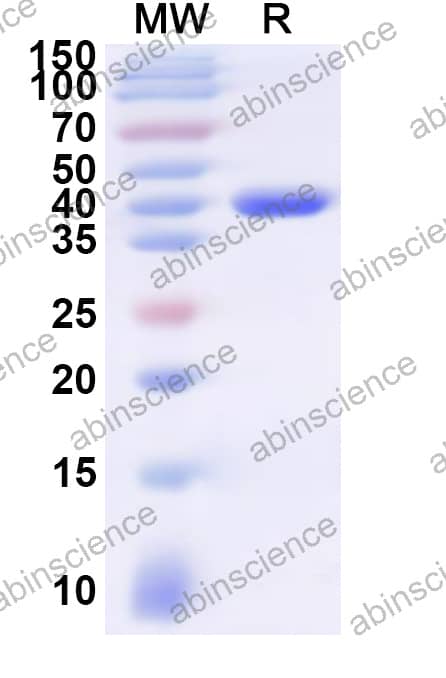
| 배경 | N-formyl peptide receptor 1 (FPR1) is a ~40 kDa protein. Pattern recognition G-protein coupled receptor (PRR/GPCR) involved in innate recognition of N-formyl-methionyl peptides derived from invading microbes and host mitochondria as pathogen- and damage-associated molecular patterns (PAMPs and DAMPs). Functions as a sensor of PAMPs and DAMPs released upon microbial infection or tissue damage, triggering immune cell activation and chemotaxis to eliminate pathogens and restore tissue homeostasis. Peptide binding leads to conformational changes coupled to heterotrimeric G(i) protein signaling. Upon GDP to GTP conversion, G(i)-alpha subunit dissociates from G-beta and G-gamma subunits. Free G(i)-alpha subunit inhibits cyclic adenylate cyclase and cAMP synthesis whereas the G-beta and G-gamma dimer activates downstream phospholipase C-beta and phosphoinositide 3-kinase signaling cascades leading to Ca(2+) influx. 1. Southgate, EL. et al. (2008) Journal of immunology (Baltimore, Md. : 1950) 181, 1429-37. PMID: 18606697 2. Bufe, B. et al. (2015) The Journal of biological chemistry 290, 7369-87. PMID: 25605714 3. Gao, JL. et al. (1993) The Journal of biological chemistry 268, 25395-401. PMID: 8244972 4. Gao, JL. et al. (1999) The Journal of experimental medicine 189, 657-62. PMID: 9989980 5. McDonald, B. et al. (2010) Science (New York, N.Y.) 330, 362-6. PMID: 20947763 | ||||||||
| 참고사항 | For research use only |
문의하기
+86-027-65523339
중국 우한시 심둔사로 666번지 C동, 우한, 430206


