
 中文
中文 English
 한국어
한국어 日本語
日本語 Español
 Français
 Русский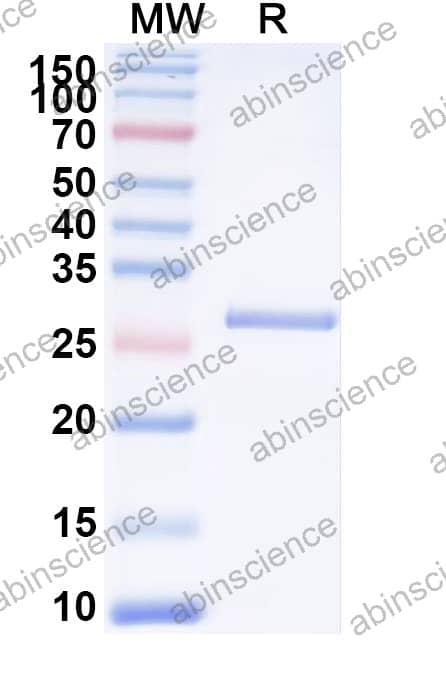

| 카탈로그 번호 | MV176011 |
|---|---|
| 설명 |
Recombinant Mouse ANGPTL3 Protein, C-His (MV176011) expressed in Mammalian Cells, spanning Ser17-Thr206. Purity: >90% by SDS-PAGE.
Highlights
|
| 발현 시스템 | Mammalian cells |
| 등록번호 | Q9R182 |
| 단백질 길이 | Ser17-Thr206 |
| 응용 분야 | ELISA, Immunogen, SDS-PAGE, WB, Bioactivity testing in progress |
| 종 | Mus musculus (Mouse) |
| 성질 | Recombinant |
| 내독소 수준 | Please contact with the lab for this information. |
| 순도 | >90% as determined by SDS-PAGE. |
| 예측 분자량 | 24.81 kDa |
| 형태 | Lyophilized |
| 저장 완충액 | Lyophilized from a solution in PBS pH 7.4, 1 mM EDTA, 4% Trehalose, 1% Mannitol. 데이터시트 인쇄본 또는 로트별 COA에 기재된 구체적인 완충액 정보를 참조하세요. |
| 재구성 | Reconstitute in sterile water for a stock solution. A copy of datasheet will be provided with the products, please refer to it for details. |
| 배송 | In general, proteins are provided as lyophilized powder/frozen liquid. They are shipped out with dry ice/blue ice unless customers require otherwise. |
| 안정성 및 저장 | Use a manual defrost freezer and avoid repeated freeze thaw cycles. Store at 2 to 8°C for frequent use. Store at -20 to -80°C for twelve months from the date of receipt. |
| 대체 이름 | ANG-5, ANGPT5, ANGPTL3, ANGPTL3(17-221), ANGPTL3(17-224), Angiopoietin-5, Angiopoietin-like protein 3, Angiopoietin-related protein 3 |
| 배경 | Angiopoietin-related protein 3 is a ~52 kDa protein. Acts in part as a hepatokine that is involved in regulation of lipid and glucose metabolism. Proposed to play a role in the trafficking of energy substrates to either storage or oxidative tissues in response to food intake. Has a stimulatory effect on plasma triglycerides (TG), which is achieved by suppressing plasma TG clearance via inhibition of LPL activity; the function seems to be specific for the feeding conditions. The inhibition of LPL activity appears to be an indirect mechanism involving recruitment of proprotein convertases PCSK6 and FURIN to LPL leading to cleavage and dissociation of LPL from the cell surface; the function does not require ANGPTL3 proteolytic cleavage but seems to be mediated by the N-terminal domain, and is not inhibited by GPIHBP1. Can inhibit endothelial lipase, causing increased plasma levels of high density lipoprotein (HDL) cholesterol and phospholipids; the cleaved N-terminal domain is more efficient than the uncleaved proprotein. 1. Koishi, R. et al. (2002) Nature genetics 30, 151-7. PMID: 11788823 2. Ando, Y. et al. (2003) Journal of lipid research 44, 1216-23. PMID: 12671033 3. Wang, Y. et al. (2015) Proceedings of the National Academy of Sciences of the United States of America 112, 11630-5. PMID: 26305978 4. Ono, M. et al. (2003) The Journal of biological chemistry 278, 41804-9. PMID: 12909640 5. Köster, A. et al. (2005) Endocrinology 146, 4943-50. PMID: 16081640 6. Liu, J. et al. (2010) The Journal of biological chemistry 285, 27561-70. PMID: 20581395 7. Jin, W. et al. (2007) Cell metabolism 6, 129-36. PMID: 17681148 8. Wang, Y. et al. (2015) Journal of lipid research 56, 1296-307. PMID: 25954050 9. Kim, HK. et al. (2015) Diabetes 64, 1142-53. PMID: 25338813 |
| 참고사항 | For research use only |
+86-027-65523339
중국 우한시 심둔사로 666번지 C동, 우한, 430206


