
 中文
中文 English
 한국어
한국어 日本語
日本語 Español
 Français
 Русский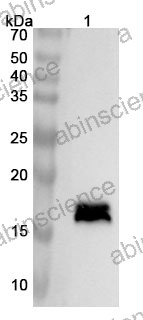


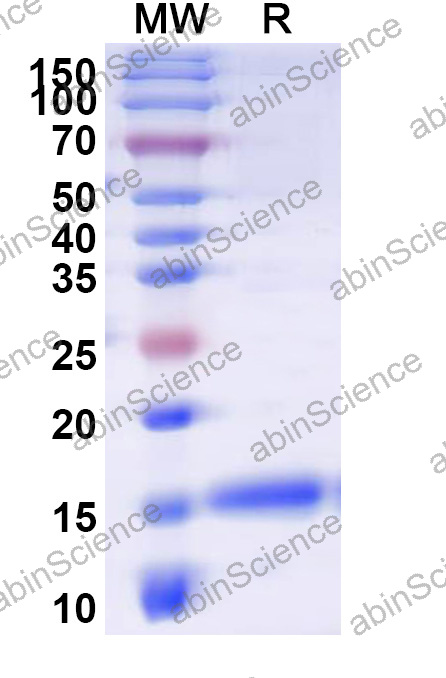

| 카탈로그 번호 | HY485043 | ||||
|---|---|---|---|---|---|
| 종 반응성 | Human | ||||
| 응용 분야 | ELISA, WB, Neutralization | ||||
| 숙주 종 | Human | ||||
| 클론성 | Monoclonal | ||||
| 이소타입 | VHH-hFc | ||||
| 클론 ID | SAA2767 | ||||
| 타겟 | G1P2, IP17, ISG15, Interferon-induced 15 kDa protein, Interferon-induced 17 kDa protein, UCRP, Ubiquitin cross-reactive protein, Ubiquitin-like protein ISG15, hUCRP | ||||
| 내독소 수준 | <10 EU/mg | ||||
| 순도 | >95% as determined by SDS-PAGE. | ||||
| 정제 | Protein A/G purified from cell culture supernatant. | ||||
| 등록번호 | P05161 | ||||
| 형태 | Liquid | ||||
| 저장 완충액 | 0.01M PBS pH 7.4 데이터시트 인쇄본 또는 로트별 COA에 기재된 구체적인 완충액 정보를 참조하세요. |
||||
| 재구성 | Reconstitute in sterile water for a stock solution. A copy of datasheet will be provided with the products, please refer to it for details. | ||||
| 배송 | In general, proteins are provided as lyophilized powder/frozen liquid. They are shipped out with dry ice/blue ice unless customers require otherwise. | ||||
| 제품 사용 정보 |
| ||||
| 안정성 및 저장 | Use a manual defrost freezer and avoid repeated freeze thaw cycles. Store at 2 to 8°C for frequent use. Store at -20 to -80°C for twelve months from the date of receipt. | ||||
| 배경 | Ubiquitin-like protein ISG15 is a ~17 kDa protein. Ubiquitin-like protein which plays a key role in the innate immune response to viral infection either via its conjugation to a target protein (ISGylation) or via its action as a free or unconjugated protein. ISGylation involves a cascade of enzymatic reactions involving E1, E2, and E3 enzymes which catalyze the conjugation of ISG15 to a lysine residue in the target protein. Its target proteins include IFIT1, MX1/MxA, PPM1B, UBE2L6, UBA7, CHMP5, CHMP2A, CHMP4B and CHMP6. Isgylation of the viral sensor IFIH1/MDA5 promotes IFIH1/MDA5 oligomerization and triggers activation of innate immunity against a range of viruses, including coronaviruses, flaviviruses and picornaviruses. Can also isgylate: EIF2AK2/PKR which results in its activation, RIGI which inhibits its function in antiviral signaling response, EIF4E2 which enhances its cap structure-binding activity and translation-inhibition activity, UBE2N and UBE2E1 which negatively regulates their activity, IRF3 which inhibits its ubiquitination and degradation and FLNB which prevents its ability to interact with the upstream activators of the JNK cascade thereby inhibiting IFNA-induced JNK signaling. 1. Kim, YJ. et al. (2016) PLoS pathogens 12, e1005850. PMID: 27564865 2. Deng, Z. et al. (2024) Bone research 12, 63. PMID: 39465252 3. Liu, G. et al. (2021) Nature microbiology 6, 467-478. PMID: 33727702 4. Swaim, CD. et al. (2017) Molecular cell 68, 581-590.e5. PMID: 29100055 | ||||
| 참고사항 | For research use only |
+86-027-65523339
중국 우한시 심둔사로 666번지 C동, 우한, 430206


