
 中文
中文 English
 한국어
한국어 日本語
日本語 Español
 Français
 Русский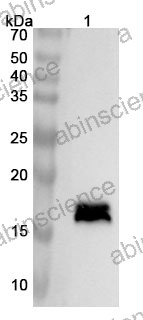
| Catalog No. | HY485014 | ||||||||
|---|---|---|---|---|---|---|---|---|---|
| Description |
Anti-Human ISG15 Polyclonal Antibody (HY485014) is a rabbit polyclonal antibody detecting ISG15 in ELISA, IHC, WB. Suitable for Human.
Highlights
|
||||||||
| Species reactivity | Human | ||||||||
| Applications | ELISA, IHC, WB | ||||||||
| Host species | Rabbit | ||||||||
| Clonality | Polyclonal | ||||||||
| Isotype | IgG | ||||||||
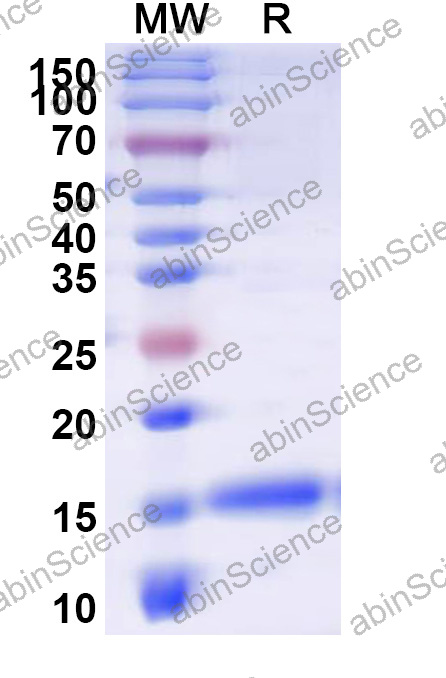
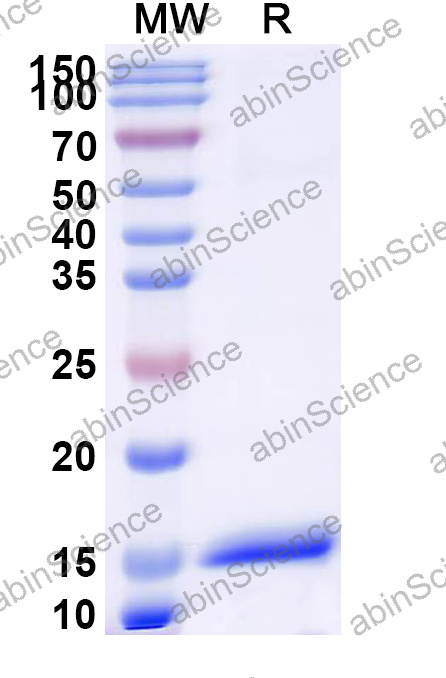
| Immunogen | E. coli - derived recombinant Human ISG15 (Gly2-Ser165). | ||||||||
| Target | Ubiquitin-like protein ISG15, Interferon-induced 15 kDa protein, Interferon-induced 17 kDa protein, IP17, Ubiquitin cross-reactive protein, hUCRP, ISG15, G1P2, UCRP | ||||||||
| Purification | Purified by antigen affinity column. | ||||||||
| Accession | P05161 | ||||||||
| Form | Liquid | ||||||||
| Storage buffer | 0.01M PBS, pH 7.4, 50% Glycerol, 0.05% Proclin 300. Please refer to the specific buffer information in the hardcopy of datasheet or the lot-specific COA. |
||||||||
| Product Usage Information |
| ||||||||
| Stability and Storage | Use a manual defrost freezer and avoid repeated freeze thaw cycles. Store at 2 to 8°C for frequent use. Store at -20 to -80°C for twelve months from the date of receipt. | ||||||||
| Background | Ubiquitin-like protein ISG15 is a ~17 kDa protein. Ubiquitin-like protein which plays a key role in the innate immune response to viral infection either via its conjugation to a target protein (ISGylation) or via its action as a free or unconjugated protein. ISGylation involves a cascade of enzymatic reactions involving E1, E2, and E3 enzymes which catalyze the conjugation of ISG15 to a lysine residue in the target protein. Its target proteins include IFIT1, MX1/MxA, PPM1B, UBE2L6, UBA7, CHMP5, CHMP2A, CHMP4B and CHMP6. Isgylation of the viral sensor IFIH1/MDA5 promotes IFIH1/MDA5 oligomerization and triggers activation of innate immunity against a range of viruses, including coronaviruses, flaviviruses and picornaviruses. Can also isgylate: EIF2AK2/PKR which results in its activation, RIGI which inhibits its function in antiviral signaling response, EIF4E2 which enhances its cap structure-binding activity and translation-inhibition activity, UBE2N and UBE2E1 which negatively regulates their activity, IRF3 which inhibits its ubiquitination and degradation and FLNB which prevents its ability to interact with the upstream activators of the JNK cascade thereby inhibiting IFNA-induced JNK signaling. 1. Kim, YJ. et al. (2016) PLoS pathogens 12, e1005850. PMID: 27564865 2. Deng, Z. et al. (2024) Bone research 12, 63. PMID: 39465252 3. Liu, G. et al. (2021) Nature microbiology 6, 467-478. PMID: 33727702 4. Swaim, CD. et al. (2017) Molecular cell 68, 581-590.e5. PMID: 29100055 | ||||||||
| Note | For research use only. |
Lane 1: Mouse spleen lysate


Contact us for custom quotes, bulk requests and any other issues.
Mail: [email protected]
+86-27-65523339
Building C, No. 666, Shen Dun Si Lu, Wuhan, 430206, China


