
 中文
中文 English
 한국어
한국어 日本語
日本語 Español
 Français
 Русский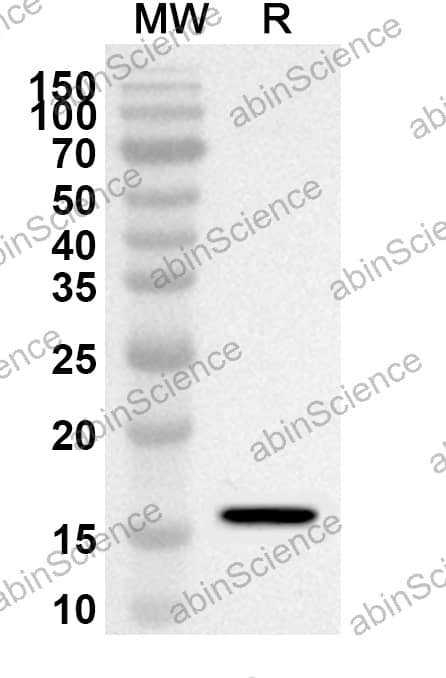
| Catalog No. | HP012014 | ||||||||
|---|---|---|---|---|---|---|---|---|---|
| Description |
Anti-EMC6/TMEM93 Polyclonal Antibody (HP012014) is a rabbit polyclonal antibody detecting TMEM93 in ELISA, IHC, WB. Suitable for Bovine, Danio rerio, Human, Mouse, and Xenopus laevis.
Highlights
|
||||||||
| Species reactivity | Bos taurus, Danio rerio, Human, Mouse, Xenopus laevis, Xenopus tropicalis | ||||||||
| Applications | ELISA, IHC, WB | ||||||||
| Host species | Rabbit | ||||||||
| Isotype | IgG | ||||||||
| Clonality | Polyclonal | ||||||||
| Immunogen | E. coli - derived recombinant Human EMC6/TMEM93 (Val4-Thr47). | ||||||||
| Target | Transmembrane protein 93, TMEM93, EMC6, ER membrane protein complex subunit 6 | ||||||||
| Purification | Purified by antigen affinity column. | ||||||||
| Accession | Q9BV81 | ||||||||
| RRID | Anti-EMC6/TMEM93 Polyclonal Antibody (abinScience Cat# HP012014, RRID:AB_3730213) |
||||||||
| Form | Liquid | ||||||||
| Storage buffer | 0.01M PBS, pH 7.4, 50% Glycerol, 0.05% Proclin 300. Please refer to the specific buffer information in the hardcopy of datasheet or the lot-specific COA. |
||||||||
| Product Usage Information |
| ||||||||
| Stability and Storage | Use a manual defrost freezer and avoid repeated freeze thaw cycles. Store at 2 to 8°C for frequent use. Store at -20 to -80°C for twelve months from the date of receipt. | ||||||||
| Background | ER membrane protein complex subunit 6 (EMC6/TMEM93) is a ~12 kDa protein. Part of the endoplasmic reticulum membrane protein complex (EMC) that enables the energy-independent insertion into endoplasmic reticulum membranes of newly synthesized membrane proteins. Preferentially accommodates proteins with transmembrane domains that are weakly hydrophobic or contain destabilizing features such as charged and aromatic residues. Involved in the cotranslational insertion of multi-pass membrane proteins in which stop-transfer membrane-anchor sequences become ER membrane spanning helices. It is also required for the post-translational insertion of tail-anchored/TA proteins in endoplasmic reticulum membranes. By mediating the proper cotranslational insertion of N-terminal transmembrane domains in an N-exo topology, with translocated N-terminus in the lumen of the ER, controls the topology of multi-pass membrane proteins like the G protein-coupled receptors. 1. Guna, A. et al. (2018) Science (New York, N.Y.) 359, 470-473. PMID: 29242231 2. Shurtleff, MJ. et al. (2018) eLife 7. PMID: 29809151 3. Chitwood, PJ. et al. (2018) Cell 175, 1507-1519.e16. PMID: 30415835 4. Pleiner, T. et al. (2020) Science (New York, N.Y.) 369, 433-436. PMID: 32439656 5. O'Donnell, JP. et al. (2020) eLife 9. PMID: 32459176 | ||||||||
| Note | For research use only. |
Western blot analysis was performed using anti-EMC6/TMEM93 polyclonal antibody at 1ug/mL on recombinant EMC6/TMEM93 (Catalog No. HP012012).

Contact us for custom quotes, bulk requests and any other issues.
Mail: support@abinScience.com
+86-27-65523339
Building C, No. 666, Shen Dun Si Lu, Wuhan, 430206, China


