
 中文
中文 English
 한국어
한국어 日本語
日本語 Español
 Français
 Русский
| Catalog No. | HF674014 | ||||||||
|---|---|---|---|---|---|---|---|---|---|
| Description |
Anti-PGK1 Polyclonal Antibody (HF674014) is a rabbit polyclonal antibody detecting PGK1 in ELISA, IHC, WB. Suitable for Human, Mouse, Rat, Bovine, and Cricetulus griseus.
Highlights
|
||||||||
| Species reactivity | Human, Mouse, Rat, Bos taurus, Cricetulus griseus, Equus caballus, Chicken, Macaca fascicularis, Notamacropus eugenii, Pan troglodytes, Pongo abelii, Pig | ||||||||
| Applications | ELISA, IHC, WB | ||||||||
| Host species | Rabbit | ||||||||
| Isotype | IgG | ||||||||
| Clonality | Polyclonal | ||||||||
| Immunogen | E. coli - derived recombinant Human PGK1 (Ser2-Ile417). | ||||||||
| Target | PRP 2, Primer recognition protein 2, PGKA, PGK1, Phosphoglycerate kinase 1, Cell migration-inducing gene 10 protein | ||||||||
| Purification | Purified by antigen affinity column. | ||||||||
| Accession | P00558 | ||||||||
| Form | Liquid | ||||||||
| Storage buffer | 0.01M PBS, pH 7.4, 50% Glycerol, 0.05% Proclin 300. Please refer to the specific buffer information in the hardcopy of datasheet or the lot-specific COA. |
||||||||
| Product Usage Information |
| ||||||||
| Stability and Storage | Use a manual defrost freezer and avoid repeated freeze thaw cycles. Store at 2 to 8°C for frequent use. Store at -20 to -80°C for twelve months from the date of receipt. | ||||||||
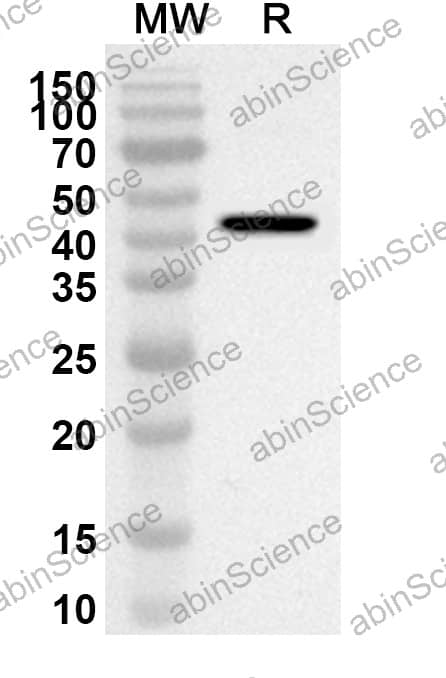
| Background | Phosphoglycerate kinase 1 (PGK1) is a ~44 kDa protein. Catalyzes one of the two ATP producing reactions in the glycolytic pathway via the reversible conversion of 1,3-diphosphoglycerate to 3-phosphoglycerate. Both L- and D- forms of purine and pyrimidine nucleotides can be used as substrates, but the activity is much lower on pyrimidines. In addition to its role as a glycolytic enzyme, it seems that PGK1 acts as a polymerase alpha cofactor protein (primer recognition protein). Acts as a protein kinase when localized to the mitochondrion where it phosphorylates pyruvate dehydrogenase kinase PDK1 to inhibit pyruvate dehydrogenase complex activity and suppress the formation of acetyl-coenzyme A from pyruvate, and consequently inhibit oxidative phosphorylation and promote glycolysis. May play a role in sperm motility. 1. Bollong, MJ. et al. (2018) Nature 562, 600-604. PMID: 30323285 2. Fujii, H. et al. (1980) The Journal of biological chemistry 255, 6421-3. PMID: 7391028 3. Gondeau, C. et al. (2008) Nucleic acids research 36, 3620-9. PMID: 18463139 4. Jindal, HK. et al. (1990) The Journal of biological chemistry 265, 6540-3. PMID: 2324090 5. Li, X. et al. (2016) Molecular cell 61, 705-719. PMID: 26942675 6. Chen, Z. et al. (2023) Nature communications 14, 1121. PMID: 36849569 7. Liu, XX. et al. (2016) Human reproduction (Oxford, England) 31, 273-9. PMID: 26677959 | ||||||||
| Note | For research use only. |
Western blot analysis was performed using anti-PGK1 polyclonal antibody at 1ug/mL on recombinant PGK1 (Catalog No. HF674012).
Contact us for custom quotes, bulk requests and any other issues.
Mail: support@abinScience.com
+86-27-65523339
Building C, No. 666, Shen Dun Si Lu, Wuhan, 430206, China


