
 中文
中文 English
 한국어
한국어 日本語
日本語 Español
 Français
 Русский


| Catalog No. | HY127012 |
|---|---|
| Description |
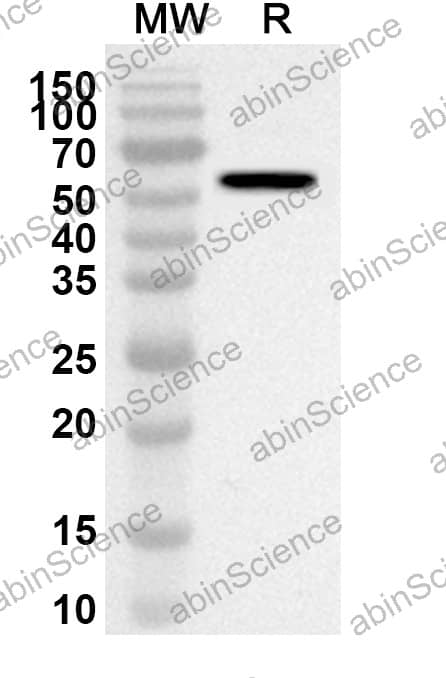
Recombinant Human ALPL Protein, N-His (HY127012) expressed in E. coli, spanning Leu18-Ser501. Purity: >90% by SDS-PAGE.
Highlights
|
| Expression system | E. coli |
| Accession | P05186 |
| Protein length | Leu18-Ser501 |
| Applications | ELISA, Immunogen, SDS-PAGE, WB, Bioactivity testing in progress |
| Species | Homo sapiens (Human) |
| Nature | Recombinant |
| Endotoxin level | Please contact with the lab for this information. |
| Purity | >90% as determined by SDS-PAGE. |
| Predicted molecular weight | 55.59 kDa |
| Form | Lyophilized |
| Storage buffer | Lyophilized from a solution in PBS pH 7.4, 0.02% NLS, 1 mM EDTA, 4% Trehalose, 1% Mannitol. Please refer to the specific buffer information in the hardcopy of datasheet or the lot-specific COA. |
| Reconstitution | Reconstitute in sterile water for a stock solution. Adjust the volume of sterile water so that, after reconstitution, the final stock concentration matches the value indicated on the product label or datasheet. RECONSTITUTION PROTOCOL 1. Allow the product to be reconstituted and the reconstitution diluent to reach room temperature. 2. Tap or briefly centrifuge the product vial before opening to dislodge any lyophilized material that may be dispersed on the wall or cap of the vial. 3. Use the diluent and stock concentration recommended in the product datasheet. If preparing a stock concentration higher than recommended, contact Technical Service. 4. After adding the diluent, re-cap the vial and invert gently by hand or place on a slow rocking platform to allow the reconstitution diluent to coat all the surfaces inside the vial. Note: Do not mix by vortexing or by pipetting the material up and down. 5. Allow the vial to sit at room temperature with gentle agitation for at least 15 minutes before aliquotting or using. 6. Store the reconstituted material in single use aliquots in polypropylene or siliconized tubes. Aliquots of 10 μL or larger are recommended. |
| Shipping | In general, proteins are provided as lyophilized powder/frozen liquid. They are shipped out with dry ice/blue ice unless customers require otherwise. |
| Stability and Storage | Use a manual defrost freezer and avoid repeated freeze thaw cycles. Store at 2 to 8°C for frequent use. Store at -20 to -80°C for twelve months from the date of receipt. |
| Alternate Names | Alkaline phosphatase liver/bone/kidney isozyme, AP-TNAP, TNSALP, Alkaline phosphatase, tissue-nonspecific isozyme, ALPL |
| Background | Alkaline phosphatase, tissue-nonspecific isozyme (ALPL) is a ~57 kDa protein. Alkaline phosphatase that metabolizes various phosphate compounds and plays a key role in skeletal mineralization and adaptive thermogenesis. Has broad substrate specificity and can hydrolyze a considerable variety of compounds: however, only a few substrates, such as diphosphate (inorganic pyrophosphate; PPi), pyridoxal 5'-phosphate (PLP) and N-phosphocreatine are natural substrates. Plays an essential role in skeletal and dental mineralization via its ability to hydrolyze extracellular diphosphate, a potent mineralization inhibitor, to phosphate: it thereby promotes hydroxyapatite crystal formation and increases inorganic phosphate concentration. Acts in a non-redundant manner with PHOSPHO1 in skeletal mineralization: while PHOSPHO1 mediates the initiation of hydroxyapatite crystallization in the matrix vesicles (MVs), ALPL/TNAP catalyzes the spread of hydroxyapatite crystallization in the extracellular matrix. Also promotes dephosphorylation of osteopontin (SSP1), an inhibitor of hydroxyapatite crystallization in its phosphorylated state; it is however unclear whether ALPL/TNAP mediates SSP1 dephosphorylation via a direct or indirect manner. 1. Di Mauro, S. et al. (2002) Journal of bone and mineral research : the official journal of the American Society for Bone and Mineral Research 17, 1383-91. PMID: 12162492 2. Sultana, S. et al. (2013) Molecular genetics and metabolism 109, 282-8. PMID: 23688511 3. Numa-Kinjoh, N. et al. (2015) Molecular genetics and metabolism 115, 180-5. PMID: 25982064 4. Fedde, KN. et al. (1990) American journal of human genetics 47, 767-75. PMID: 2220817 5. Balasubramaniam, S. et al. (2010) Journal of inherited metabolic disease 33 Suppl 3, S25-33. PMID: 20049532 6. Pettengill, M. et al. (2017) PloS one 12, e0175936. PMID: 28448526 |
| Note | For research use only. |
SDS-PAGE for Recombinant Human ALPL Protein, N-His
Contact us for custom quotes, bulk requests and any other issues.
Mail: support@abinScience.com
+86-27-87433958
Building C, No. 666, Shen Dun Si Lu, Wuhan, 430206, China


